
Subchapter V Cramdown for Small Businesses: How to Confirm a Reorganization Plan Over Creditor Objection in New York
By Jeb Singer, Esq., Managing Partner, Singer Law Group
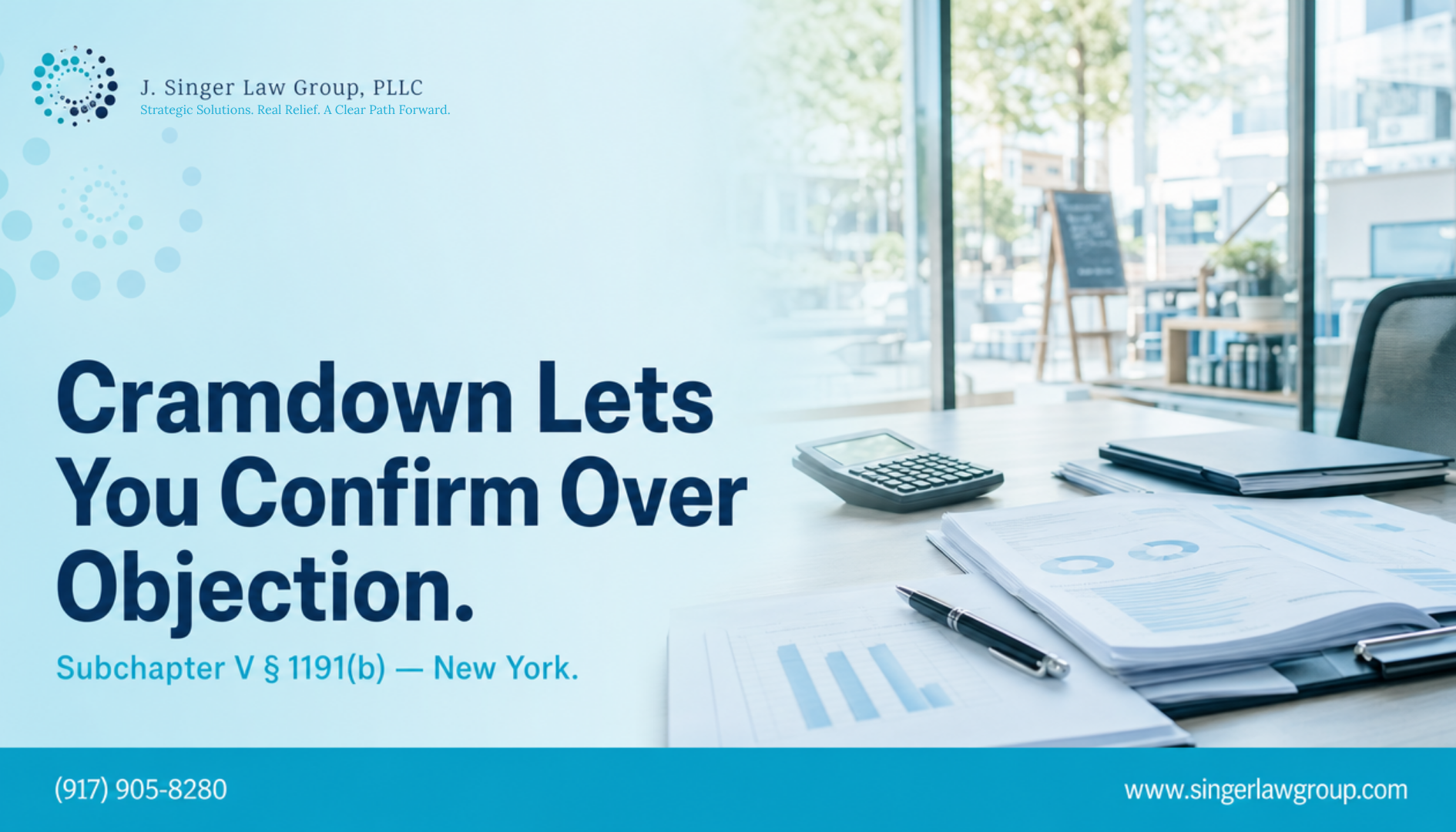
A Subchapter V cramdown gives a qualifying small business a way to confirm a Chapter 11 reorganization plan even when one or more creditor classes object.
That does not mean creditor objections stop mattering.
It means an objection does not necessarily end the reorganization.
Subchapter V was created to give qualifying small businesses a more practical Chapter 11 process. One of its most important features is the ability to confirm a non-consensual plan without applying the absolute priority rule as it does in a traditional Chapter 11 cramdown.
For a closely held business, that distinction can be significant.
The owner may be able to retain the business even if unsecured creditors are not paid in full, provided the plan meets the requirements for non-consensual confirmation.
That comes with a tradeoff.
A cramdown plan generally requires the debtor to devote projected disposable income to plan payments over a three-to-five-year period. The business therefore needs more than a plan that works on paper. It needs financial projections realistic enough to support the payments while allowing the company to keep operating.
This article focuses on that stage of the process: what happens when a qualifying small business wants to reorganize but its creditors will not agree to the proposed plan.
Jeb Singer, Managing Partner of Singer Law Group, previously served as a law clerk to Judge Stuart M. Bernstein in the U.S. Bankruptcy Court for the Southern District of New York. Singer Law Group’s restructuring practice also includes Ira Reid, who previously clerked for Judge Cecelia H. Goetz in the Eastern District of New York and spent approximately two decades as a restructuring partner at Baker McKenzie before joining the firm.
That bankruptcy and restructuring experience shapes the firm’s approach to Subchapter V.
The legal requirements matter, but so do the numbers. A plan has to address creditor claims while leaving the business with enough cash to operate.
That is why the confirmation strategy should begin before the plan is filed.
What Is a Subchapter V Cramdown? (Definition & Legal Basis)
A Subchapter V cramdown is the confirmation of a reorganization plan over the objection of one or more impaired creditor classes.
In a consensual case, the debtor and its creditors agree to the proposed treatment, and the plan can proceed through the consensual confirmation process.
A cramdown is different.
The debtor asks the bankruptcy court to confirm the plan even though it has not obtained the necessary creditor acceptance.
The court, not the dissenting creditor, ultimately determines whether the plan meets the requirements for confirmation.
For the business owner, that distinction is important.
A creditor can object. It can challenge the proposed treatment. It can question the debtor’s projections and argue that the plan does not meet the Bankruptcy Code's requirements.
But an objection does not automatically give the creditor the ability to prevent an otherwise confirmable Subchapter V reorganization.
The Legal Standard Under 11 U.S.C. § 1191(b)
A non-consensual Subchapter V plan must satisfy the statutory requirements for confirmation, including the standards applicable to objecting creditor classes.
Central issues include whether the plan discriminates unfairly and whether it is fair and equitable with respect to the affected classes.
For secured creditors, the analysis may involve the creditor’s lien, the collateral's value, the proposed payment terms, and whether the treatment provides the value required by the Bankruptcy Code.
For unsecured creditors, projected disposable income becomes particularly important in a non-consensual Subchapter V plan.
The business needs to determine what income is reasonably expected during the applicable period, what expenses are reasonably necessary to continue operating, and what remains available for plan payments.
Those numbers need to be defensible.
A projection that leaves out necessary expenses may make the plan impossible to perform. A projection that understates available income may invite creditor objections and additional scrutiny.
The goal is not to create the most optimistic forecast.
It is to develop a plan the business can realistically perform and support in court.
How Subchapter V Cramdown Differs from Standard Chapter 11 Cramdown
Traditional Chapter 11 and Subchapter V both provide mechanisms for confirming plans over creditor objections, but they do not operate the same way.
One of the most important differences for a closely held business is how they treat equity.
In a traditional Chapter 11 cramdown, the absolute priority rule can create a major obstacle when existing owners want to retain their interests. At the same time, senior unsecured creditors are not being paid in full.
Subchapter V changes that framework for qualifying small businesses.
A non-consensual Subchapter V plan can allow existing owners to retain their interests without satisfying the absolute priority rule in the traditional Chapter 11 manner, provided the plan satisfies the requirements that apply under Subchapter V.
For an owner-operated business, this can fundamentally change the restructuring analysis.
The owner may be the person who built the company, maintains its customer relationships, manages employees, oversees operations, and generates much of its value. Removing that owner may do little to improve the recovery available to creditors.
Subchapter V provides another path.
Instead of making retention of ownership depend on paying senior creditors in full, the cramdown framework can require the business to commit its
available disposable income to the plan for the required period.
That does not make confirmation automatic.
It changes the negotiation structure.
The Absolute Priority Rule — and Why Subchapter V Eliminates It
The absolute priority rule can prevent junior interests from retaining value under a traditional non-consensual Chapter 11 plan when senior creditor classes have not received the treatment required by the Bankruptcy Code.
For a small, closely held company, that can create a practical problem.
The owner may also be the operator.
If the company cannot pay unsecured creditors in full, requiring the owner to surrender the business may undermine the very reorganization that could produce a better recovery than liquidation.
Subchapter V was designed differently.
For a qualifying debtor seeking non-consensual confirmation, the business may be able to preserve existing ownership while committing the income available under the statutory framework to creditor payments.
The distinction matters because it changes what the business must prove.
The question becomes whether the proposed plan satisfies Subchapter V’s confirmation requirements and whether the business can realistically perform it.
That is why financial modeling should begin early.
Keeping the business only matters if the company can survive the plan.
Does My Business Qualify for Subchapter V? Eligibility Requirements
Subchapter V is available only to debtors that satisfy the eligibility requirements in effect when the bankruptcy case is filed.
Confirm eligibility before a business builds its entire restructuring strategy around Subchapter V.
The analysis includes the debtor’s total qualifying debt, the nature of those obligations, the company’s business activities, its ownership and affiliate relationships, and any applicable statutory exclusions.
The debt threshold deserves particular attention because it has changed over time.
Business owners may still encounter articles, presentations, or older advice referring to the temporary CARES Act threshold. That number should not be assumed to remain applicable to a new filing.
The correct analysis uses the statutory threshold in effect on the petition date.
Singer Law Group’s guide to understanding Subchapter V bankruptcy in New York provides additional context on the eligibility and restructuring issues to consider before a business elects Subchapter V treatment.
The $3,424,000 Debt Limit (Post-CARES Act, June 2024)
The Subchapter V debt threshold has changed since the Small Business Reorganization Act was enacted.
The CARES Act temporarily expanded eligibility by increasing the debt ceiling. That temporary expansion later expired, returning Subchapter V to the statutory debt threshold in effect at the time.
Because bankruptcy debt limits are subject to statutory adjustment, a business considering a current filing should confirm the threshold that applies on the petition date rather than relying on a number from an older article.
That is especially important for a company near the eligibility line.
A relatively small difference in how qualifying debt is calculated can determine whether the business can elect Subchapter V or must evaluate a traditional Chapter 11 case instead.
Complete the analysis before filing, using the company’s actual debt schedule rather than a rough estimate of total liabilities.
What Counts Toward the Debt Cap — and What Doesn’t
The debt-cap analysis is more specific than adding every number appearing on the company’s balance sheet.
The Bankruptcy Code focuses on the debt categories included in the Subchapter V eligibility calculation.
Whether an obligation is contingent, non-contingent, liquidated, or unliquidated can therefore matter.
Secured debt may also factor into the calculation.
A disputed obligation presents another issue. The business's disagreement with a creditor does not automatically mean the debt can be excluded from the eligibility analysis.
The nature of the dispute and whether the amount can be readily determined need to be examined.
For a company close to the statutory limit, those distinctions can determine which form of Chapter 11 is available.
That makes the pre-filing debt review more than an accounting exercise.
It is part of the legal strategy.
Eligibility Exclusions: Publicly Traded Affiliates and Passive Entities
Debt size is not the only eligibility consideration.
Certain debtors and affiliates are excluded from Subchapter V, and the company’s ownership and business structure should be reviewed before an election is made.
Affiliation with a publicly traded company can create an eligibility issue.
The nature of the debtor’s business activities may also matter. A company actively operating a commercial business presents a different eligibility analysis from an entity whose role is primarily passive investment or ownership.
These issues are fact-specific.
A business should not assume that being privately held or having debt below the applicable threshold automatically makes it eligible.
The entity structure, affiliates, operations, and debt must be considered together.
What Are the Two Plan Confirmation Tracks in Subchapter V?
A Subchapter V case can move toward confirmation through a consensual plan or, when the required creditor acceptance cannot be obtained, through a non-consensual plan under the cramdown provisions.
The difference affects more than creditor voting.
It can affect discharge, trustee involvement, the length of the debtor’s payment obligations, and how long the business remains subject to the confirmed plan's requirements.
Choosing between the two tracks is a strategic issue from the beginning of the case.
The Consensual Plan Track — Benefits and Discharge Timing
A consensual plan is generally the cleaner outcome when creditors can agree to acceptable terms.
Agreement can reduce confirmation disputes, professional fees, and uncertainty.
It may also lead to more favorable outcomes for discharge and post-confirmation administration than a non-consensual plan.
That does not mean a debtor should agree to terms it cannot afford simply to obtain consent.
A plan that creditors support but the business cannot perform is not a successful restructuring.
The company still needs to determine whether the required payments leave enough cash for payroll, taxes, vendors, rent, inventory, insurance, and other ordinary expenses.
Creditor consent is valuable.
Feasibility remains essential.
The Cramdown Track — Requirements, Timeline, and Discharge
When the necessary creditor acceptance cannot be obtained, Subchapter V gives the debtor a path to seek confirmation without consent.
That path comes with additional obligations.
The plan must satisfy the requirements for non-consensual confirmation, including the applicable fair-and-equitable standard and disposable-income requirements.
Discharge also works differently from a consensual Subchapter V plan.
Under a cramdown plan, the debtor generally must complete the payments required by the applicable statutory framework before receiving the discharge provided for a non-consensual plan.
That makes the post-confirmation period particularly important.
The business is not simply getting through a confirmation hearing.
It is committing to a financial structure that may govern operations for several years.
A company considering this path should therefore model what happens if revenue declines, a major customer is lost, costs increase, or another predictable business risk occurs during the payment period.
The plan needs enough discipline to satisfy the court and enough realism to survive actual business conditions.
Strategic Considerations: Which Track Is Right for Your Business?
A consensual plan is often worth pursuing, but consent has a price.
Creditors may request higher payments, additional protections, different treatment of collateral, or other concessions before agreeing to the plan.
The business must compare those concessions with the obligations and risks associated with a cramdown.
That is both a legal and financial decision.
How much can the business realistically pay?
What level of projected disposable income can be supported?
How much operating cash does the company need?
What happens if the projections are wrong?
Would additional concessions to creditors create a more sustainable consensual plan, or would they leave the company worse off than proceeding through cramdown?
Understanding how Chapter 11 bankruptcy for small businesses works outside Subchapter V can also help put those choices in context.
The correct answer depends on the particular business.
The objective is not simply to obtain confirmation.
It is to confirm a plan the company has a realistic chance of completing.
What Are the Key Advantages of Subchapter V Over Standard Chapter 11?
Subchapter V was designed to reduce several of the costs and procedural burdens that can make a traditional Chapter 11 difficult for a small business.
Those differences can affect how quickly a case moves, how much professional expense the estate incurs, how creditors participate, and whether
existing owners can retain the business.
They are not shortcuts around the Bankruptcy Code.
The debtor still needs accurate financial information, credible projections, complete disclosures, and a confirmable plan.
But the structure can make reorganization more practical for a qualifying small business.
No Disclosure Statement Required
Traditional Chapter 11 commonly involves a separate disclosure-statement process before creditors vote on the plan.
That process can add time, briefing, hearings, and professional expense to a case.
Subchapter V generally eliminates the need for a separate disclosure statement.
Instead, the plan itself must provide the information required under the Subchapter V framework.
For a small business, removing a separate stage of the confirmation process can reduce both time and cost.
It does not eliminate the need for clear disclosure.
The debtor still needs to explain how the business will reorganize, what creditors will receive, and why the proposed plan is feasible.
No Creditors’ Committee
A traditional Chapter 11 case may include an official committee of unsecured creditors, whose professionals' fees can become administrative expenses of the bankruptcy estate.
Subchapter V generally does not follow that structure unless the court orders otherwise.
Individual creditors still retain their rights.
They may object to the plan, challenge proposed treatment, question the debtor’s projections, and participate in the case.
What changes is the structure through which those rights are exercised.
For a small business, that can reduce some of the expense and complexity associated with a traditional Chapter 11.
Equity Owners Can Retain Ownership Without Paying Creditors in Full
For many closely held companies, this is one of Subchapter V's most important advantages over Chapter 11.
A qualifying business may be able to confirm a non-consensual Subchapter V plan while existing owners retain their interests even though unsecured creditors are not being paid in full.
That does not mean creditors receive nothing.
The debtor must satisfy the plan's requirements, including the disposable-income provisions that govern non-consensual confirmation.
For an owner-operated business, preserving ownership can also preserve operational value.
Customers, employees, vendors, and lenders may depend on relationships the owner developed over many years.
A restructuring that recognizes that reality may provide a better path than forcing an ownership change that damages the underlying business.
Administrative Expenses Can Be Deferred Over the Plan Term
Administrative expenses can create substantial pressure on a business emerging from Chapter 11.
Professional fees and other bankruptcy-related expenses may come due as the company tries to preserve cash and stabilize operations.
Subchapter V can provide additional flexibility in treating certain administrative expenses under a non-consensual plan.
That flexibility can matter when determining feasibility.
The business still needs to pay what the Bankruptcy Code requires.
The question is whether those obligations can be structured to allow the company to keep operating while satisfying its plan.
A feasible payment schedule is more valuable than a plan that creates an immediate cash requirement the business cannot meet.
The 90-Day Plan Filing Deadline — Strict but Manageable
Subchapter V moves quickly.
The debtor generally must file its plan within 90 days after the order for relief, unless the Bankruptcy Code permits additional time.
That deadline makes pre-filing preparation particularly important.
A business should not wait until after filing the petition to start thinking about its reorganization plan.
Financial records need to be organized. Creditor claims need to be understood. Cash flow needs to be modeled. Identify necessary operating expenses.
The business needs to know what it can realistically devote to creditor payments.
If a cramdown may be necessary, the debtor should also start thinking about how it will support its projections if a creditor challenges them.
The faster timeline is one of Subchapter V’s advantages.
It also leaves less room for an unprepared filing.
What Does the Subchapter V Trustee Actually Do?
A Subchapter V trustee is part of the reorganization process, but the trustee’s presence does not ordinarily mean management loses control of the company.
The debtor generally remains in possession of its assets and continues operating the business.
The trustee has a different role.
One of the trustee’s central functions is helping facilitate the development of a consensual plan. The trustee may review financial information, participate in the case, work with the debtor and creditors, and address issues that affect the proposed reorganization.
That can make the trustee an important part of the confirmation process.
A business owner should not approach the trustee as though the trustee were automatically an adversary.
Accurate financial information, realistic projections, timely reporting, and a clear explanation of the proposed restructuring can make the process more productive.
The trustee’s involvement may differ depending on whether the case results in a consensual plan or a non-consensual plan.
The important point for the business owner is that filing under Subchapter V does not, by itself, mean handing day-to-day management of the company to the trustee.
Management should still be prepared for oversight and bankruptcy reporting requirements.
The business remains responsible for complying with the Bankruptcy Code, court orders, plan requirements, and its other obligations during the case.
Where Do New York City and Long Island Businesses File Subchapter V Cases?
New York businesses file bankruptcy cases in the appropriate federal bankruptcy district based on the applicable venue rules.
For businesses in New York City, Long Island, and the surrounding region, that often means the Southern District of New York or the Eastern District of New York.
Businesses in Manhattan, the Bronx, and Westchester commonly fall within the Southern District.
Businesses in Brooklyn, Queens, Nassau County, and Suffolk County commonly fall within the Eastern District.
Both courts apply the federal Bankruptcy Code, including the provisions governing Subchapter V.
Local practice still matters.
Bankruptcy courts have local rules, procedures, standing orders, filing requirements, and practices that counsel needs to understand. Individual judges may also manage confirmation issues and case administration differently within the Bankruptcy Code.
That is one reason experience in the relevant court can matter.
Singer Law Group handles bankruptcy and restructuring matters involving businesses in both the Southern and Eastern Districts of New York.
Jeb Singer’s prior clerkship with Judge Stuart M. Bernstein in the Southern District and Ira Reid’s prior clerkship with Judge Cecelia H. Goetz in the Eastern District give the firm’s restructuring practice experience rooted in both New York bankruptcy districts.
The venue analysis should still be completed for the particular debtor.
A business should not select a court simply because one district appears more convenient. The appropriate filing location depends on the applicable bankruptcy venue rules and the business's facts.
The Four Misconceptions That Lead Small Business Owners to Reject Subchapter V Before Understanding It
Subchapter V is often misunderstood because business owners hear pieces of the process without seeing how they fit together.
Cramdown does not mean creditors receive nothing. Subchapter V is not available to every company that considers itself a small business. The trustee does not ordinarily arrive to take over operations. And eligibility should never be based on an old debt threshold without confirming the law in effect when the petition is filed.
Understanding those distinctions can change the restructuring conversation.
Misconception 1: “Cramdown means creditors get nothing.”
A Subchapter V cramdown is not a plan that eliminates creditor claims without payment.
A non-consensual plan must meet Bankruptcy Code requirements, including the provisions governing projected disposable income.
The debtor may be able to confirm a plan without paying unsecured creditors in full, but that is very different from saying the creditors receive nothing.
The business is proposing a court-supervised restructuring based on what it can reasonably pay under the statutory framework.
That payment obligation is what makes a cramdown possible.
Misconception 2: “Any small business can use Subchapter V.”
Calling a company a small business does not make it eligible for Subchapter V.
The debtor needs to satisfy the eligibility requirements in effect on the filing date.
That includes the applicable debt threshold and other statutory requirements and exclusions.
The type of debt matters. The company’s business activities matter. Its ownership and affiliate relationships can matter.
Therefore, establish eligibility before building a Subchapter V filing strategy.
Misconception 3: “The Subchapter V Trustee will take over my business.”
The Subchapter V trustee is not the same as a Chapter 7 trustee appointed to administer a liquidation.
In an ordinary Subchapter V case, the debtor remains in possession and continues operating the business.
The trustee participates in the reorganization process and works within the responsibilities the Bankruptcy Code establishes.
That can include helping facilitate a consensual plan and reviewing issues relevant to the debtor’s reorganization.
The business remains responsible for operating properly and complying with its bankruptcy obligations.
The presence of a trustee should therefore be understood as part of the Subchapter V structure, not as an automatic transfer of the company to someone else.
Misconception 4: “The $7.5 million debt limit is still active.”
The temporary CARES Act expansion of the Subchapter V debt limit should not be treated as the permanent eligibility threshold.
The temporary increase expired, and the statutory debt limit is subject to periodic adjustment.
For a business considering a current filing, the only useful number is the threshold legally in effect on the petition date.
This matters most when the company is close to the eligibility line.
Relying on an old threshold can lead a business to build a restructuring strategy around a bankruptcy option that may no longer be available.
Confirm eligibility first.
Then build the plan.
Frequently Asked Questions
What is a Subchapter V cramdown and how does it differ from standard Chapter 11 cramdown?
A Subchapter V cramdown allows a qualifying small business to seek confirmation of a reorganization plan even though one or more impaired creditor classes have not accepted it.
The court determines whether the plan satisfies the requirements for non-consensual confirmation.
One of the most important differences from a traditional Chapter 11 cramdown involves the absolute priority rule.
Subchapter V can allow existing equity owners to retain their interests without paying unsecured creditors in full, provided the debtor meets the requirements for non-consensual confirmation.
For an owner-operated business, that can make reorganization possible where a traditional Chapter 11 cramdown would be more difficult.
The tradeoff is that the debtor must comply with Subchapter V’s requirements, including the applicable disposable-income commitment.
Can I keep my business equity in a Subchapter V cramdown if creditors object?
Potentially, yes.
One of Subchapter V’s central advantages is that the traditional absolute priority rule does not prevent existing owners from retaining their interests in the same way it can in a traditional Chapter 11 cramdown.
That does not give the owner an unconditional right to keep the company.
The plan still needs to satisfy the requirements for non-consensual confirmation.
For the business owner, the practical question is whether the company can support the plan required to preserve the reorganization.
Retaining equity has value only if the business can perform its obligations after confirmation.
What is the current debt limit to qualify for Subchapter V in New York?
Federal bankruptcy law, not New York law, sets the Subchapter V debt limit, which is subject to statutory adjustment.
The temporary CARES Act increase to $7.5 million expired, so business owners should not rely on that figure when evaluating a new case.
Because the statutory threshold can change, confirm eligibility using the limit in effect on the date the bankruptcy petition will be filed.
The calculation also requires more than looking at total liabilities on a balance sheet.
Counsel needs to determine which obligations count toward the statutory debt threshold and whether particular debts are contingent, non-contingent,
liquidated, or unliquidated.
A company near the threshold should complete that analysis before assuming Subchapter V is available.
When does discharge occur in a Subchapter V cramdown vs. a consensual plan?
Discharge is one of the important differences between consensual and non-consensual Subchapter V plans.
A consensual plan generally provides a different path to discharge than a plan confirmed through cramdown.
Under a non-consensual plan, discharge is generally tied to completion of the payments required under the applicable Subchapter V provisions rather than occurring simply because the plan has been confirmed.
That distinction matters because a cramdown case does not end economically at confirmation.
The business may need to perform under the plan for several years before reaching the discharge stage.
The company should therefore evaluate the entire payment period before committing to a proposed plan.
Does the Subchapter V Trustee take control of my business during reorganization?
Ordinarily, no.
The debtor generally remains in possession and continues operating its business during a Subchapter V case.
The trustee participates in the reorganization process but does not ordinarily replace management simply because Subchapter V was elected.
The trustee’s responsibilities can include facilitating the development of a consensual plan and participating in matters related to the debtor’s
reorganization.
The business still has significant responsibilities.
It needs to comply with reporting requirements, court orders, bankruptcy obligations, and the terms of any confirmed plan.
Subchapter V allows the owner to continue operating the business, but it does not remove the accountability that comes with Chapter 11.
Where do New York City and Long Island businesses file Subchapter V cases?
Businesses in Manhattan, the Bronx, and Westchester commonly file bankruptcy cases in the Southern District of New York, while businesses in
Brooklyn, Queens, Nassau County, and Suffolk County commonly file in the Eastern District of New York.
The appropriate venue still depends on the bankruptcy venue rules for the particular debtor.
Both districts apply the federal Subchapter V framework, but local procedures and court practices can differ.
Counsel should therefore consider both the federal requirements and the procedures applicable in the court where the case is filed.
Singer Law Group has handled bankruptcy and restructuring matters in both New York districts.
The Strategic Decision Before You File
A Subchapter V cramdown should not begin as a reaction to a creditor saying no.
Consider non-consensual confirmation before filing the bankruptcy petition.
The business needs to understand its debt, cash flow, operating expenses, creditor relationships, secured obligations, and realistic future revenue.
It also needs to understand what happens if creditors object.
How much projected disposable income can the business commit without undermining operations?
What expenses are genuinely necessary to keep the company running?
How will the debtor support its projections?
Can the business perform for the required period if revenue falls below expectations?
Would concessions to creditors produce a better consensual plan, or would those concessions create a payment structure the company cannot sustain?
Those questions should be answered with actual financial information.
Subchapter V can provide a powerful restructuring framework for a qualifying small business, but its value isn't simply in getting a plan confirmed.
The value is in using Chapter 11 to create a capital and debt structure the business can live with after confirmation.
That requires legal analysis and financial discipline from the beginning.
Singer Law Group’s bankruptcy law practice brings those issues together.
Managing Partner Jeb Singer previously clerked for Judge Stuart M. Bernstein in the U.S. Bankruptcy Court for the Southern District of New York. Ira
Reid previously clerked for Judge Cecelia H. Goetz in the Eastern District of New York and later spent approximately two decades as a restructuring partner at Baker McKenzie before joining Singer Law Group.
The firm evaluates the restructuring as a whole.
That means determining whether Subchapter V is available, understanding creditor claims, developing realistic financial projections, evaluating the path
to consensual confirmation, and preparing for a possible cramdown when creditors cannot agree.
The objective is not simply to get through bankruptcy.
It is to determine whether the business can emerge with a debt structure it can actually support.
If your business is considering Subchapter V, facing creditor objections, or trying to determine whether a non-consensual plan is realistic, start the analysis before you set your filing strategy.
Contact Singer Law Group or call (917) 905-8280 to discuss your business and restructuring options.