
MCA Lawsuit Against Your New York E-Commerce Business: Defenses, Rights & Next Steps
By Jeb Singer, Esq. | J. Singer Law Group, PLLC | 1 Liberty Street, Suite 2327, New York, NY 10006
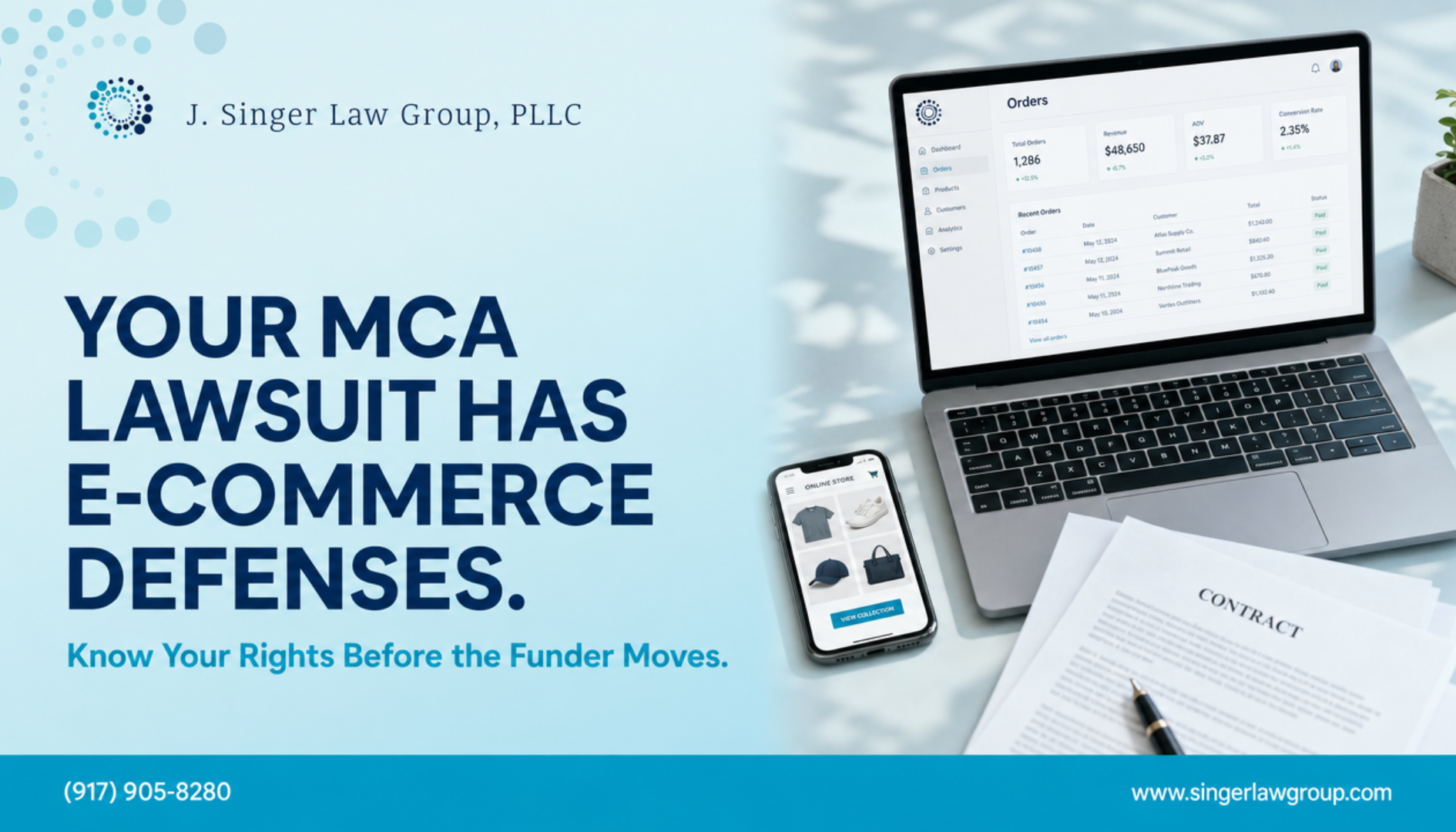
If you are a New York e-commerce seller who just received an MCA lawsuit, or a default notice that may become one, the defenses available to you may be more significant than you realize. New York courts apply a three-part test to determine whether your MCA agreement is actually a disguised loan subject to the state’s criminal usury laws. If your funder imposed fixed daily debits regardless of your actual Shopify, Stripe, or Amazon revenue, you may have a recharacterization argument. Here is what that analysis looks like and what to do in the next 72 hours.
A merchant cash advance (MCA) gives a business money upfront in exchange for a percentage of its future receivables, such as Shopify sales, Amazon payouts, or Stripe deposits. It is usually written as a purchase of future receivables rather than a loan. A confession of judgment (COJ) can give the funder a faster path to a judgment if the agreement and filing meet New York’s legal requirements. Recharacterization is what happens when a court looks past the MCA label and decides the deal actually operated as a loan. If that happens, New York’s usury laws may apply.
What Is an MCA Lawsuit and Why Are E-Commerce Sellers Being Targeted in New York?
An MCA lawsuit is a legal action filed by a merchant cash advance funder to collect on an alleged default, and New York e-commerce sellers can be particularly attractive MCA customers because their high-volume digital receivables from Shopify, Amazon, Stripe, and PayPal provide funders with recurring, electronically traceable revenue.
A business generating $50,000 per month through Shopify or Amazon presents a funder with predictable, traceable, electronically accessible revenue. Fixed daily ACH debits can be pulled directly from a linked bank account, whether or not that day's sales justified the amount. That structure can become important when evaluating whether the transaction operated as a genuine purchase of receivables or functioned more like a loan.
The regulatory environment around MCA financing in New York has also received increased attention, particularly around how MCA agreements are structured, marketed, and enforced. For a merchant facing a collection action, the practical question is how the specific agreement operated in the real world.
How MCA Funders Define “Receivables” for E-Commerce Businesses
MCA agreements often define “receivables” to include more than credit card sales. For an e-commerce business, that may include money coming in from Shopify, Amazon, Stripe, Etsy, PayPal, and other sales platforms.
The broad definition matters legally because the funder may claim a contractual right to a percentage of the revenue the merchant’s platforms send to the business, depending on the agreement's language.
How those receivables were actually collected can also matter.
If the agreement describes a percentage-based purchase of future receivables but the funder collected a fixed amount regardless of actual revenue, that payment history may become relevant to the legal analysis.
Why New York Is Ground Zero for MCA Enforcement Actions
Many MCA agreements designate New York law or New York courts for disputes, and much MCA litigation has developed in the state.
That makes the contract’s choice-of-law, forum-selection, payment, reconciliation, default, and enforcement provisions important from the beginning of a dispute.
If an e-commerce business outside New York signed an agreement requiring disputes to be handled here, the business should not assume that the location of its Shopify store, warehouse, or headquarters determines where the dispute will proceed.
You need to review the agreement and the facts surrounding the transaction together.
The Difference Between an MCA Default Notice and a Formal Lawsuit
A default notice is the funder’s written claim that you have breached the agreement, often by missing remittances, changing bank accounts, or taking additional advances without consent.
A formal lawsuit is a complaint filed in court.
The distinction matters.
A default notice may arrive before litigation begins, allowing the business to have the agreement and alleged default reviewed before the dispute moves further into enforcement.
A filed lawsuit creates response deadlines you should not ignore.
A confession of judgment presents a different procedural issue and must be evaluated based on the agreement, the judgment documents, and the requirements that apply to the particular filing.
If you received a default notice or lawsuit, the first step is to identify exactly what has happened.
Has the funder merely declared a default?
Has a complaint been filed?
Has a judgment already been entered?
Has a restraining notice been served?
Are business accounts already frozen?
Those are different stages of the dispute and may require different responses.
How New York Courts Decide Whether Your MCA Is a Loan: The Tripartite Test
New York courts use a three-part framework when evaluating whether an MCA agreement is a true purchase of future receivables or a loan. For an e-commerce seller whose funder collected fixed daily debits regardless of actual revenue, the way the agreement operated can become an important part of that analysis.
This is the core of merchant cash advance defense in New York.
The tripartite test looks at three features of the transaction: whether there is a reconciliation provision, whether the agreement has a finite term, and whether the funder has recourse if the merchant declares bankruptcy.
No single factor should be viewed in isolation.
The larger question is whether repayment was absolute or contingent on the merchant actually generating the receivables the funder purported to purchase.
The Three Factors: Reconciliation, Unlimited Term, and Bankruptcy Recourse
The three factors are:
- Whether the agreement contains a reconciliation provision.
- Whether the agreement has a finite term or whether the term changes based on business performance.
- Whether the funder has recourse against the merchant in the event of bankruptcy.
These factors help determine whether the funder assumed the risk of purchasing future receivables.
If repayment was effectively fixed and absolute regardless of business performance, the transaction may look more like a loan.
If payment genuinely changed with revenue and the funder assumed the risk that receivables might not materialize, that can support the position that the transaction was a purchase of receivables.
Both the contract language and payment history matter.
What “No Reconciliation Provision” Means for Your E-Commerce MCA
A genuine reconciliation provision allows the merchant’s remittance to adjust based on actual revenue.
If your Shopify store had a slow week, the payment mechanism should operate according to the percentage of receivables contemplated by the agreement. If your Amazon account was suspended and revenue dropped sharply, the reconciliation process may become particularly important.
A contract may contain language labeled “reconciliation” while still requiring a closer look at whether that process was actually available and workable.
For an e-commerce seller, payment processor records can become important.
Shopify, Stripe, Amazon, PayPal, and bank statements can show what the business actually received during the same period in which the funder collected its remittances.
If revenue changed substantially but the funder’s debits remained fixed, those records may become relevant when evaluating how the MCA functioned.
SDNY vs. New York State Court: Which Forum Is More Favorable for Merchants?
MCA disputes can arise in New York State courts and federal courts, depending on the parties, claims, jurisdiction, and procedural posture of the case.
The forum matters because procedural rules, jurisdiction, available claims, and the dispute's specific facts can affect litigation strategy.
But a merchant should not assume that moving a case from one court to another automatically improves the outcome.
If a funder has filed suit, counsel should first determine whether the selected court has jurisdiction, whether venue is proper, what defenses and counterclaims are available, whether any basis for removal exists, and what response deadline applies.
The first strategic decision should come from the case that was actually filed, not from a general assumption that one court is always better for merchants than another.
Confessions of Judgment: How MCA Funders Freeze E-Commerce Accounts Without Warning
A confession of judgment can allow an MCA funder to obtain a court judgment and move quickly into enforcement without a conventional trial process. Depending on the judgment and enforcement steps taken, this can result in restrictions on business bank accounts and accounts connected to payment processors such as Stripe, Shopify Payments, and PayPal.
For most e-commerce sellers, the COJ is the moment the crisis becomes acute. You may find out when your Shopify payouts stop arriving, your Stripe dashboard shows a hold, or your bank notifies you that a restraining notice has been served.
At that point, you may have outstanding orders to fulfill, suppliers to pay, and employees to meet payroll, all of which depend on access to the accounts that are now restricted.
How a COJ Leads to a Frozen Shopify or Stripe Account
The process can move quickly.
After a judgment is entered, the funder may use New York judgment-enforcement procedures to serve a restraining notice on a bank or another institution holding the merchant’s funds.
For an e-commerce business, the impact can extend beyond the bank account itself.
If Stripe, PayPal, Shopify Payments, or another processor normally sends revenue into a restrained account, the business may suddenly have difficulty accessing the cash it relies on for ordinary operations.
That is why the first question after discovering an account restraint is not simply how much the funder says is owed.
The business also needs to determine how the judgment was obtained, what documents were filed, whether the confession of judgment complied with the applicable requirements, and whether there are grounds to challenge the judgment or enforcement.
New York’s 2019 COJ Reform: Protections for Out-of-State E-Commerce Sellers
New York changed its confession of judgment rules in 2019, limiting the use of New York confessions of judgment against certain out-of-state debtors.
For an e-commerce seller operating from New Jersey, Connecticut, Florida, or another state, residency and the circumstances surrounding the confession of judgment can matter when determining whether New York properly entered the judgment.
The reform does not mean that every confession of judgment involving an out-of-state business is automatically invalid.
The parties, residency, transaction documents, filing location, and other procedural facts need to be reviewed.
If a COJ has already been entered, the next question is whether there are grounds to ask the court to vacate the judgment or challenge the resulting enforcement.
Steps to Challenge or Vacate a Confession of Judgment in New York
Understanding how to fight a confession of judgment in New York requires looking at the judgment from several angles.
Potential issues can include whether the confession complied with New York’s procedural requirements, whether the court had a proper basis to enter the judgment, whether the underlying MCA agreement is enforceable, and whether fraud or misrepresentation affected the transaction.
Usury may also become relevant if the MCA can first be recharacterized as a loan and the other requirements of the defense are satisfied.
Each argument depends on the facts.
An attorney may seek relief from the court through the appropriate motion or order to show cause and, where the circumstances support it, request temporary relief while the challenge is being considered.
For an e-commerce business with restrained operating funds, timing matters because every day without access to cash can affect inventory, fulfillment, payroll, advertising, and vendor relationships.
RICO Claims, Usury Defenses, and Other Legal Strategies for E-Commerce Sellers
E-commerce sellers facing MCA lawsuits may have defenses or counterclaims beyond a straightforward contract dispute, including recharacterization, usury, fraud, misrepresentation, and, in appropriate cases, civil RICO claims.
These are significant legal arguments, and they require careful framing.
Not every MCA dispute supports a RICO counterclaim.
Not every MCA agreement will be recharacterized as a loan.
And a high effective rate by itself does not establish criminal usury if the transaction is a genuine purchase of receivables rather than a loan.
The starting point is the agreement and how the transaction actually operated.
For an e-commerce seller, that means looking at the contract alongside bank records, Shopify or Amazon revenue, Stripe or PayPal deposits, reconciliation requests, communications with the funder, and the actual remittance history.
Criminal Usury Under New York Penal Law § 190.40: The 25% Cap
New York criminal usury law can become relevant when an MCA transaction is first determined to be a loan.
That first step matters.
An MCA is generally structured as a purchase of future receivables, not a loan. A merchant cannot simply take the factor rate, convert it into an annual percentage rate, and conclude that the agreement is automatically usurious.
The court must first determine the transaction's true nature.
If the MCA is recharacterized as a loan, the interest charged under the transaction can then be evaluated under New York’s usury laws, including the 25% annual criminal usury threshold.
For an e-commerce seller, the payment structure may be central to that analysis.
Were the debits fixed regardless of actual Shopify, Amazon, or Stripe revenue?
Could the merchant obtain a genuine reconciliation?
Did the funder assume the risk that receivables might decline or never materialize?
Was there a finite repayment obligation regardless of business performance?
Those facts can help determine whether the transaction functioned as a purchase of receivables or as a loan.
If the agreement is determined to be a loan and the applicable requirements for a criminal usury defense are satisfied, the consequences can be significant.
But recharacterization comes first.
Civil RICO Counterclaims and What They Mean for E-Commerce Sellers
Civil RICO claims can arise in certain MCA disputes involving allegations that extend beyond a single disagreement over one contract.
A RICO claim requires more than showing that an MCA agreement was unfavorable, expensive, or potentially unenforceable.
The facts must support the elements of a civil RICO claim, including the required pattern of conduct.
For an e-commerce seller, that means the analysis may extend beyond what happened under one MCA agreement.
The funder’s broader conduct, the way transactions were structured, representations made to merchants, collection practices, and other relevant facts may need to be examined.
RICO is not a default counterclaim.
It should not be added to an MCA lawsuit simply because the merchant disputes the debt.
The facts have to support it.
Jeb Singer previously clerked for the Honorable Stuart M. Bernstein in the U.S. Bankruptcy Court for the Southern District of New York. Singer Law Group’s approach starts with the specific funder conduct and transaction documents involved in the dispute, rather than assuming every MCA case supports the same claims.
For a business owner, the practical question is not how many claims can be asserted.
It is which claims are supported by the facts and which strategy puts the business in the strongest legal and financial position.
Fraud, Unconscionability, and Misrepresentation Defenses
Beyond usury and RICO, e-commerce sellers may have contract-based defenses involving fraud, misrepresentation, or unconscionability.
For example, a funder’s representative may have told the merchant that daily payments would adjust automatically with revenue, while the written agreement provides a different process.
A merchant may have been told there was no personal guarantee and later discovered guarantee language in the documents.
Or the merchant may have communications showing that representations made during the sales process were materially different from the terms ultimately enforced after default.
These defenses are fact-specific.
The original MCA agreement matters.
So do emails, text messages, recorded calls, funding documents, reconciliation requests, payment history, and post-default communications.
For an e-commerce seller, platform and bank records can also help show how the transaction worked in practice.
The goal is to compare what the agreement says, what the funder represented, and what actually happened.
Those three things do not always match.
The MCA Debt Spiral: Stacking, Defaults, and What E-Commerce Sellers Must Avoid
MCA stacking, taking a second or third advance to pay off the first, can create serious financial problems for an e-commerce seller. Each new advance adds another payment obligation, increases the effective cost of capital, and can accelerate default risk.
E-commerce businesses can be particularly vulnerable to stacking because their revenue is seasonal and platform-dependent. A strong Q4 followed by a slow January creates a cash-flow gap that a second MCA may appear to solve. Instead, it can compound the problem by adding a second daily debit obligation on top of the first, often at a higher factor rate.
How MCA Stacking Destroys E-Commerce Cash Flow
The math is straightforward.
If your first MCA carries a 1.45 factor rate and your second carries a 1.50 factor rate, the combined daily debit obligation can take a substantial portion of daily revenue before the business pays a single operating expense.
For an e-commerce business, those operating expenses may include inventory, fulfillment, shipping, advertising, platform fees, payroll, taxes, and supplier payments.
When multiple MCA debits are coming out at the same time, even a business with strong gross sales can run short of the cash it needs to operate.
That is the core problem with stacking.
The question is not simply how much revenue the business generates. It is how much cash remains after the MCA payments are taken.
If the business needs another advance to cover existing MCA payments and ordinary operating expenses, the financing structure itself needs to be examined.
Recognizing Predatory MCA Terms Before You Sign
Understanding what happens if you default on MCA loans starts with reading the contract before signing.
Key provisions to review include a reconciliation provision that may require the merchant to request an adjustment, a personal guarantee despite verbal assurances to the contrary, a confession of judgment provision, and a default definition broad enough to include changing bank accounts or taking additional financing without consent.
For an e-commerce seller, the reconciliation provision deserves particular attention.
If the MCA is meant to represent a purchase of a percentage of future receivables, review the agreement to understand what happens when Shopify, Amazon, Stripe, or other platform revenue drops.
Does the payment adjust?
Does the merchant have to request reconciliation?
What records have to be submitted?
How quickly must the funder respond?
And what happens while the request is pending?
The personal guarantee also needs careful review.
A business owner should know whether signing the agreement creates potential personal liability if the company defaults.
The same applies to provisions involving additional financing, bank-account changes, payment processors, and events of default.
Those terms can become critical later if the business experiences a cash-flow problem.
What to Do If You Are Already in a Stacked MCA Situation
If you are already carrying multiple MCA obligations, prioritize diagnosis before action.
Do not assume that taking another advance will solve the problem.
Do not enter a consolidation arrangement without understanding what is being offered and what new obligations you may be taking on.
MCA debt consolidation fraud can leave a merchant paying a third party while the original MCA funders continue collection efforts.
Before agreeing to a consolidation or restructuring proposal, identify every MCA obligation, the remaining balances claimed by each funder, the daily or weekly payment amounts, personal guarantees, UCC filings, confessions of judgment, and any pending defaults or lawsuits.
Then look at the business itself.
How much revenue is actually coming in?
How much is left after platform fees, inventory, fulfillment, payroll, taxes, rent, advertising, and other operating costs?
Can the business support a negotiated payment structure?
Is there a legal basis to challenge one or more MCA agreements?
Would a bankruptcy or restructuring option provide a more workable path?
An attorney can assess whether recharacterization, negotiated resolution, or a structured bankruptcy option makes sense based on the agreements and the business’s actual cash flow.
The goal is not simply to lower this week’s payment.
It is to find a structure the business can actually maintain.
Three Mistakes E-Commerce Sellers Make After Receiving an MCA Lawsuit
- Making voluntary payments after default without legal advice. Once a default is declared, making additional payments without first understanding the legal and financial position can limit the business’s options. Before sending money in response to a lawsuit or default notice, have the agreement, alleged default, payment history, and any available defenses reviewed.
- Signing a settlement without assessing recharacterization first. A funder may offer to negotiate a reduced payoff or new payment schedule. That may be the right outcome, but the underlying agreement should be reviewed before the business signs away defenses or accepts new obligations. If there is a legitimate basis to challenge how the MCA was structured or enforced, that issue should be part of the settlement analysis.
- Treating a COJ as final and uncontestable. A business owner may assume that once a judgment has been entered, there is nothing left to do. That is not necessarily the case. Depending on the facts, there may be procedural or substantive grounds to challenge a confession of judgment or the enforcement that followed. We need to review the judgment documents, the underlying MCA agreement, the filing history, and the applicable procedural requirements.
- Ignoring the lawsuit and waiting for the situation to resolve itself. A formal lawsuit creates deadlines. If the business does not respond, the funder may seek a default judgment and move to enforce it. That can make the situation more difficult and reduce the merchant's options. If a complaint has been filed, identify the response deadline immediately and determine what needs to be filed.
The common thread in all four mistakes is acting before understanding the legal position, or failing to act when a response is required.
An MCA lawsuit is not something an e-commerce seller should handle based only on collection calls, settlement offers, or assumptions about what the contract allows.
Start with the documents.
Review the agreement.
Confirm what has actually been filed.
Look at the payment history.
Then decide whether the right next step is to defend the lawsuit, challenge a judgment, negotiate, or consider a broader restructuring strategy.
Your Action Plan: What to Do Immediately After Receiving an MCA Lawsuit in New York
If you receive an MCA lawsuit or default notice as a New York e-commerce seller, your priority is to preserve all MCA documents and payment processor revenue records, avoid making voluntary payments without legal advice, and contact a qualified MCA defense attorney immediately to assess recharacterization, usury, RICO, and COJ invalidity arguments.
Here is the structured 72-hour action plan:
Step 1: Preserve every document you have. Gather the original MCA agreement, all amendments and addenda, every communication from the funder or their attorneys, and all remittance records. Then pull your payment processor statements from Shopify, Stripe, Amazon, and PayPal showing actual daily deposits for the entire MCA period. These statements can support a reconciliation-provision argument because they show your actual revenue during the same period the funder collected its remittances.
Step 2: Do not make any voluntary payments. This includes partial payments, “good faith” payments, and payments made in response to phone calls from the funder’s collection team. Before making additional payments after a default declaration, have an attorney assess the agreement, the alleged default, and the business’s legal position.
Step 3: Do not sign any settlement, forbearance, or consolidation agreement. Funders and consolidation companies may contact you quickly after a default. Their offers may seem to solve the immediate crisis, but you should have a lawyer review them before signing, especially any agreement that includes a new confession of judgment, a new personal guarantee, or a waiver of defenses.
Step 4: Contact a qualified MCA defense attorney immediately. The defenses available to you, including recharacterization, criminal usury if the transaction is first determined to be a loan, potential civil RICO claims where the facts support them, and COJ challenges, can involve time-sensitive procedural requirements. If a lawsuit has already been filed or a judgment entered, identify what happened and what deadlines apply before deciding how to respond.
Step 5: Assess bankruptcy as a strategic option. For e-commerce sellers with viable businesses overwhelmed by MCA debt, Chapter 11 bankruptcy for small businesses and Subchapter V bankruptcy in New York may offer structured paths to reorganize debt while keeping the business operating.
When a bankruptcy petition is filed, the automatic stay generally takes effect and restricts many covered collection actions against the debtor and property of the bankruptcy estate. How that affects a particular judgment, account restraint, guarantor, or enforcement action depends on the facts and the bankruptcy case.
Ira Reid, who clerked for the Honorable Cecelia H. Goetz in the U.S. Bankruptcy Court for the Eastern District of New York and spent approximately 20 years as a restructuring partner at Baker McKenzie before joining J. Singer Law Group, works with the firm’s Chapter 11 and Subchapter V matters.
For e-commerce sellers whose underlying business remains viable but whose MCA obligations have made the current capital structure unworkable, a restructuring analysis can determine whether bankruptcy provides a realistic path forward.
Step 6: Explore MCA take-out financing. For sellers who don't need bankruptcy but need to exit their current MCA structure, MCA take-out financing may replace existing advances with a more structured financing arrangement.
This option depends on the business's financial condition and the terms of the replacement financing. The numbers still have to work. A new financing arrangement should address the existing cash-flow problem rather than recreate it under a different name.
J. Singer Law Group represents New York businesses facing MCA lawsuits and related disputes in New York state and federal courts. Jeb Singer previously clerked for the Honorable Stuart M. Bernstein in the U.S. Bankruptcy Court for the Southern District of New York before founding the firm.
That combination of MCA defense and restructuring experience allows the legal analysis to look beyond a single response to the lawsuit. Depending on the circumstances, the business may need to defend the claim, challenge the agreement or judgment, negotiate with the funder, restructure the debt, or consider bankruptcy.
Frequently Asked Questions
Can an e-commerce seller in New York challenge an MCA agreement in court?
Yes. If your MCA agreement lacks a genuine reconciliation provision, imposes fixed payment obligations regardless of actual revenue, or was obtained through misrepresentation, there may be grounds to argue that the transaction functioned as a loan rather than a true purchase of future receivables.
New York courts use a three-part test when evaluating whether an MCA agreement should be treated as a true purchase of receivables or recharacterized as a loan. The analysis looks at reconciliation provisions, whether the agreement has a finite term, and whether the funder has recourse in bankruptcy.
If the agreement is recharacterized as a loan, New York’s usury laws may become relevant, including the 25% annual criminal usury threshold.
E-commerce sellers with fixed daily debits that did not change with actual Shopify, Stripe, or Amazon revenue may have facts that are relevant to this analysis.
An experienced MCA defense attorney can evaluate the contract terms, payment history, reconciliation process, and how the transaction actually operated before the business responds to a lawsuit or default notice.
What happens if my e-commerce business bank account is frozen due to an MCA lawsuit?
An MCA funder with an enforceable judgment may use New York judgment-enforcement procedures that restrain a business bank account, which can affect accounts connected to Shopify Payments, Stripe, PayPal, or other payment processors.
Once an account is restrained, the business may struggle to access funds needed to process orders, pay suppliers, meet payroll, purchase inventory, or cover other operating expenses.
The first step is to determine how the account was frozen.
Was a confession of judgment entered?
Was there a default judgment after a lawsuit?
Was a restraining notice served following another type of judgment?
The answer affects your options.
Depending on the circumstances, an attorney may evaluate whether there are grounds to challenge the judgment, seek relief from the restraint, raise defenses involving the underlying MCA agreement, or negotiate a resolution with the funder.
If operating funds have been restrained, the business should address the situation promptly because the longer access to cash remains limited, the greater the practical impact.
Does New York’s 2019 COJ law protect out-of-state e-commerce sellers?
Potentially.
New York changed its confession of judgment rules in 2019 in a way that limits the use of New York confessions of judgment against certain out-of-state debtors.
For an e-commerce seller operating from New Jersey, Connecticut, Florida, or another state, the debtor’s residency and the circumstances surrounding the confession of judgment may therefore be important when evaluating whether a judgment was properly entered in New York.
The protection is not automatic.
Review the agreement, confession of judgment, parties, residency, filing location, and procedural history before determining whether a particular judgment can be challenged.
Funders may also use other contractual and litigation mechanisms to pursue collection, so the 2019 changes do not mean every dispute involving an out-of-state merchant ends with the COJ analysis.
If a judgment has already been entered, an MCA defense attorney can review whether there is a basis to challenge it and what procedure applies.
What is the RICO claim strategy in MCA lawsuits, and does it apply to e-commerce sellers?
Civil RICO claims may be available in certain MCA disputes when the facts support the claim's required elements.
A RICO claim requires more than a disagreement over one MCA contract.
The merchant must meet the statutory requirements, including the required pattern of conduct. That can require looking beyond one transaction and examining the funder’s broader practices, related transactions, representations, collection activity, and other relevant conduct.
For an e-commerce seller, a RICO claim should therefore be evaluated based on the actual evidence rather than treated as a standard counterclaim in every MCA lawsuit.
When the facts support it, a RICO claim can materially change the scope of the litigation.
When they do not, asserting the claim simply because an MCA lawsuit has been filed does not strengthen the merchant’s position.
The goal is to identify the defenses and counterclaims that the documents and evidence actually support.
Are MCA companies regulated in New York?
MCA transactions are generally structured as purchases of future receivables rather than traditional loans.
That distinction matters because the legal treatment of an MCA depends in part on whether the transaction operates as the purchase it claims to be.
New York has increased its attention to commercial financing practices, including the disclosures and terms associated with certain forms of business financing.
But regulation does not replace the contract analysis in an MCA dispute.
For a merchant facing a lawsuit, the central questions remain practical.
What does the agreement say?
Was there a genuine reconciliation process?
Did payments actually change with revenue?
Was repayment contingent on the merchant generating receivables?
What happened when revenue declined?
What rights did the funder claim after default?
Those facts can help determine whether the transaction operated as a true purchase of future receivables and what defenses may be available.
What should an e-commerce seller do immediately after receiving an MCA lawsuit in New York?
Take four steps immediately.
First, do not ignore the lawsuit. A filed complaint creates response deadlines, and failing to respond may allow the funder to seek a default judgment.
Second, preserve all MCA documents, including the original agreement, amendments, remittance records, communications with the funder, and payment processor statements from Shopify, Stripe, Amazon, or PayPal showing actual revenue.
Third, do not make additional voluntary payments or sign a settlement, forbearance, or consolidation agreement without first understanding what those actions may mean for the business’s legal position.
Fourth, contact a qualified MCA defense attorney in New York to assess the agreement, the alleged default, the lawsuit, and any available defenses or counterclaims.
That review may include recharacterization, usury if the transaction is first determined to be a loan, potential RICO claims when supported by the facts, and challenges involving a confession of judgment or other enforcement action.
The important thing is to understand where the case stands before deciding what to do next.
If you received an MCA lawsuit, default notice, or notice that your business accounts have been restrained, call (917) 905-8280 to discuss the situation with J. Singer Law Group.
Get a Second Opinion Before You Sign Anything
Get a second opinion before you sign anything.
If you are a New York e-commerce seller facing an MCA lawsuit, default notice, or frozen account, J. Singer Law Group can review your specific agreement, the funder’s claims, the payment history, and the options available to your business.
The right response depends on what actually happened.
That may mean defending the lawsuit, challenging the MCA agreement or a judgment, negotiating with the funder, addressing a confession of judgment, or evaluating whether a broader restructuring strategy makes sense for the business.
If bankruptcy is part of the conversation, evaluate it alongside the other options, not as an automatic answer. The same is true of settlement. Before agreeing to new payment terms, signing a forbearance agreement, or taking on replacement financing, understand the legal position and whether the proposed solution actually works with the business’s cash flow.
For an e-commerce seller, the numbers matter just as much as the legal documents.
What is the business bringing in through Shopify, Amazon, Stripe, PayPal, and other platforms?
How much are MCA funders taking?
What does the business need for inventory, fulfillment, payroll, advertising, taxes, and ordinary operating expenses?
And after all of that, is there enough cash left to support the proposed solution?
Answer those questions before the business signs anything else.
If you are dealing with an MCA lawsuit, default notice, frozen account, or collection pressure, call J. Singer Law Group at (917) 905-8280 or contact us for a confidential consultation.
Strategy. Not just defense.
About the Author
Jeb Singer, Esq. is the Managing Partner of J. Singer Law Group, PLLC. He was admitted to practice in New York in 2009 and previously served as a law clerk to the Honorable Stuart M. Bernstein of the U.S. Bankruptcy Court for the Southern District of New York.
Jeb’s practice includes merchant cash advance defense, commercial litigation, bankruptcy, and restructuring matters involving New York businesses facing significant financial and creditor pressure. His approach begins with understanding both the legal dispute and the business's financial condition so the strategy addresses the larger problem, not just the immediate lawsuit.
J. Singer Law Group is located at 1 Liberty Street, Suite 2327, New York, NY 10006.