
Commercial Foreclosure Attorney in Queens, NY: Protect Your Property or Enforce Your Rights
By Jeb Singer, Esq., Managing Partner, J. Singer Law Group, PLLC
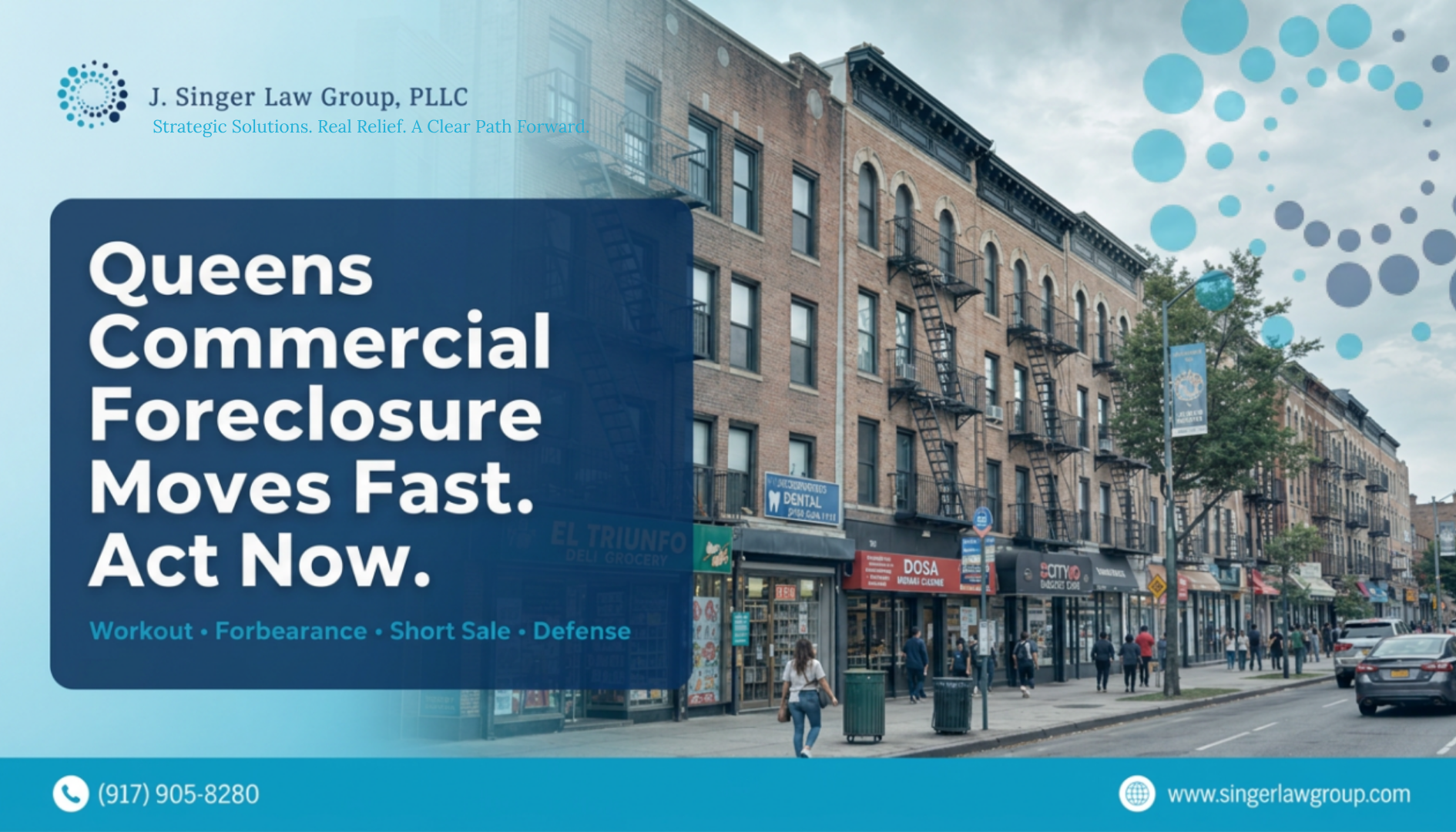
Commercial foreclosure in Queens is a judicial process handled in the Queens County Supreme Court. Unlike residential foreclosure, commercial borrowers do not have a mandatory settlement conference under CPLR § 3408, extended redemption rights, or a statutory cooling-off period. If you have received a default notice or been served with a foreclosure summons, a commercial foreclosure attorney in Queens can help you evaluate your options, protect the property, and determine whether a workout or another resolution makes sense. The earlier you address the foreclosure, the more options you may have.
Commercial foreclosure is the legal process a lender uses to enforce a mortgage after a borrower defaults on a retail building, mixed-use property, industrial facility, or other commercial property. If the case proceeds through judgment, the property may ultimately be sold at a court-ordered foreclosure sale. A Notice of Pendency (lis pendens), filed with the Queens County Clerk under CPLR § 6511, puts others on notice of the foreclosure action and clouds the property’s title, making a sale or refinancing difficult while the case is pending. The lender may also ask the court to appoint a receiver to collect rents and manage the property during the foreclosure case.
What Is Commercial Foreclosure in Queens, NY?
Commercial foreclosure in Queens is a court-supervised judicial process in which a lender enforces its mortgage security interest after a commercial borrower defaults, ultimately resulting in a court-ordered property sale through the Queens County Supreme Court.
Queens commercial property owners, including retail building owners, mixed-use landlords, and industrial property holders, face a faster, less protective process than the residential foreclosure process most people know. The action is filed in Queens County Supreme Court at 88-11 Sutphin Boulevard, Jamaica, NY 11435. From there, the lender can move immediately for a court-appointed receiver to take control of the property and redirect tenant rents, often within weeks of filing.
How New York’s Judicial Foreclosure Process Works
Commercial mortgage foreclosures in New York go through the courts. The lender starts the case by filing a summons and complaint, along with a Notice of Pendency under CPLR § 6511. The parties are served, and the lender can ask the court to appoint a referee to determine the amount owed. If the case proceeds to a judgment of foreclosure and sale, the property can then be sold at auction. A commercial foreclosure may take six months to a year from filing to auction, but the process can take longer with multiple liens, mezzanine debt, a bankruptcy filing, or other issues that need to be resolved.
Key Legal Terms Every Queens Property Owner Must Know
- Notice of Pendency (Lis Pendens): A filing made with the Queens County Clerk when the foreclosure action begins. It puts others on notice that the property is involved in a foreclosure case and clouds the title, which can make a sale or refinancing difficult while the case is pending.
- Court-Appointed Receiver: A third party appointed by the court to take over certain responsibilities for the property during the foreclosure case. A receiver may collect rents, manage the property, pay expenses, and protect the property while the case moves forward.
- Acceleration of Debt: A provision that may allow the lender to declare the full loan balance due after a default. Acceleration can also affect when the six-year statute of limitations under CPLR § 213 begins to run.
- Mezzanine Loan Foreclosure: A foreclosure involving the ownership interests in the entity that owns the property rather than the real estate itself. These foreclosures proceed under UCC Article 9 and can move much faster than a traditional mortgage foreclosure.
- Deficiency Judgment: A judgment that may allow the lender to pursue the borrower for the difference between the amount recovered through the foreclosure sale and the remaining debt.
How Does Commercial Foreclosure Differ From Residential Foreclosure in New York?
One important difference between commercial and residential foreclosure in New York is the settlement conference process. Commercial borrowers are not entitled to the mandatory settlement conference available to qualifying residential borrowers under CPLR § 3408, so no built-in court conference occurs before the commercial case moves forward.
For residential borrowers covered by CPLR § 3408, the settlement conference gives the borrower and lender a formal opportunity to discuss possible ways to resolve the default. Commercial foreclosure does not include that same step. Once the lender files the case, the borrower may need to negotiate a workout, raise available defenses, or consider other options while the foreclosure moves through the court.
No Mandatory Settlement Conference for Commercial Borrowers
The CPLR § 3408 settlement conference requirement was enacted specifically to protect homeowners. It has no commercial equivalent. A Queens commercial property owner who waits for the court to schedule a conference, expecting the same process that applies to residential foreclosure, will find no such conference on the docket. The lender’s counsel will be filing motions.
Reduced RPAPL Protections for Commercial Properties
New York’s Real Property Actions and Proceedings Law (RPAPL) gives residential borrowers certain protections during foreclosure. Commercial borrowers do not have the same protections. Much of a commercial foreclosure depends on the terms of the loan documents and the procedures that apply once the lender goes to court.
Why Commercial Borrowers Must Act Faster Than Homeowners
Timing matters in a commercial foreclosure because the lender can keep moving the case forward while the property owner considers what to do. The lender may file a Notice of Pendency, seek appointment of a receiver, or take other steps allowed under the loan documents and New York law. A workout may still be possible after the case is filed, but it is usually better to start that conversation before foreclosure moves further along.
Defending Against Commercial Foreclosure in Queens: Your Options
Queens commercial property owners can stop or delay foreclosure through loan modification, Chapter 11 bankruptcy, lender standing challenges, commercial short sale, or deed in lieu of foreclosure, even after a court action has been filed.
A commercial property owner may have several ways to respond to a foreclosure, but timing can affect which options are still available. Some issues can be addressed after the case is filed, while others are better handled before the foreclosure gets that far. The right approach depends on the loan, the property, and where the case stands.
Challenging Lender Standing and Procedural Defects
A lender bringing a commercial foreclosure must have the legal right to enforce the debt. Commercial loans may be assigned or transferred, sometimes more than once, so review the loan history and assignment documents carefully. Questions about standing or defects in the foreclosure process may provide a defense in some cases. CPLR § 213 and New York’s six-year statute of limitations may also become relevant when a lender accelerated the debt but waited to bring the foreclosure action. You need to identify and raise these issues at the appropriate point in the case.
Loan Modification, Forbearance, and Workout Agreements
There may be more room to negotiate before the lender files a Notice of Pendency and the foreclosure is underway. Depending on the circumstances, a commercial real estate loan workout may change payment terms, the interest rate, the maturity date, or give the borrower time to address the default through a forbearance agreement. The details matter. Review any proposed agreement carefully, including how it treats the remaining debt, defaults, guarantees, and the lender’s rights if the borrower cannot meet the new terms.
Jeb Singer, Managing Partner of J. Singer Law Group, brings a bankruptcy and restructuring background to commercial foreclosure matters. That experience helps when a property owner weighs a workout against foreclosure litigation or Chapter 11. The goal is to understand the financial problem behind the foreclosure and determine which option makes sense for the property and the business.
Chapter 11 Bankruptcy and the Automatic Stay
Chapter 11 can become an option when a commercial foreclosure is already underway, and the business needs time to deal with the debt. Filing a bankruptcy petition generally puts an automatic stay in place under11 U.S.C. § 362, which can stop the pending foreclosure. The stay does not make the underlying problem go away. A lender can ask the bankruptcy court for permission to continue with the foreclosure, and the borrower needs a realistic plan for moving forward. Smaller businesses that qualify may also consider Subchapter V bankruptcy. Whether bankruptcy makes sense depends on the property, the debt, the business, and whether the problem can be resolved another way.
Commercial Short Sale as an Alternative to Foreclosure
Sometimes keeping the property is no longer the best option. If the property is worth less than what is owed and the lender is willing to work toward a sale, a commercial short sale may allow the property to be sold without going through a foreclosure auction. The lender has to approve the transaction because the sale will not pay the debt in full. The borrower also needs to understand how the lender will treat any amount that remains unpaid. These discussions are generally easier to have before the foreclosure reaches the sale stage.
Emergency Filings: Acting Within 24–48 Hours
A scheduled foreclosure sale does not necessarily mean there is nothing left to do. Depending on the situation, a Chapter 11 filing or an application to the state court may affect whether the sale can go forward. These steps are meant to address an immediate deadline. They do not replace the need for a longer-term plan. J. Singer Law Group handles urgent foreclosure matters for Queens commercial property owners and can review what options may still be available.
Four Mistakes Queens Commercial Property Owners Make After Receiving a Default Notice
- Waiting until after the Notice of Pendency is filed to speak with counsel. Once the foreclosure is filed, the Notice of Pendency can affect the property’s title, and the lender may already be taking the next steps. Speaking with counsel when the default notice arrives gives the property owner more time to review the loan, understand the lender’s position, and consider whether a workout or another response makes sense.
- Trying to negotiate a workout without having the proposed terms reviewed. A workout can change more than the monthly payment. Forbearance terms, default provisions, waivers, personal guarantees, and how any remaining debt is treated can all matter if the borrower runs into trouble again. Borrowers should understand those terms before signing an agreement.
- Filing Chapter 11 before comparing it with the other available options. Bankruptcy comes with filing costs, professional fees, court requirements, and ongoing obligations. In some cases, Chapter 11 may be the right way to address the foreclosure. In others, a workout or short sale may make more sense. The decision should be based on the property, the debt, and what the business is trying to accomplish.
- Ignoring the mezzanine layer if the property carries layered financing. A senior mortgage workout can become irrelevant if a mezzanine lender moves under UCC Article 9 on a 10-day timeline. Any defense strategy for a property with layered debt must account for every layer simultaneously.
Lender-Side Commercial Foreclosure Representation in Queens
Commercial lenders bringing a foreclosure in Queens need to follow New York’s requirements for filing the case, serving the parties, filing the Notice of Pendency, and establishing the amount owed.
Problems with service, the Notice of Pendency, or the lender’s debt calculation can affect the foreclosure and create delays. The case can also change quickly if the borrower files for bankruptcy. Lender-side representation should account for both the foreclosure in Queens County Supreme Court and any bankruptcy issues that may arise along the way.
Filing the Foreclosure Action and Notice of Pendency
The foreclosure complaint must include the necessary parties, and the Notice of Pendency must be filed with the Queens County Clerk under CPLR § 6511. The lender also needs to make sure service is handled properly. Early mistakes can create problems later. J. Singer Law Group handles real estate litigation for lenders from the filing of the foreclosure action through judgment.
Moving for Court-Appointed Receiver to Protect Collateral
A commercial property still needs management while the foreclosure is pending. Depending on the property and the loan documents, a lender may ask the court to appoint a receiver to collect rents, oversee expenses, and manage the property during the case. Seeking a receiver early may matter when there are concerns about rental income, property expenses, or the property's condition.
Coordinating with Bankruptcy Counsel When Borrowers File Chapter 11
A borrower’s Chapter 11 filing generally puts the automatic stay in place under 11 U.S.C. § 362 and can stop the pending foreclosure. At that point, the lender may be dealing with the foreclosure case in Queens County Supreme Court and the bankruptcy case in federal court at the same time. Depending on the circumstances, the lender may seek relief from the stay while protecting its rights in the state-court foreclosure.
Mezzanine Loan Foreclosure Under UCC Article 9
A mezzanine loan is generally secured by equity interests in the entity that owns the property rather than by a mortgage on the real estate itself. Because the collateral is different, a mezzanine foreclosure proceeds under UCC Article 9 rather than through the judicial mortgage foreclosure process. These proceedings can move much faster than a traditional commercial mortgage foreclosure. For lenders and borrowers with both senior and mezzanine debt, each part of the financing must be considered separately.
Why Queens Commercial Property Owners Choose J. Singer Law Group
J. Singer Law Group provides integrated commercial foreclosure representation in Queens, combining real estate litigation, bankruptcy, and loan workout expertise under one roof.
Most competing practices in this space are either residential foreclosure firms that added “commercial” to their keyword list, or large real estate litigation firms that do not handle bankruptcy. The structural problem: a firm that understands only real estate litigation cannot tell you whether Chapter 11 is cheaper and faster than a workout. A firm that handles only bankruptcy cannot negotiate your forbearance agreement or litigate your standing challenge in Queens County Supreme Court.
J. Singer Law Group is built differently. Jeb Singer clerked for the Honorable Stuart M. Bernstein in the Southern District of New York bankruptcy court before spending nearly two decades as a restructuring partner at Baker McKenzie. The firm handles the Queens County Supreme Court defense, the loan workout negotiation, and the Chapter 11 filing, without handing the case off between departments or firms. That integration is not a marketing claim; it is the structure of the practice.
The firm serves Queens, Manhattan, Brooklyn, the Bronx, Long Island, and Westchester. Emergency consultations are available with a 24- to 48-hour response. Call (917) 905-8280.
Frequently Asked Questions About Commercial Foreclosure in Queens
The most common questions from Queens commercial property owners involve foreclosure timelines, available defenses, the impact of Chapter 11 bankruptcy, and how court-appointed receivers affect business operations.
Q: What is the difference between commercial and residential foreclosure in Queens, NY?
Both commercial and residential foreclosures in Queens are judicial processes filed in Queens County Supreme Court. The critical difference is consumer protection. Under CPLR § 3408, residential borrowers are entitled to a mandatory court-supervised settlement conference, a structured opportunity to negotiate with the lender before the case proceeds. That protection does not apply to commercial foreclosures. Commercial borrowers also face reduced RPAPL notice protections and no extended statutory redemption period. The practical result: commercial foreclosures move faster, and the borrower’s window to act is shorter. Retaining counsel immediately upon receiving a default notice is not optional. It is the difference between having a full option set and having a narrowed one.
Q: How long does a commercial foreclosure take in Queens County?
A standard commercial foreclosure proceeding in Queens County runs approximately six months to one year from filing to completion. That timeline assumes no significant complications. Cases involving multiple liens, mezzanine debt, contested standing, or a borrower’s Chapter 11 filing can extend considerably longer. During that period, the lender will typically move to appoint a court-appointed receiver to manage the property and collect rents, a disruption that begins well before the foreclosure sale. The six-month to one-year timeline is also the window in which a workout, short sale, or reorganization plan can be negotiated and executed, which is why early legal intervention matters.
Q: Can a Queens commercial property owner stop a foreclosure after it has been filed?
Yes. Even after a foreclosure action has been filed in Queens County Supreme Court, multiple options remain available. You can negotiate a loan modification or forbearance agreement directly with the lender. A Chapter 11 bankruptcy filing triggers an automatic stay under 11 U.S.C. § 362 that immediately halts all foreclosure proceedings. An emergency filing can be completed within 24 to 48 hours. You can raise lender-standing challenges and procedural defenses in the Queens County action itself. A commercial short sale or deed-in-lieu of foreclosure can provide a controlled exit that avoids a forced auction. The option set narrows as the case progresses toward judgment, but it does not disappear until the gavel falls at the foreclosure sale.
Q: What is a court-appointed receiver in a New York commercial foreclosure?
A court-appointed receiver is a neutral third party the Queens County Supreme Court designates to manage a commercial property during the foreclosure proceeding. The receiver collects rents from tenants, maintains the property, pays carrying costs, and protects the lender’s collateral while the litigation is ongoing. Receiver appointment is standard in most New York commercial foreclosure cases and typically occurs early in the proceeding, often within weeks of the foreclosure filing. For a business owner operating out of the foreclosed property, a receiver appointment immediately disrupts operations. It is one of the strongest reasons to retain counsel before the foreclosure action is filed, when a workout agreement can prevent receiver appointment entirely.
Q: Does filing Chapter 11 bankruptcy stop a commercial foreclosure in Queens?
A Chapter 11 filing triggers an automatic stay under 11 U.S.C. § 362 that immediately halts all foreclosure proceedings, including any pending Queens County Supreme Court action. The stay is effective the moment the petition is filed. It is not permanent. The lender can petition the bankruptcy court to lift the stay by showing that the borrower cannot adequately protect the lender’s interest or that the borrower has no viable reorganization plan. The stay’s durability depends on the borrower’s ability to present a credible path forward. Evaluate Chapter 11 as part of a comprehensive strategy, not as a reflexive filing. In some cases, a negotiated workout or short sale resolves the problem faster and at lower total cost than a full reorganization proceeding.
Q: What is a mezzanine loan foreclosure and how does it differ from a standard commercial mortgage foreclosure in New York?
A mezzanine loan is secured by the equity interests in the entity that owns the commercial property, not by the real property itself. Because the collateral is personal property (equity interests), mezzanine foreclosures proceed under UCC Article 9 as a sale of those equity interests, not through the standard judicial mortgage foreclosure process in Queens County Supreme Court. The speed difference is significant: a mezzanine foreclosure can be completed in as little as 10 days with proper notice, compared to the six-month to one-year timeline for a standard judicial mortgage foreclosure. For Queens commercial property owners with layered financing, this means a mezzanine lender can move to foreclose on the ownership entity while the senior mortgage foreclosure is still in its early stages, effectively stripping the borrower of the property without waiting for the court process to conclude.
If your commercial property is facing foreclosure, a lender workout, a receiver motion, or pressure from multiple layers of debt, the earlier you understand your options, the more clearly you can decide what comes next. J. Singer Law Group represents Queens commercial property owners and lenders in commercial foreclosure, real estate litigation, loan workouts, and bankruptcy matters.
Call (917) 905-8280 or contact J. Singer Law Group to discuss your situation.