
MCA Frozen Account Attorney in Brooklyn: Emergency Defense for Bank Restraints & COJ Enforcement
By
Jeb Singer, Esq., Managing Partner, Singer Law Group
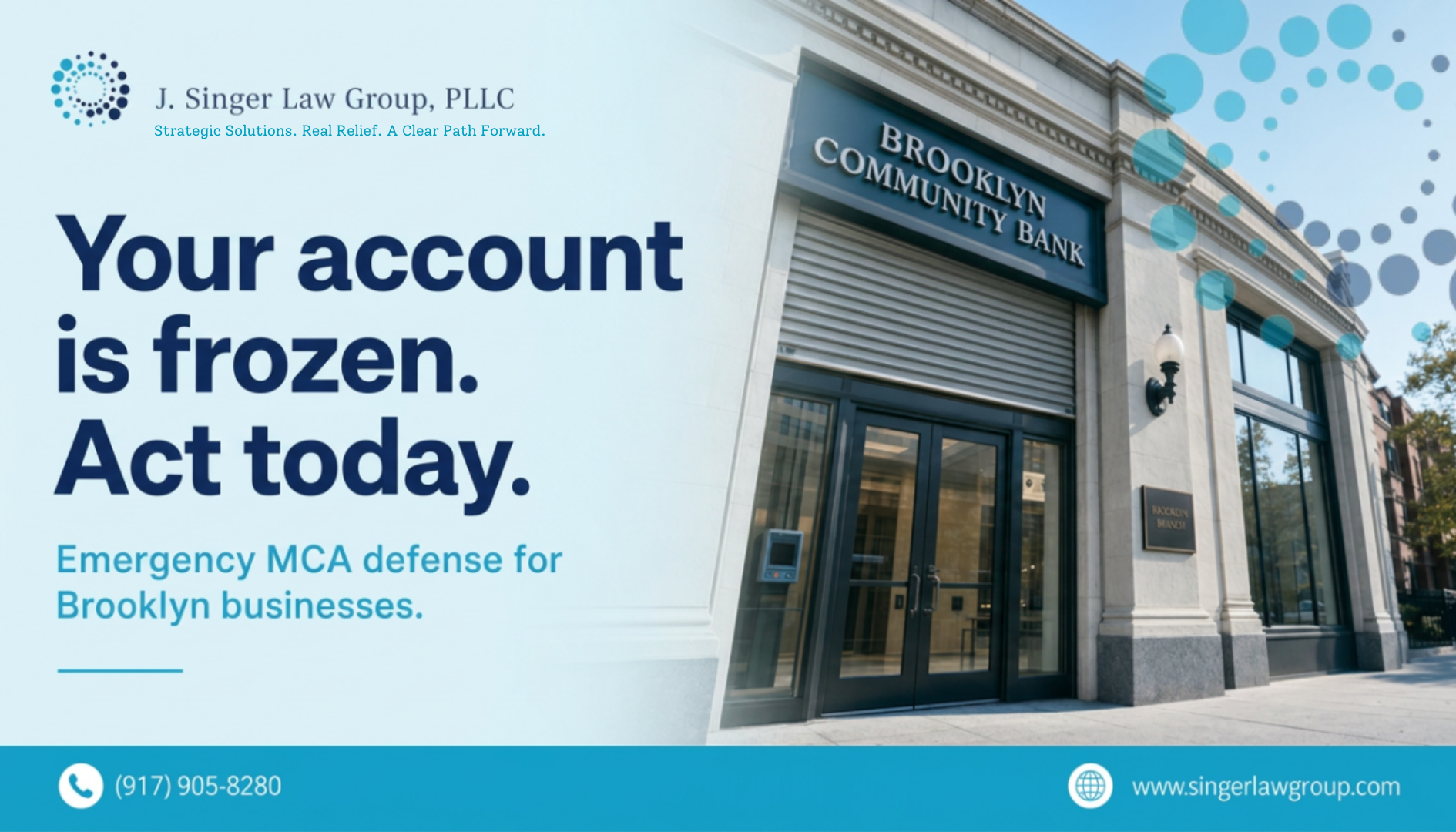
When an MCA funder freezes a Brooklyn business bank account, the effects can quickly reach the entire operation. Money needed for payroll, inventory, rent, vendors, taxes, and other expenses may suddenly become unavailable.
For many business owners, the restraint is also the first sign that an MCA dispute has moved into judgment enforcement.
A funder may have obtained a judgment based on a Confession of Judgment signed in connection with the MCA agreement and then used that judgment to pursue the business’s bank account. By the time the owner receives notice from the bank, enforcement may already be underway.
That does not mean you should accept the funder’s position.
Review the judgment, Confession of Judgment, MCA agreement, restraint notice, payment history, and court record together. Depending on the circumstances, there may be questions involving the procedure used to obtain the judgment, the underlying MCA transaction, the scope of the restraint, or the funder’s claimed enforcement rights.
Singer Law Group’s MCA defense practice represents New York businesses dealing with MCA lawsuits, judgments, bank restraints, UCC enforcement, and related financial distress.
Jeb Singer, Managing Partner of Singer Law Group, represents businesses in merchant cash advance disputes, commercial litigation, restructuring, and bankruptcy matters. His background includes clerking for Judge Stuart M. Bernstein in the U.S. Bankruptcy Court for the Southern District of New York.
That litigation and bankruptcy experience is particularly relevant when a frozen account is not an isolated problem, but part of a larger situation involving multiple MCA obligations, liens, personal guarantees, or broader financial distress.
If your Brooklyn business account has been restrained, the priority is understanding what happened and what options may still be available.
Your Brooklyn Business Bank Account Was Frozen — Here’s What’s Happening
A frozen business account can happen without warning.
One day, the company uses its account normally. The next day, payments are declined, available funds are restricted, or the bank notifies you that the account is under restraint.
When an MCA judgment is involved, the sequence may have started before the business realized enforcement was underway.
The funder may have obtained a judgment and then served a restraining notice on the bank under New York judgment-enforcement procedures. Once the bank receives the restraint, access to funds can be affected while the creditor continues pursuing collection.
For a Brooklyn business, the immediate concern is often keeping the company operating.
Employees still need to be paid. Vendors still expect payment. The business may need to purchase inventory or supplies. Rent, insurance, utilities, and taxes continue to come due.
But before reacting to the freeze, the business needs to determine exactly what legal action produced it.
- Was the judgment based on a Confession of Judgment?
- Was there a conventional lawsuit?
- When was the judgment entered?
- Which funder obtained it?
- What amount is being claimed?
- What does the MCA agreement say about default, reconciliation, personal guarantees, and enforcement?
- Has the funder taken additional steps beyond the bank restraint?
Those questions help establish where the business stands and what to review next.
How MCA Funders Freeze Accounts in Brooklyn (Kings County)
When an MCA funder has a judgment against a business, it may use New York judgment-enforcement procedures to pursue money held in the company’s bank account.
A restraining notice can prevent the business from accessing funds while collection continues.
For a Brooklyn business owner, it is important to distinguish the restraint from later enforcement steps.
A restraint generally restricts access to funds. Additional procedures may then be used to obtain those funds to satisfy the judgment.
That distinction matters because the business needs to know what has already occurred and what may happen next.
If the restraint is connected to a Confession of Judgment, the confession itself should be reviewed along with the resulting judgment.
A COJ can create a very different procedural situation from a conventional lawsuit because the business may not have litigated the underlying MCA dispute before judgment was entered.
The court record can help establish the sequence.
Obtain the judgment, Confession of Judgment, docket information, restraint notice, and any related enforcement documents. Compare those materials with the MCA agreement and communications from the funder.
The business should also identify whether other MCA companies have judgments, UCC filings, or claims against the same assets.
That broader review becomes especially important when several funders are competing for the same operating cash.
The existence of a bank restraint does not automatically mean the judgment can be vacated or that the account will immediately be released.
It does mean the procedural history and underlying MCA deserve prompt review.
Depending on the facts, counsel may need to evaluate whether there are grounds to challenge the judgment or enforcement, seek emergency relief, negotiate access to funds, or address the MCA as part of a broader restructuring.
What a Bank Restraint Notice Looks Like — and What It Means
A bank restraint notice can provide important information about what has happened.
The notice may identify the judgment creditor, the amount being enforced, court information, and other details connected with the restraint.
Do not set it aside as another collection letter.
Keep the complete notice and provide it to counsel along with the MCA agreement and court papers.
Then compare the information with the actual court record.
The business needs to determine whether a judgment exists, how it was obtained, when it was entered, and what enforcement action has followed.
If the business maintains more than one account with the same financial institution, it should also review the restraint's effect on those accounts before moving money or making changes.
A business owner should avoid assuming that opening another account, transferring funds, or redirecting revenue will solve the problem.
The MCA agreement and enforcement documents may contain provisions that make those decisions legally significant.
The same caution applies to contacting the funder and immediately agreeing to new payment terms.
A settlement may ultimately make sense, but the business should first understand the judgment and the underlying MCA.
If a Confession of Judgment was used, counsel may need to review whether the applicable procedural requirements were satisfied.
If the MCA itself raises questions involving reconciliation or the allocation of receivables risk, those issues may also affect the broader strategy.
And if the frozen account is only one part of a larger debt problem, resolving the restraint without addressing the remaining MCA obligations may provide only temporary relief.
For a Brooklyn business owner, the first objective is therefore not simply to get money moving again at any cost.
It is to understand what created the restraint, what legal and financial issues it raises, and which response gives the business the best chance to address both the immediate enforcement problem and what comes next.
Emergency Legal Options When an MCA Funder Freezes Your Brooklyn Account
A frozen operating account can quickly become a serious business problem. Payroll, rent, inventory, vendors, taxes, and other expenses don't stop just because an MCA funder has restrained the account.
The legal response should start by determining exactly what caused the freeze.
If the restraint followed a Confession of Judgment, counsel should review the confession, judgment, MCA agreement, court record, and enforcement documents together. If the judgment resulted from a conventional lawsuit, the case's procedural history may require a different analysis.
The underlying MCA matters as well.
A business may have issues involving reconciliation, the funder’s claimed default, the structure of the transaction, personal guarantees, or UCC filings in addition to questions about the judgment itself.
Depending on the circumstances, counsel may evaluate whether there are grounds to challenge the judgment, seek emergency court relief, contest aspects of the restraint, negotiate access to funds, or address the MCA through a broader restructuring strategy.
The key is to understand both the immediate enforcement problem and the transaction behind it before deciding what to do.
How to Fight a Confession of Judgment in Kings County
A Confession of Judgment can allow an MCA dispute to reach the judgment-enforcement stage without the same litigation process a business would ordinarily expect before judgment.
For a Brooklyn business owner who first learns about the problem after receiving a bank restraint notice, the COJ should be one of the first documents reviewed.
New York changed CPLR § 3218 in 2019, and the timing and circumstances of the confession can matter.
Counsel may need to examine when the COJ was signed, when and where it was filed, the parties involved, the factual statements supporting the
judgment, and whether the requirements applicable to that particular confession were satisfied.
You should also review the underlying MCA agreement.
A procedural challenge to a COJ and a substantive challenge involving the MCA are not necessarily the same thing. Depending on the facts, the business may have questions about how the judgment was obtained, as well as separate issues involving reconciliation, recharacterization, alleged default, fraud or misrepresentation, or the funder’s enforcement rights.
Singer Law Group’s discussion of how to fight a Confession of Judgment in New York provides additional information about the issues that may need to be considered when a funder has already obtained a COJ.
If grounds exist to challenge the judgment, counsel can evaluate the appropriate court procedure and whether to request emergency relief as well.
A temporary restraining order may become part of that strategy when ongoing enforcement threatens immediate harm to the business. Whether that relief is available depends on the facts, procedural posture, and applicable legal requirements.
For a retailer, restaurant, contractor, healthcare practice, or other Brooklyn business, a frozen operating account can cause substantial practical harm.
The company may need access to cash to make payroll, purchase inventory or supplies, pay vendors, cover rent, or meet other obligations necessary to remain open.
Those facts matter when counsel evaluates whether emergency relief is appropriate.
But a business owner should not assume that filing a motion automatically lifts the restraint.
Counsel must first review the judgment, enforcement documents, MCA agreement, and financial circumstances so the requested relief is based on the actual record.
That is why gathering the documents quickly matters.
Keep the complete COJ, judgment, restraint notice, MCA agreement, bank statements, payment history, reconciliation requests, personal guarantees,
UCC records, and communications with the funder.
If several MCA companies are involved, gather the same materials for each one.
The objective is to understand what the funder has done, what legal rights it claims, what defenses the business may have, and what action is appropriate under the circumstances.
Challenging the Bank Restraint Directly
The underlying judgment is not the only issue that may require review.
The bank restraint itself should also be examined.
Counsel may need to determine how the restraint was served, what accounts and funds it affects, whether the enforcement procedure was properly followed, and whether there are grounds to seek relief from some or all of the restraint.
The restraint notice and the bank’s communications are important documents in that analysis.
Keep every page the bank provided and note when the business first became aware that access to the account had been restricted.
Do not assume that every dollar affected by a restraint is necessarily available to satisfy the judgment.
The nature and source of the funds can matter, and particular funds may receive protections under applicable law depending on the circumstances.
If there is a question about whether funds are protected or whether the restraint reaches property it should not reach, evaluate that issue based on the specific account and source of the money.
The business’s operating needs may also factor into the broader strategy.
In some cases, counsel may explore whether the parties can agree on access to funds while addressing the underlying MCA dispute.
Whether a funder is willing to negotiate, and on what terms, depends on the case's legal and financial circumstances.
The business should not assume that a negotiated release is guaranteed or that accepting the first proposed payment arrangement is the best solution.
Before agreeing to new terms, understand what defenses may exist and whether the business’s current cash flow can actually support the proposed payment.
That is particularly important when more than one MCA funder is involved.
A payment arrangement with one creditor may accomplish very little if two or three other funders continue withdrawing money or pursuing the same business assets.
You need to consider the complete debt structure.
A frozen account can therefore require more than one type of response.
You may have an immediate question about accessing operating cash. There may also be a judgment that needs review, an underlying MCA agreement that raises legal issues, UCC filings that affect business assets, and other creditors pressuring the company.
For a viable Brooklyn business, the goal should be to address the immediate restraint without losing sight of what the company needs to continue operating.
For a business facing broader financial distress, the freeze may signal that litigation alone will not solve the problem.
The right response comes from understanding both situations before deciding whether to challenge the judgment, seek relief from the restraint, negotiate with the funder, restructure the MCA obligations, or consider a broader financial solution.
Legal Defenses Available to Brooklyn Business Owners Against MCA Funders
A frozen bank account may be the most immediate problem, but the underlying MCA agreement can be just as important as the restraint itself.
When an MCA funder has obtained a judgment or begun collection against a Brooklyn business, counsel should review how the judgment was obtained and whether the underlying transaction raises defenses of its own.
That review starts with the agreement, but it should not end there.
The business’s payment history, revenue records, reconciliation requests, communications with the funder, personal guarantees, UCC filings, and court documents can help establish how the transaction actually operated.
For some businesses, the strongest issue may involve the Confession of Judgment and the procedure used to obtain it.
For others, the larger question may be whether an agreement described as a purchase of future receivables functioned more like a loan.
These defenses are fact-specific. A high-cost MCA does not automatically establish usury, and the existence of a procedural issue does not automatically result in vacatur of a judgment.
The documents and the actual conduct of the parties need to support the argument.
Singer Law Group’s discussion of MCA defense strategies for New York small businesses provides additional information about the issues business owners may need to evaluate when an MCA dispute reaches the enforcement stage.
Criminal Usury Defense (NY Penal Law § 190.40)
New York’s criminal usury law can become relevant in an MCA dispute if the transaction is first determined to be a loan rather than a genuine purchase of future receivables.
That first step matters.
An MCA is generally structured as a purchase of a portion of the business’s future receivables. In a true receivables purchase, the amount and timing of collection should reflect the revenue the business actually generates, and the funder assumes some risk that future receivables may not materialize as expected.
A loan works differently because repayment is generally required under agreed terms, regardless of business performance.
For a Brooklyn business owner, one of the first areas to examine is reconciliation.
- Did the agreement provide a practical way to adjust withdrawals when revenue declined?
- Did the business request an adjustment?
- What information did the funder require?
- Did the payment actually change?
If the written agreement refers to reconciliation but the process did not provide a meaningful way to adjust payments based on actual receivables, that fact may deserve closer review.
The collection period can also matter.
If the amount and timing of payments were effectively fixed from the beginning rather than dependent on the retailer’s future revenue, counsel may need to consider whether the transaction operated consistently with a true purchase of receivables.
The funder’s recourse rights are another part of that analysis.
- What happened if the business experienced a legitimate decline in sales?
- What happened if the anticipated receivables were never generated?
- Did the funder bear that risk, or did the merchant remain responsible for paying the full amount regardless of business performance?
No single provision should be viewed in isolation.
Consider the agreement, payment structure, reconciliation process, default provisions, guarantees, and the parties' actual conduct as a whole.
If that analysis supports treating the transaction as a loan, New York Penal Law § 190.40 may become relevant when evaluating whether the interest charged exceeds the criminal usury threshold.
The calculation should be based on the actual transaction, not the factor rate alone.
A factor rate tells the business how much it must ultimately deliver to the funder compared with the amount advanced. It does not, standing alone, establish the annualized interest rate or prove that the agreement is legally a loan.
That is why the characterization analysis comes first.
If the transaction is treated as a loan and the applicable criminal usury requirements are satisfied, the consequences can be significant.
But the defense should be based on what the MCA actually did, not simply that the financing was expensive.
Civil Usury Defense (NY Gen. Oblig. Law § 5-501)
Civil usury requires a separate analysis.
The original MCA agreement, the identity of the borrower or merchant, the business structure, and the nature of the transaction can all affect whether a civil usury argument is available.
For that reason, a Brooklyn business owner should not assume that the civil usury rules apply to every MCA simply because the transaction carries a high effective cost.
Entity status matters.
An MCA entered into by a corporation or LLC can raise different issues from financing involving an individual or sole proprietor.
Analyze personal guarantees separately from the business's obligations.
The first question remains whether the MCA should be treated as a loan.
If the transaction operated as a genuine purchase of future receivables, traditional usury analysis may not apply as it would to a loan.
If the facts support recharacterization, counsel can determine which usury provisions may apply based on the merchant, transaction, and applicable New York law.
That distinction is important because criminal and civil usury are not interchangeable defenses.
A business owner should not assume that one automatically establishes the other.
The better approach is to begin with the transaction itself and work outward.
Review how much money was advanced, how much the funder was entitled to collect, how payments were calculated, whether those payments adjusted with revenue, whether reconciliation worked, and what happened if the business could not generate the expected receivables.
That factual record determines whether a usury analysis should become part of the defense strategy.
COJ Procedural Defects Under the 2019 CPLR § 3218 Reform
When an MCA funder has relied on a Confession of Judgment, the procedure used to obtain that judgment should be reviewed independently from the underlying MCA.
New York changed CPLR § 3218 in 2019, making the timing, parties, venue, and circumstances surrounding a COJ important to the analysis.
For a Brooklyn business owner, that means counsel should not look only at the amount of the judgment.
The confession itself matters.
So does the court record.
Counsel may need to examine when the COJ was executed, when it was filed, where the parties were located, where the judgment was entered, what factual information accompanied the confession, and whether the requirements applicable to that particular filing were satisfied.
The age of the MCA documents can also matter.
A business may have signed an agreement or confession before changes to New York’s COJ rules took effect, while another transaction may have been entered afterward.
The applicable legal and procedural framework should therefore be determined from the actual dates and documents rather than assumed.
If the COJ contains a procedural defect, counsel can evaluate whether that issue provides a basis for seeking relief from the judgment.
But a defect should not be treated as an automatic path to vacatur.
The court record and applicable requirements need to support the challenge.
The court should still review the underlying MCA.
A business may have a procedural argument involving the judgment and separate substantive issues involving reconciliation, recharacterization, usury, misrepresentation, or the claimed default.
Those issues can overlap, but you should not confuse them.
That distinction matters most when the funder has already restrained the business’s bank account.
Challenging the COJ may address the judgment that supports the enforcement activity. Reviewing the MCA addresses whether additional defenses apply to the underlying transaction.
For a Brooklyn business facing both problems, the stronger strategy is to evaluate them together.
A frozen account is the immediate symptom.
The judgment explains how the funder reached enforcement.
The MCA agreement and payment history help determine what defenses may exist.
Understanding all three gives the business a clearer picture of what it can realistically challenge and what should happen next.
The Three Mistakes Brooklyn Business Owners Make in the First 72 Hours After an Account Freeze
The first few days after a business account is frozen can put enormous pressure on a Brooklyn business owner.
Payroll may be approaching. Vendors may be waiting. Rent, taxes, insurance, inventory, and other operating expenses continue even though the business cannot freely access its own cash.
That pressure can make it tempting to act before understanding exactly what caused the restraint.
The better approach is to identify the judgment, review the MCA agreement, determine what enforcement has already occurred, and understand what options may be available before making a decision that creates another problem.
Three mistakes are particularly important to avoid.
Mistake 1: Waiting to call an attorney.
A bank restraint connected to an MCA judgment should not be treated like an ordinary payment dispute.
First, the business needs to determine how the funder reached the judgment-enforcement stage.
Was a Confession of Judgment used? Was there a conventional lawsuit? When was the judgment entered? What court documents support it? Has the funder taken additional enforcement steps beyond the bank restraint?
Those questions can affect what relief may be available.
Waiting can also make the operational problem more difficult. A retailer, restaurant, contractor, healthcare practice, or other Brooklyn business may depend on daily access to operating cash. Losing that access can disrupt payroll, supplies, inventory, rent, and other expenses needed to keep the company running.
That does not mean every frozen account can be released immediately or that every judgment can be challenged successfully.
It means the business should understand the legal posture promptly rather than assuming the freeze will resolve on its own.
Direct negotiations with the funder may eventually become part of the strategy, but they should not replace a review of the judgment and underlying MCA.
Before agreeing to anything, the business should know what the funder has, what defenses may exist, and what deadlines or enforcement activity require attention.
Mistake 2: Moving money between accounts at the same bank.
A business owner who suddenly loses access to an operating account may instinctively look for another way to move money.
Do not make that decision without understanding the restraint.
The business should determine which accounts and funds are affected, what the bank has been instructed to restrain, and whether additional enforcement activity is underway.
Do not assume that another account at the same financial institution is outside the scope of the restraint simply because the funder did not specifically identify that account in a communication with the business.
Review the bank’s notice and the underlying enforcement documents before moving money or changing accounts.
The MCA agreement matters as well.
Many MCA agreements contain provisions addressing designated bank accounts, ACH withdrawals, receivables, changes to banking arrangements, and conduct the funder may characterize as interference with collection.
A rushed attempt to restore cash flow can therefore create additional issues under the agreement.
At the same time, the business’s need for operating cash is real.
The goal is not to leave the company unable to function. It is to understand what can legally be done with the affected accounts and what options may exist to access funds without creating another dispute.
Bank statements should also be preserved.
They can help establish what funds were in the account when the restraint occurred, what deposits and withdrawals were taking place, and whether multiple MCA funders were drawing from the same operating cash.
That financial record may matter for both the immediate frozen-account strategy and the broader MCA analysis.
Mistake 3: Signing a settlement or payment plan before an attorney reviews the COJ.
A funder may offer to discuss releasing the account if the business agrees to a settlement or new payment arrangement.
That can sound attractive when payroll or other expenses are due.
But the business should understand the judgment and MCA agreement before signing new terms whenever circumstances allow.
If a Confession of Judgment was used, counsel may need to review whether the applicable procedural requirements were satisfied and whether there are grounds to challenge the judgment.
The underlying MCA may raise separate questions.
- Did payments genuinely adjust with revenue?
- Was reconciliation meaningful in practice?
- Did the transaction operate as a purchase of future receivables, or does the payment history support a closer recharacterization analysis?
- What personal guarantees and UCC filings are involved?
Those questions may affect the business’s position before settlement negotiations begin.
Cash flow matters just as much.
A settlement is not a meaningful solution if the new payment schedule leaves the business unable to meet payroll, buy inventory, pay vendors, or cover rent.
That becomes even more important when the company has several MCA positions.
Agreeing to a payment plan with one funder may ease immediate pressure while leaving the business unable to support payments to other creditors.
Settlement can be the right strategy.
The mistake is committing before understanding the legal position and whether the business can actually perform under the new agreement.
The MCA Frozen Account Defense Process at J. Singer Law Group
When a Brooklyn business comes to Singer Law Group with a frozen account, the immediate bank restraint is only one part of the review.
The firm begins by determining what happened before the account was restrained.
That means reviewing the judgment, any Confession of Judgment, the MCA agreement, court records, bank notices, payment history, reconciliation records, UCC filings, personal guarantees, and communications with the funder.
The business’s financial condition also matters.
A company facing one MCA judgment may need a very different strategy from a business with several stacked advances, multiple UCC filings, tax debt,
landlord arrears, vendor obligations, or other financial pressure.
The objective is to determine whether the business is primarily dealing with a judgment-enforcement problem, a dispute over the underlying MCA, a broader debt problem, or some combination of the three.
Singer Law Group’s MCA practice brings litigation and restructuring considerations into the same review.
Jeb Singer, Managing Partner of Singer Law Group, represents businesses in merchant cash advance disputes, commercial litigation, restructuring, and bankruptcy matters. His background includes clerking for Judge Stuart M. Bernstein in the U.S. Bankruptcy Court for the Southern District of New York.
That experience becomes particularly relevant when releasing a bank restraint alone would not solve the business’s financial problem.
The right strategy should address the immediate enforcement issue while also considering what the company needs to continue operating.
Step 1: Emergency Intake and Document Review
The first step is gathering the complete record.
Start with every MCA agreement and renewal connected to the business.
If there are multiple funders, keep the documents organized separately so counsel can identify the obligations, payment history, guarantees, security interests, and enforcement activity associated with each one.
Next, gather the court documents.
That should include the Confession of Judgment if one was used, the judgment itself, docket information, any summons or complaint, and other papers connected with the case.
Keep every notice you receive from the bank about the restraint.
The business should also preserve communications with the funder, including emails, text messages, reconciliation requests, default notices, settlement offers, and payment discussions.
Bank statements and revenue records can provide another part of the picture.
Those records can show how MCA withdrawals operated before the alleged default, whether payments changed as revenue changed, how much money
was taken from the business, and whether several funders withdrew from the same operating account.
Counsel should also identify UCC filings and personal guarantees.
Together, these documents allow counsel to examine several questions at once.
- Was the judgment obtained through a Confession of Judgment or a conventional lawsuit?
- Are there procedural issues involving the judgment?
- Does the MCA agreement raise questions involving reconciliation or recharacterization?
- What security interests does the funder claim?
- Is the owner personally exposed under a guarantee?
- Has enforcement progressed beyond the bank restraint?
- And can the underlying business continue operating if the immediate collection pressure is addressed?
Not every frozen-account matter will produce the same answer.
One business may have a viable challenge to the judgment.
Another may be better served by negotiating with the funder.
A company with several MCA obligations may need a broader restructuring strategy rather than treating each creditor separately.
The purpose of the initial document review is to identify the business's actual situation before deciding what comes next.
Step 2: Filing the Emergency Motion
Once the judgment, Confession of Judgment, bank restraint, and underlying MCA documents have been reviewed, the next step is determining whether there are grounds to seek relief from the court.
The appropriate filing depends on what the documents show.
If a Confession of Judgment was used, counsel may need to evaluate whether the applicable procedural requirements were satisfied and whether there are grounds to seek relief from the judgment.
If the funder has already restrained the business’s bank account, counsel may also need to address the immediate effect of that enforcement.
For a Brooklyn business, the practical consequences can be significant.
A company may need access to operating cash for payroll, inventory, rent, vendors, taxes, insurance, and other expenses necessary to remain open. If the restraint is interfering with those obligations, counsel can evaluate whether the circumstances support a request for emergency court relief.
That may include seeking a temporary restraining order or other appropriate relief while the underlying dispute is addressed.
Emergency relief is not automatic.
The court will consider the legal and factual basis for the request, which is why the initial document review matters. The motion should be based on the judgment, enforcement record, MCA agreement, and the business's financial circumstances.
The underlying MCA may also become part of the analysis.
If payments remained fixed despite declining revenue, reconciliation did not function in practice, or the funder’s recourse made repayment effectively absolute, those facts may support a closer review of whether the transaction operated as a genuine purchase of future receivables.
The business may therefore be dealing with two related issues at the same time: whether the judgment and restraint can be challenged and whether the MCA itself raises substantive defenses.
Those issues should be coordinated rather than treated as separate problems.
Step 3: Negotiating From a Position of Strength
Not every MCA dispute needs to end in extended litigation.
Negotiation may be the right strategy when it can resolve the immediate enforcement problem and produce terms the business can realistically support.
But meaningful negotiation starts with understanding the business’s legal and financial position.
Before discussing settlement, counsel should know how the judgment was obtained, whether the COJ or enforcement procedure raises issues, what defenses may exist under the MCA agreement, and what the funder claims as collateral.
The business’s cash flow matters just as much.
A payment plan that looks manageable on paper may still fail if it leaves the company without enough money for payroll, rent, inventory, vendors, taxes, and ordinary operating expenses.
That becomes even more important when several MCA funders are involved.
Resolving one judgment may provide little long-term benefit if other funders continue withdrawing from the same operating revenue or pursuing the same assets.
The business should understand the complete MCA burden before committing to new terms.
Depending on the circumstances, negotiations may address payment amounts, timing, enforcement activity, judgments, liens, or other issues affecting the business.
The objective is not simply to obtain a lower payment.
It is to determine whether a negotiated resolution actually gives the business a workable path forward.
For some companies, negotiation may make that possible.
For others, the frozen account signals a larger financial problem that cannot realistically be solved one funder at a time.
In those situations, restructuring or bankruptcy may need to become part of the discussion.
Singer Law Group’s discussion of how to get out of MCA debt in New York provides additional context for business owners evaluating options beyond a single MCA settlement.
Understanding New York’s MCA Legal Landscape in 2025–2026
New York’s legal treatment of merchant cash advances continues to make the transaction's structure and operation important.
For a Brooklyn business facing a frozen account, that means the analysis should not stop with the judgment.
The underlying agreement still matters.
An MCA may be described as a purchase of future receivables, but counsel may need to examine whether the transaction actually operated that way.
- Did payments change with revenue?
- Was reconciliation meaningful?
- Was the collection period dependent on the amount of receivables the business generated?
- What happened if the business experienced a legitimate decline and could no longer generate the expected receivables?
Those questions can affect whether the agreement is treated as a true receivables purchase or requires closer analysis as a potential loan.
The procedural history matters as well.
New York’s rules concerning Confessions of Judgment have changed over time. That makes the agreement date, execution, parties, venue, and filing history important when a COJ supports enforcement of the judgment.
For a Brooklyn business owner, the practical lesson is to avoid relying on assumptions about how MCA agreements or judgments work.
The specific documents control the analysis.
The Yellowstone Capital Settlement and What It Means for Your Case
Developments in MCA enforcement have reinforced an important point for New York business owners: compare the language used to describe a transaction with how the agreement actually operates.
For a Brooklyn business facing an account restraint, the most useful question is not what happened in another merchant’s dispute.
It is what happened in your own transaction.
Start with the MCA agreement.
Then compare it with the business’s bank statements, revenue history, reconciliation requests, payment records, default notices, and communications with the funder.
If the agreement ties payments to future receivables, determine whether withdrawals actually changed when revenue changed.
If the contract provides reconciliation, determine whether the business could realistically use that process.
If the funder claims that it assumed the risk associated with future receivables, examine what happened when the business’s revenue declined.
Those facts can help determine whether the MCA operated consistently with the agreement’s stated structure.
Use the same transaction-specific approach when a judgment has already been entered.
Review the judgment, Confession of Judgment, and enforcement record alongside the underlying MCA, rather than assuming enforcement ends the inquiry.
For a Brooklyn business owner, the important issue is the strength of the facts and documents in the business’s own case.
Senate Bill S1726 and Pending MCA Disclosure Requirements
New York’s regulation of commercial financing has continued to develop, particularly around the information provided to businesses entering financing transactions.
For a business owner, clearer financing terms can make it easier to understand an MCA's cost and structure before signing.
But disclosure and enforceability are separate questions.
A disclosure document does not, by itself, determine whether an MCA is a genuine purchase of receivables or whether a particular defense exists.
That analysis still depends on the agreement and how the transaction operated in practice.
For businesses already facing enforcement, the focus should remain on the documents that governed their own transaction.
- What amount was advanced?
- What amount was the funder entitled to collect?
- How were withdrawals calculated?
- Could payments adjust with actual revenue?
- How did reconciliation work?
- What constituted a default?
- What remedies did the funder claim?
- Was a Confession of Judgment involved?
Those questions are more useful to the immediate defense than relying on a general assumption about the MCA industry.
The business should also preserve any disclosures, funding summaries, term sheets, or other documents provided before signing the agreement.
Those records may help establish how the transaction was presented and how those representations compare with the final agreement and later conduct.
Why Brooklyn Business Owners Choose J. Singer Law Group for MCA Frozen Account Defense
A frozen account can require more than one type of legal analysis.
There may be an immediate judgment-enforcement problem.
The underlying MCA may raise separate questions involving reconciliation, recharacterization, usury, default, UCC filings, or personal guarantees.
And if the business has several MCA obligations, the financial problem may extend well beyond the account restraint.
Singer Law Group approaches those issues together.
Jeb Singer, Managing Partner of Singer Law Group, represents businesses in merchant cash advance disputes, commercial litigation, restructuring, and bankruptcy matters. His background includes clerking for Judge Stuart M. Bernstein in the U.S. Bankruptcy Court for the Southern District of New York.
Singer Law Group’s restructuring practice also includes Ira Reid, who served as a law clerk to Judge Cecelia H. Goetz in the U.S. Bankruptcy Court for the Eastern District of New York and spent about two decades as a restructuring partner at Baker McKenzie.
That combination of litigation and restructuring experience can matter when a frozen account is only one part of a business’s financial distress.
A viable company with one disputed MCA may need a focused litigation or negotiation strategy.
A business with several stacked advances, UCC liens, judgments, tax obligations, landlord arrears, and other debt may need a broader solution.
The objective is to understand the business's situation before deciding what to do.
Commercial Litigation and Bankruptcy Under One Roof
An MCA dispute can move between litigation, negotiation, and restructuring.
A business may begin by challenging a judgment or seeking relief from a bank restraint. The same company may later need to negotiate multiple MCA positions or determine whether it can reorganize its overall debt.
Keeping those issues within one coordinated strategy can matter.
The litigation side focuses on the judgment, enforcement activity, underlying agreement, and document-supported defenses.
The restructuring side asks a different question: if the immediate collection pressure is addressed, is the business financially viable?
If the answer is yes, the company may have options for preserving operations while dealing with its debt.
If the answer is no, continuing to fight one creditor at a time may only delay a larger decision.
Bankruptcy can factor into that analysis when the business’s financial distress extends beyond a single MCA.
Singer Law Group discusses merchant cash advance lawsuits and Chapter 7 bankruptcy for business owners evaluating how MCA enforcement may intersect with bankruptcy.
Chapter 7 is not the right solution for every business, and a viable operating company may need to consider a different restructuring path.
The point is to evaluate the business as a whole, not treat the frozen account as the only problem.
Local Presence: 1 Liberty Street, Manhattan — 15 Minutes From Brooklyn Courts
Singer Law Group is based at 1 Liberty Street in Lower Manhattan and represents New York businesses facing MCA disputes, judgments, bank restraints, commercial litigation, and financial distress.
For Brooklyn business owners, having counsel familiar with New York MCA disputes and the courts involved in commercial enforcement can be important.
But location alone is not the reason to choose a legal strategy.
The value comes from understanding how the MCA agreement, judgment, enforcement activity, and the business's financial condition fit together.
A Brooklyn restaurant may need a different approach from a contractor, retailer, medical practice, trucking company, or professional services business.
One company may be dealing with a single frozen account.
Another may have several MCA funders, multiple UCC filings, personal guarantees, and other creditors competing for the same cash.
The strategy should reflect those differences.
Singer Law Group’s role is to identify the immediate legal problem, understand the business behind it, and evaluate the options available based on the
actual documents and financial circumstances.
That may mean challenging a judgment or enforcement action.
It may mean negotiating with a funder.
It may require restructuring several MCA obligations.
And when the financial problem is broader, you may need to consider bankruptcy as part of the overall strategy.
The starting point is the same in each situation: understand what happened, determine what the documents support, and choose a path that addresses both the immediate enforcement problem and the business's future.
Frequently Asked Questions
What should I do immediately if an MCA funder froze my Brooklyn business bank account?
Start by gathering the documents that explain how the restraint happened.
This includes every MCA agreement connected to the business, the Confession of Judgment (if one was used), the judgment, court papers, bank restraint notices, payment records, personal guarantees, UCC filings, and recent communications with the funder.
Do not assume that the freeze is simply a payment dispute that can be resolved by agreeing to new terms with the funder.
The business first needs to determine how the judgment was obtained, what enforcement has already occurred, and whether the underlying MCA raises additional issues involving reconciliation, recharacterization, default, or the funder’s claimed security interests.
Avoid making significant changes to the business’s banking arrangements until you understand the restraint and the MCA agreement. Moving money, closing an account, or redirecting receivables without reviewing the documents can create additional issues depending on the circumstances.
A frozen operating account can affect payroll, inventory, vendors, rent, taxes, and other expenses necessary to keep the business running. Prompt legal review can help the owner understand what options may be available before the financial pressure becomes more difficult to manage.
Can a Brooklyn MCA attorney actually get my frozen bank account unfrozen?
Legal or negotiated options may exist to release some or all of the restrained funds, but the outcome depends on the judgment, enforcement procedure, MCA agreement, and the facts of the case.
If a Confession of Judgment supports the restraint, counsel can review how the COJ was executed and filed and whether the applicable procedural requirements were satisfied.
Depending on what that review shows, the business may have grounds to seek relief from the judgment or request emergency court relief affecting the restraint.
The restraint itself may also require separate review.
Counsel may need to examine how it was served, what funds and accounts it reaches, and whether there are other grounds for seeking relief.
Negotiation may provide another path in some cases. A funder may be willing to discuss releasing funds as part of a broader resolution, particularly when disputed issues involve the judgment or underlying MCA.
None of those outcomes should be assumed in advance.
The first step is determining what happened and what the documents support.
What is a Confession of Judgment and how does it allow an MCA funder to freeze my account in Brooklyn?
A Confession of Judgment is a document through which a party consents in advance to the entry of a judgment under specified circumstances.
When a COJ is connected with an MCA agreement, it can create a very different enforcement situation from a conventional lawsuit.
Rather than litigating the underlying contract dispute through the ordinary lawsuit process before judgment, the funder may seek entry of judgment based on the confession.
Once a judgment exists, the funder may pursue available judgment-enforcement procedures, which can include a restraint affecting the business’s bank account.
For a Brooklyn business owner, that may mean learning about the judgment after collection activity has already begun.
New York changed CPLR § 3218 in 2019, making the date, parties, venue, filing, and other circumstances surrounding a COJ important to the legal review.
Singer Law Group explains the Confession of Judgment process in MCA agreements in more detail for business owners who need to understand how these provisions can affect MCA enforcement.
The existence of a COJ does not automatically mean the judgment can be vacated.
It does mean you should review the confession, judgment, MCA agreement, court docket, and enforcement documents before assuming there is nothing left to challenge.
Can I argue that my MCA is an illegal loan subject to New York usury laws?
The analysis begins with a different question: did the MCA actually operate as a loan?
An MCA is generally structured as a purchase of a portion of a business’s future receivables. A genuine receivables purchase should involve some uncertainty because future revenue may rise, fall, or fail to materialize as expected.
When a dispute develops, counsel may examine whether payments genuinely changed with revenue, whether reconciliation provided a meaningful adjustment, whether the collection period depended on future receivables, and what recourse the funder had if the business could no longer generate the expected revenue.
The agreement should then be compared with what actually happened.
Bank statements, revenue records, reconciliation requests, payment history, and communications with the funder can help establish whether the transaction operated consistently with a purchase of future receivables.
If the facts support treating the transaction as a loan, New York’s usury laws may become relevant, including the criminal usury provisions under Penal Law § 190.40 when the applicable legal requirements are satisfied.
Civil usury requires a separate analysis and can depend on factors including the identity of the merchant, business structure, and transaction.
A high factor rate alone does not establish that an MCA is a usurious loan.
The transaction must first be characterized based on its substance and actual operation.
Are any funds in my frozen bank account legally protected from MCA collection in New York?
Certain types of funds may receive protection from judgment enforcement under applicable law.
Whether those protections apply depends on the money's source and nature and the circumstances of the restraint.
That makes it important to identify where the restrained funds came from rather than assuming that every dollar in the account is treated the same way.
Keep bank statements and records showing the source of deposits.
If there is a question about whether particular funds are protected, counsel can review the account history, restraint notice, and applicable enforcement rules to determine whether an exemption or other form of relief should be asserted.
For a business owner, this issue should be kept separate from the larger challenge to the MCA judgment.
Whether particular funds can be restrained is one issue.
Whether the judgment itself can be challenged is another.
And whether the underlying MCA raises defenses involving reconciliation, recharacterization, usury, or other issues is a third.
All three may need to be evaluated when a frozen account is affecting the business.
What is NY Senate Bill S1726 and how could it affect my MCA dispute?
Proposed changes to New York’s regulation of commercial financing reflect continuing attention to the way MCA transactions are structured, disclosed, and enforced.
But proposed legislation should not be treated as though it already determines a business's rights in an existing dispute.
For a Brooklyn business owner facing a frozen account today, the stronger analysis remains focused on the law that applies to the transaction, the MCA agreement, and what actually happened between the business and funder.
That means reviewing the payment structure, reconciliation process, default provisions, personal guarantees, UCC filings, Confession of Judgment, and enforcement history.
If the business is considering settlement, the broader commercial financing environment may factor into the discussion. Still, they do not replace the legal analysis of the specific MCA.
The business’s strongest position comes from the documents and facts of its own case.
Talk With Singer Law Group About a Frozen MCA Business Account
A frozen business account can create an immediate cash-flow problem, but restoring access is only one part of the situation.
You need to understand the judgment that produced the restraint.
So does the MCA agreement behind it.
Was a Confession of Judgment used? Were the applicable procedures followed? Did payments actually adjust when revenue changed? Was reconciliation available in practice? What UCC filings and personal guarantees exist? Is one MCA funder involved, or is the business carrying several advances at the same time?
Those answers help determine what should happen next.
For one Brooklyn business, the appropriate strategy may involve challenging a judgment or seeking relief from a restraint. For another, negotiation may provide a workable resolution. A business dealing with several MCA positions and broader financial distress may need to consider restructuring or bankruptcy as part of a more complete strategy.
Singer Law Group brings MCA defense, commercial litigation, and restructuring considerations into the same analysis.
Jeb Singer, Managing Partner of Singer Law Group, represents businesses in merchant cash advance disputes, commercial litigation, restructuring, and bankruptcy matters. His background includes clerking for Judge Stuart M. Bernstein in the U.S. Bankruptcy Court for the Southern District of New York.
Singer Law Group’s restructuring practice also includes Ira Reid, who served as a law clerk to Judge Cecelia H. Goetz in the U.S. Bankruptcy Court for the Eastern District of New York and spent about two decades as a restructuring partner at Baker McKenzie.
That combined litigation and restructuring experience allows the firm to look beyond the immediate restraint and consider what the business needs to address both the enforcement problem and its longer-term financial position.
If your Brooklyn business is facing an MCA bank restraint, Confession of Judgment, UCC enforcement, or pressure from multiple MCA funders, contact
Singer Law Group to discuss your situation.
The sooner the judgment, MCA agreement, enforcement documents, and financial records are reviewed together, the sooner you can understand your options and decide on a path forward.
Singer Law Group, PLLC
1 Liberty Street, Suite 2327
New York, NY 10006
(917) 905-8280