
MCA Default Options for Brooklyn Business Owners: Your Legal Roadmap
By Jeb Singer, Esq., J. Singer Law Group
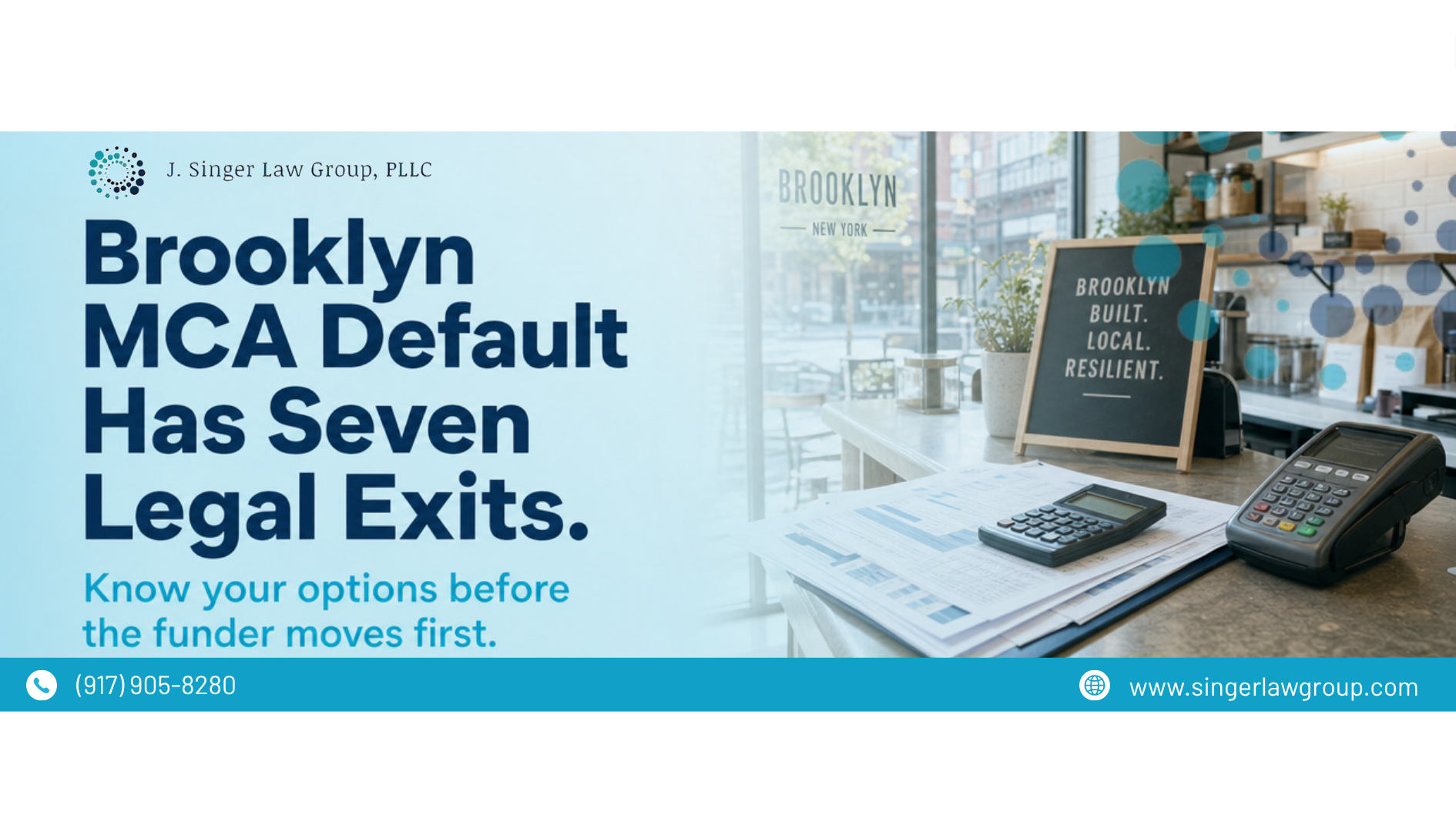
Brooklyn business owners facing MCA default have several legal options, and the one that applies to your situation depends on whether you’ve been served, whether you signed a Confession of Judgment, what enforcement has already started, and what your MCA agreement actually says.
If you own a business in Brooklyn and an MCA funder has restrained your account, filed a lawsuit, or is threatening enforcement, the first step is figuring out exactly where things stand. The sooner you understand what happened, the more time you have to evaluate your options.
What Is an MCA Default and What Does It Mean for a Brooklyn Business?
An MCA default occurs when a Brooklyn business breaches the terms of its merchant cash advance agreement, which can lead to collection activity, UCC enforcement, a lawsuit, or judgment enforcement depending on the agreement and what the funder does next.
Three terms are important to understand:
A Merchant Cash Advance (MCA) is a form of business financing generally structured as the purchase of a portion of a company’s future receivables rather than a traditional loan.
An MCA default occurs when the business violates a default provision in the agreement. That can involve missed ACH withdrawals, unauthorized additional financing, closing or changing a bank account, or another contractual breach.
A Confession of Judgment (COJ) can allow an MCA dispute to reach the judgment stage without the same litigation process a business would ordinarily expect before judgment. New York changed CPLR § 3218 in 2019, so you need to review the timing, parties, location, and circumstances of a particular COJ carefully.
How MCA Funders Define Default in New York Contracts
MCA agreements often define default broadly.
Missing an ACH withdrawal, taking another MCA in violation of the agreement, closing a designated bank account, or failing to comply with another contractual requirement can trigger a default provision.
That is why the agreement itself matters.
A Brooklyn restaurant owner who changes banks because of an operating problem can be in a very different position from a business that intentionally stopped payments after receiving a default notice. The contract, payment history, communications with the funder, and what happened before the alleged default all need to be considered together.
The Daily ACH Drain and Why Cash Flow Matters
The structural problem for many businesses is how often withdrawals occur.
Unlike a traditional monthly loan payment, MCA remittances often come out daily or weekly.
A Williamsburg retail shop, a Flatbush medical practice, or a Bay Ridge construction company may have revenue that changes week to week while withdrawals continue on a fixed schedule.
When several MCAs are involved, the pressure can become even harder to manage.
The important question is not simply whether the business missed a payment. It is why the default happened, what the agreement requires, whether reconciliation was available, and what the funder has already done in response.
What Are the Immediate Consequences of MCA Default in Brooklyn?
After an MCA default, a Brooklyn business can face continued ACH withdrawals, a lawsuit, enforcement involving receivables or other collateral, a
Confession of Judgment, or collection activity based on a judgment that has already been entered.
Understanding what happens if you default on an MCA can help a business owner identify where the dispute stands and what needs attention first.
Bank Restraints and Frozen Accounts
For a business that depends on its operating account to make payroll, pay vendors, cover rent, and purchase inventory, a bank restraint can create an immediate problem.
But the first question is how the funder reached that point.
- Was there a Confession of Judgment?
- Was a conventional lawsuit filed?
- Has a judgment already been entered?
- What amount is being claimed?
- What enforcement papers were served on the bank?
A frozen account does not automatically mean the restraint can be lifted. It does mean you should review the judgment, court record, underlying MCA agreement, and enforcement activity.
UCC Enforcement Against Your Brooklyn Business Assets
Many MCA transactions include a security agreement and a UCC-1 financing statement.
The UCC-1 itself is a public notice filing. It does not, by itself, create the funder’s security interest or establish that the funder has an unrestricted right to every business asset.
The security agreement, collateral description, filing history, perfection, competing interests, and enforcement steps all matter.
A Brooklyn business with several MCA agreements can also have several UCC filings involving overlapping collateral. When that happens, review each agreement and filing rather than assuming every funder has the same rights or priority.
Confession of Judgment and the 2019 New York Reform
New York changed its Confession of Judgment law in 2019.
For a Brooklyn business owner dealing with a COJ, the document alone does not answer every question about the judgment.
Counsel should look at when the COJ was signed, who signed it, where it was filed, what the affidavit says, whether the statutory requirements applicable to the particular confession were satisfied, and what happened after judgment was entered.
The underlying MCA agreement also matters.
A procedural challenge to a COJ and a substantive challenge to the MCA transaction are not necessarily the same thing.
If a COJ has already moved into the judgment or enforcement stage, fighting a Confession of Judgment in New York starts with understanding the documents and procedural history.
Lawsuit Deadlines and Why Waiting Creates Problems
If the funder files a conventional lawsuit, the deadline to respond depends on how service was made and the applicable New York procedural rules.
Do not assume you have a certain number of days without reviewing the summons and service information.
Missing the applicable deadline can allow the funder to seek a default judgment.
Once a judgment exists, the dispute moves into a different stage, and additional enforcement options can become available.
If your Brooklyn business receives a summons, the safest approach is to have it reviewed immediately.
Your 7 Legal Options When Facing MCA Default in Brooklyn
Brooklyn business owners facing MCA default have several possible legal paths, from responding to a lawsuit and reviewing the MCA agreement to negotiating a settlement, challenging a judgment, considering disclosure issues, exploring refinancing, or evaluating bankruptcy.
Option 1: Respond to the Lawsuit Before the Deadline Expires
Responding to the lawsuit is one of the most time-sensitive steps available.
A timely response can preserve defenses you might otherwise lose.
Those defenses depend on the case but can involve contract enforceability, service, venue, the amount claimed, the funder’s performance, reconciliation, recharacterization, or other issues raised by the agreement and facts.
If you’ve been served in Kings County or New York County Supreme Court, do not rely on a general assumption about how long you have.
Review the summons, method of service, affidavit of service, and applicable deadline.
Option 2: Determine Whether the MCA Operated as a True Purchase of Receivables
An agreement can call itself a purchase of future receivables, but that label does not necessarily end the analysis.
New York courts can examine how the transaction was structured and how it operated in practice.
Questions can include whether repayment was genuinely contingent on the business’s receivables, whether reconciliation had practical meaning, whether the term was finite, and whether the funder actually assumed the risk that receivables could decline.
If the transaction functioned more like a fixed repayment obligation than a genuine purchase of receivables, recharacterization can become part of the legal analysis.
If the transaction is legally treated as a loan, New York’s usury laws can then become relevant.
That analysis is fact-specific. A high effective rate by itself does not automatically make an MCA a usurious loan or void the agreement.
Option 3: Negotiate a Settlement, Restructure, or Seek Forbearance
Not every MCA default needs to end in prolonged litigation.
Depending on the business’s financial position and the status of the dispute, the parties can discuss a lump-sum settlement, modified payments, temporary forbearance, or a broader restructuring.
Singer Law Group’s merchant cash advance restructuring practice considers the legal and financial issues together.
That means reviewing the agreements, guarantees, UCC filings, existing litigation, enforcement pressure, cash flow, and the business’s ability to support a proposed resolution.
No standard settlement percentage or payment structure works in every MCA case.
The right terms depend on the funder, the outstanding balance, the strength of the business’s defenses, the enforcement status, available cash, and whether other MCA obligations also need to be resolved.
Option 4: Move to Vacate a Default Judgment Already Entered
A default judgment should be taken seriously, but its entry does not always mean there is nothing left to review.
Depending on the procedural history, New York law provides mechanisms for seeking relief from a default judgment.
The available grounds, required showing, and deadlines depend on how the judgment was entered and why the business defaulted.
Counsel should review the summons and complaint, affidavits of service, judgment, court docket, underlying MCA agreement, and any enforcement that followed.
If the business has a potentially valid defense to the underlying claim, that can also factor into the analysis where the applicable vacatur standard requires a meritorious defense.
The important point is to act before additional enforcement makes the problem harder to manage.
Option 5: Review Commercial Finance Disclosures
New York’s Commercial Finance Disclosure Law applies disclosure requirements to certain commercial financing transactions.
For covered MCA transactions, review the disclosure documents alongside the final agreement.
A disclosure problem does not automatically void an MCA agreement or create a private claim.
Its legal significance depends on the transaction, the applicable regulations, and the remedy being considered.
Still, if a Brooklyn business received commercial financing subject to the disclosure rules, those documents are part of the overall contract review and should not be ignored.
Option 6: Consider Whether Take-Out Financing Fits the Situation
If the underlying business remains viable but MCA payments are putting too much pressure on cash flow, refinancing can sometimes become part of a broader restructuring plan.
MCA take-out financing generally involves replacing or resolving MCA positions through a more manageable capital structure when the business qualifies.
It is not available or appropriate in every case.
Singer Law Group is a law firm, not a lender or loan broker. Independent third parties make financing decisions, and approval, timing, rates, and terms cannot be guaranteed.
The point is to determine whether refinancing actually improves the business’s position rather than simply replacing one difficult obligation with another.
Option 7: Explore Chapter 7, Chapter 11, or Subchapter V Bankruptcy
Bankruptcy becomes part of the conversation when the MCA problem is part of a larger debt and cash-flow problem that cannot realistically be solved one funder at a time.
Chapter 11 bankruptcy can allow a business to reorganize its financial obligations while continuing to operate, subject to the Bankruptcy Code and court process.
Subchapter V bankruptcy provides a streamlined Chapter 11 framework for eligible small business debtors that fall within the current statutory requirements.
Chapter 7 serves a different purpose. For a business entity, Chapter 7 generally involves liquidation, and the entity does not receive a Chapter 7 discharge.
Personal guarantees also require separate attention.
A business bankruptcy does not automatically eliminate an owner’s personal liability under a guarantee. Whether the owner has separate bankruptcy or non-bankruptcy options depends on the owner’s individual circumstances.
Brooklyn-Specific Court Procedures and Venue Issues
An MCA lawsuit involving a Brooklyn business can be filed in Kings County or another permitted venue depending on the parties, agreement, forum provisions, and applicable New York procedural rules.
Kings County vs. New York County: Where Will Your Case Be Filed?
Many MCA agreements contain New York governing-law or venue provisions.
A Brooklyn business can therefore find itself litigating outside Kings County depending on the contract and whether the selected venue is enforceable.
Do not assume the case belongs in Manhattan simply because the contract says so, and do not assume a venue provision can automatically be disregarded.
If venue is an issue, evaluate it early because procedural objections can be waived if not raised properly.
Personal Guarantees and COJ Exposure for Brooklyn-Based Owners
A personal guarantee can create exposure beyond the business itself.
But a signed guarantee does not make the LLC or corporation irrelevant, and it does not answer every question about the owner’s liability.
The guarantee needs to be reviewed.
- What obligations does it cover?
- What triggers liability?
- Are there defenses to enforcement?
- Has a judgment already been entered against the guarantor?
If a Confession of Judgment is also involved, counsel should separately review how the judgment was obtained and against whom it was entered.
New York’s Commercial Finance Disclosure Rules for Brooklyn MCA Recipients
Brooklyn businesses that entered covered commercial financing transactions should have received the disclosures required by New York law and applicable regulations.
Compare those disclosures with the final MCA agreement.
If the numbers, payment terms, fees, or other required information do not line up, the issue deserves closer review.
But a disclosure problem should not be treated as an automatic defense or a guaranteed way out of the MCA.
You need to analyze the specific violation and available remedy under the law that applies to the transaction.
Common MCA Default Myths That Can Hurt Brooklyn Business Owners
Myth: “MCAs Can’t Be Challenged as Loans”
That is too broad.
An MCA is generally structured as a purchase of future receivables, but New York courts can look beyond the contract’s label.
The real question is whether the funder purchased a contingent stream of receivables and accepted the risk that those receivables could decline, or whether the transaction functioned more like loan repayment.
Reconciliation, the agreement's term, recourse, and the transaction's actual operation can all matter.
If a court characterizes the MCA as a loan, usury issues can then become relevant.
That does not mean every MCA with fixed payments is automatically a loan or that every recharacterized transaction is automatically void.
The agreement and facts control the analysis.
Myth: “Ignoring the Lawsuit Will Make It Go Away”
Ignoring an MCA lawsuit does not solve the problem.
If the business fails to respond within the applicable deadline, the funder can seek a default judgment.
That can put the funder in a stronger enforcement position and make the dispute more difficult to address.
If you receive a summons, find out when and how service occurred and determine the response deadline immediately.
Myth: “The 2019 COJ Reform Automatically Protects Every Brooklyn Business”
The 2019 changes to New York’s Confession of Judgment law did not eliminate COJs in every commercial case.
For a Brooklyn business, the right question is not simply whether the reform exists.
You should review the actual COJ.
- When was it signed?
- Who signed it?
- Where was the debtor located?
- Where was the confession filed?
- Did the filing satisfy the requirements that applied to that particular judgment?
Those details matter.
Myth: “A Default Judgment Is the End of the Road”
A default judgment is serious, but it is not always the end of the legal analysis.
Depending on the circumstances, you may have grounds to seek vacatur or other relief.
That does not mean every default judgment can be undone.
The court will look at the applicable legal standard, procedural history, timing, reason for the default, and, where required, whether the defendant has a potentially meritorious defense.
The sooner the judgment and court file are reviewed, the clearer the available options become.
Myth: “MCA Debt Cannot Be Addressed in Bankruptcy”
MCA obligations can be addressed in bankruptcy, but the result depends on who files and what type of case is involved.
A business can potentially reorganize MCA obligations through Chapter 11 or Subchapter V if it qualifies.
A business entity filing Chapter 7 generally liquidates and does not receive a Chapter 7 discharge.
Personal guarantees are separate obligations.
A bankruptcy filed by the company generally does not automatically discharge the owner’s personal guarantee or extend the automatic stay to the nondebtor owner.
That is why you need to evaluate business debt and guarantee exposure together before filing.
How J. Singer Law Group Helps Business Owners in MCA Default
J. Singer Law Group works with businesses across the country facing MCA disputes involving litigation, settlement, restructuring, UCC enforcement issues, Confessions of Judgment, personal guarantees, and bankruptcy. The business itself does not have to be located in New York. When Singer represents a business in an MCA lawsuit, that lawsuit must be filed in New York.
An MCA default rarely exists in isolation.
The immediate problem may be a lawsuit or a restrained account. Still, the bigger issue often involves multiple funders, daily withdrawals, personal guarantees, and a business that no longer has enough operating cash to keep paying everyone on the existing schedule.
Singer Law Group looks at the entire situation before deciding what legal strategy makes sense.
Jeb Singer is the Managing Partner of J. Singer Law Group, PLLC. He was admitted to practice in New York in 2009 and founded the firm in November 2014. Earlier in his career, he clerked for the Honorable Stuart M. Bernstein of the U.S. Bankruptcy Court for the Southern District of New York.
The firm’s practice combines MCA defense with business restructuring and bankruptcy, which allows the legal and financial sides of an MCA problem to be evaluated together.
For businesses dealing with several advances or companies that promised to resolve MCA debt but made the situation worse, MCA debt consolidation fraud can raise a separate set of issues involving what was promised, what was paid, and what services were actually performed.
The firm works with businesses across the country on MCA matters. When litigation is involved, the firm represents businesses in MCA lawsuits filed in New York, including businesses located in Brooklyn, Downtown Brooklyn, DUMBO, Williamsburg, Bushwick, Flatbush, Bay Ridge, Sunset Park, Crown Heights, and Borough Park, as well as businesses located outside New York.
Common Mistakes to Avoid
- Waiting to respond to a summons. Do not assume you know the deadline based on when you opened the papers. The method and timing of service matter.
- Assuming the 2019 COJ reform automatically protects you. A Brooklyn business dealing with a COJ should have the actual document, filing, and judgment reviewed.
- Negotiating without understanding the funder’s legal position. Before agreeing to new payment terms, understand the agreement, outstanding balance, judgment status, guarantees, UCC filings, and any defenses the business has.
- Filing for bankruptcy before analyzing personal guarantee exposure. A bankruptcy filed by the business does not automatically resolve an owner’s personal guarantee.
- Overlooking commercial finance disclosures. If disclosure requirements apply to the transaction, review the documents along with the MCA agreement.
- Treating a default judgment as permanent without reviewing the court record. Depending on the facts and applicable procedural rules, you may have grounds for relief. You should review the judgment and docket before reaching that conclusion.
Frequently Asked Questions
What happens when a Brooklyn business defaults on an MCA?
What happens after an MCA default depends on the agreement and what the funder does next.
The business can face continued ACH withdrawals, collection demands, a lawsuit, UCC-related enforcement, or judgment enforcement.
If a Confession of Judgment is involved, the dispute can already be at the judgment stage when the business owner first becomes aware of the problem.
A personal guarantee can also create separate exposure for the owner.
The first step is determining exactly what has happened rather than assuming every MCA default follows the same path.
How long do I have to respond to an MCA lawsuit in Brooklyn, New York?
The deadline depends on the type of action and how service was made.
Do not rely on a general 20-day or 30-day rule without reviewing the summons and service documents.
If your Brooklyn business receives an MCA lawsuit, identify the court, index number, date and method of service, and response deadline as soon as possible.
Missing the applicable deadline can allow the funder to seek a default judgment.
Can I negotiate with an MCA funder after defaulting in New York?
Yes, negotiation can still be possible after default.
Depending on the circumstances, the parties can discuss a lump-sum settlement, modified payment schedule, forbearance, or another restructuring.
But there is no standard settlement percentage or guaranteed result.
Before negotiating, understand the funder’s claim, the business’s defenses, the outstanding balance, existing enforcement, UCC filings, guarantees, and whether other MCA obligations also need to be resolved.
Does New York’s 2019 Confession of Judgment reform protect Brooklyn business owners?
The 2019 reform changed New York’s rules governing Confessions of Judgment, particularly in situations involving out-of-state debtors.
But it should not be treated as an automatic answer for every Brooklyn business.
You need to review the COJ, affidavit, parties, dates, filing location, judgment, and underlying MCA agreement.
If a judgment has already been entered, the next question is whether there are procedural or substantive grounds to seek relief.
What is New York’s Commercial Finance Disclosure Law and how does it affect Brooklyn MCA transactions?
New York’s commercial finance disclosure requirements apply to certain covered commercial financing transactions.
For a covered MCA, review the required disclosures alongside the final agreement.
If required information is missing or inaccurate, that issue can matter.
But a disclosure problem does not automatically void the agreement or guarantee a private claim.
Courts evaluate the specific transaction and available remedies under applicable law.
Can MCA debt be addressed in bankruptcy for a Brooklyn business?
Yes.
Depending on the business and its financial situation, MCA obligations can be addressed through Chapter 11 or Subchapter V if the debtor qualifies.
Chapter 7 is different. A business entity generally uses Chapter 7 to liquidate and does not receive a Chapter 7 discharge.
If the owner signed a personal guarantee, the business’s bankruptcy generally does not automatically eliminate that separate personal obligation.
Before deciding whether bankruptcy is the right path, consider the business debt, personal guarantee, secured claims, other creditors, and overall financial condition.
The Right MCA Default Strategy Starts With the Documents
An MCA default can become complicated quickly, especially when a Brooklyn business is dealing with several funders, a lawsuit, a bank restraint, a
Confession of Judgment, UCC filings, or personal guarantees.
But your next move shouldn't be based on assumptions.
Start with the documents.
Pull every MCA agreement, amendment, personal guarantee, UCC filing, payment record, default notice, court paper, and communication with the funder.
Then determine what has actually happened.
- Has a lawsuit been filed?
- Has judgment already been entered?
- Is the operating account restrained?
- Is there more than one MCA?
- Does the agreement provide for reconciliation?
- What does the personal guarantee actually cover?
Those answers tell you far more about the available options than the word “default” by itself.
J. Singer Law Group works with business owners across the country facing MCA litigation, settlement negotiations, restructuring, Confessions of Judgment, UCC enforcement issues, and bankruptcy. The business itself does not have to be located in New York. When Singer represents a business in an MCA lawsuit, that lawsuit must be filed in New York.
If your Brooklyn business is in MCA default or a funder has already started enforcement, call J. Singer Law Group at (917) 905-8280 or contact us to discuss what has happened and what options are available.
Strategy. Not just defense.