
MCA Default in Westchester, NY: What Business Owners Must Know and Do Right Now
By Jeb Singer, Esq., Managing Partner, J. Singer Law Group, PLLC
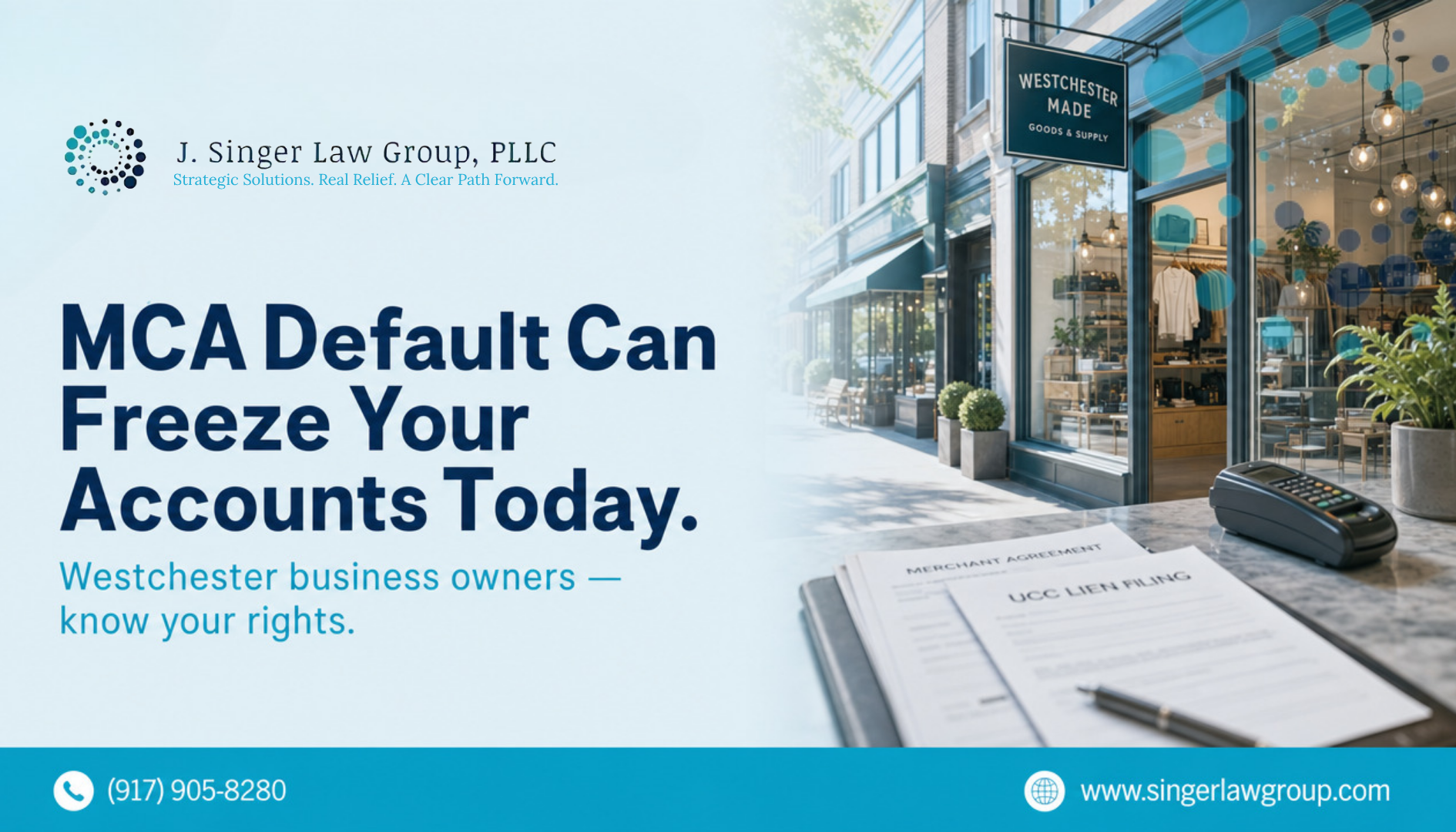
If you own a business in Westchester County and are behind on a merchant cash advance, or believe you are getting close, an MCA default can quickly put your business under serious financial pressure.
The consequences depend on the MCA agreement, the nature of the alleged default, the funder’s contractual rights, any security interests or guarantees involved, and whether collection or court proceedings have already started.
Depending on those terms and circumstances, a funder can attempt to enforce ACH rights, pursue receivables or other collateral, rely on UCC filings,
commence litigation, or pursue other remedies provided by the agreement and applicable law.
A confession of judgment can create an additional concern when properly executed and legally usable under New York law. New York’s 2019 changes to CPLR § 3218 significantly restricted the use of confessions of judgment involving out-of-state debtors, but New York businesses still need to examine whether a COJ appears in their MCA documents and what rights the funder is asserting.
For a Westchester business owner, timing matters.
Don't wait until operating cash is disrupted, a lawsuit is filed, or another enforcement step is underway to start understanding the agreement.
Pull the MCA documents.
Identify the alleged default.
Review any personal guarantee, reconciliation provision, security agreement, UCC filing, confession of judgment provision, and venue clause.
Determine what the funder has actually done and what the agreement permits it to do next.
Then evaluate the available legal and financial options before the situation becomes harder to manage.
For a business in White Plains, Yonkers, New Rochelle, Mount Vernon, or elsewhere in Westchester County, early review buys time to understand the exposure, evaluate possible defenses, consider a negotiated resolution, and determine whether a broader restructuring strategy is needed.
The time to understand the problem is before the next enforcement step, not after it.
What Is an MCA Default and Why Are Westchester Business Owners Especially Vulnerable?
An MCA default occurs when the merchant violates a default provision in the merchant cash advance agreement.
That does not always mean the business missed a payment.
The agreement itself determines what constitutes a default, which is why a Westchester business owner needs to read the actual contract before assuming what triggered the funder’s response.
A merchant cash advance (MCA) is generally structured as a purchase of a portion of a business’s future receivables rather than as a traditional loan.
That distinction matters under New York law.
Courts can look beyond the label used in the agreement and examine the transaction's substance when deciding whether an MCA is a true purchase of receivables or should be treated as a loan.
That analysis becomes particularly important when a business is evaluating defenses after default.
What Can Trigger an MCA Default?
The agreement itself generally defines an MCA default.
Depending on the contract, common default provisions can involve:
- Maintaining insufficient funds in the account connected to ACH withdrawals
- Interfering with the funder’s access to receivables
- Taking on additional financing without required consent
- Changing bank accounts without following the agreement
- Changing ownership or the structure of the business
- Providing inaccurate financial information
- Violating representations or covenants in the agreement
- Filing for bankruptcy, if the agreement identifies that event as a default
The specific language matters.
For example, a restaurant owner in White Plains or a medical practice in Yonkers could continue making scheduled remittances but still face an alleged contractual default because the business obtained additional financing without the consent required by its MCA agreement.
That is why business owners should not assume that staying current on daily or weekly withdrawals means they have satisfied every contractual obligation.
When a funder declares a default, the first question should be straightforward:
What provision of the agreement does the funder claim the business violated?
Then compare that allegation with the contract and the facts.
Why Westchester Businesses Can Face MCA Pressure
Westchester County has active commercial corridors throughout White Plains, Yonkers, New Rochelle, Mount Vernon, and surrounding communities.
Restaurants, retailers, contractors, medical practices, professional service companies, and other businesses can experience uneven cash flow even when the underlying operation remains viable.
That is one reason short-term business financing can become attractive.
The problem can develop when a business uses one MCA to cover a temporary cash-flow shortage and later takes another advance because the first MCA’s withdrawals put additional pressure on operating cash.
That can lead to MCA stacking, where the business has several advances outstanding at the same time.
Once multiple funders take daily or weekly withdrawals from the same revenue stream, the company’s cash-flow problem can become harder to control.
Payroll still needs to be met.
Vendors still need to be paid.
Rent, taxes, insurance, inventory, and operating expenses continue.
Meanwhile, several MCA funders can be asserting contractual rights against the same business.
If those funders also claim security interests in receivables or other business assets, the legal and financial issues become more complicated.
MCA Stacking Can Change the Default Analysis
A business with several MCA agreements should not evaluate each agreement in isolation.
The terms can interact.
One MCA agreement can restrict the business from obtaining additional financing without consent.
A later advance can therefore become the basis for an alleged default under an earlier agreement.
Different funders can also have UCC financing statements relating to business collateral.
That creates additional questions about the scope and priority of claimed security interests.
The business owner needs a complete picture.
How many MCA agreements are outstanding?
What does each agreement say about additional financing?
Which funders filed UCC financing statements?
What collateral is described?
Are personal guarantees involved?
What reconciliation rights appear in each agreement?
What events does each contract define as a default?
Those questions matter most when the business is already struggling to maintain enough operating cash to meet several withdrawal schedules.
An MCA Is Not Automatically Treated as a Loan Under New York Law
One of the most important distinctions in New York MCA disputes is how the law characterizes the transaction.
A properly structured purchase of future receivables is different from a traditional loan.
But calling an agreement a “merchant cash advance” does not necessarily resolve the analysis.
New York courts can examine the transaction's substance, including whether repayment is genuinely contingent on the merchant’s receivables and whether the funder actually assumed the risk of purchasing future revenue.
That distinction matters when a borrower argues that an MCA should be characterized as a loan instead.
If the transaction is treated as a true receivables purchase, traditional loan-based usury arguments generally do not apply in the same way.
If a court determines that the transaction was actually a loan, different legal issues can arise, including potential usury questions depending on the parties, agreement, rate, and other applicable requirements.
The analysis is fact-specific.
A high factor rate or high effective cost by itself does not automatically transform an MCA into a usurious loan.
The Agreement Needs to Be Reviewed Before the Defense Is Chosen
A Westchester business owner facing an MCA default should not assume every MCA is enforceable exactly as written.
The owner also should not assume that every expensive MCA can be challenged as a usurious loan.
Start with the documents.
Review the reconciliation provision.
Determine whether payments actually adjust with revenue.
Look at whether the agreement imposes a finite repayment obligation regardless of receivables.
Review the default provisions.
Examine what happens if the business experiences a legitimate decline in revenue.
Identify any personal guarantee.
Review the security agreement and UCC filings.
Determine whether additional financing created an alleged default.
That review helps establish what kind of dispute the business is actually facing.
For a Westchester company already under cash-flow pressure, understanding that distinction early can make the next decision much clearer.
The issue is not simply that an MCA payment has become difficult.
The issue is what the agreement requires, what allegedly triggered the default, what rights the funder is asserting, and what legal or restructuring options
remain available to the business.
What Happens to Your Westchester Business Within Hours of a
Declared Default?
An MCA default can move quickly.
Depending on the agreement, the funder’s security rights, existing court filings, and the circumstances of the default, a Westchester business may face collection attempts through ACH withdrawals, enforcement involving receivables or other collateral, litigation, or other remedies available under the MCA
documents and applicable law.
That is why a business owner should not assume there will always be a long period between default and enforcement.
The first step is to determine what the funder is actually entitled to do under the agreement and what enforcement steps have already been taken.
Bank Account and Receivables Pressure
Many MCA agreements authorize ACH withdrawals from a designated business bank account as part of the remittance process.
When a default is declared, the funder’s rights involving that account depend on the agreement, the authorization, the collection mechanism being used, and applicable law.
For the business owner, the practical concern is operating cash.
If substantial withdrawals continue while the business is already struggling with cash flow, the effect can reach payroll, rent, inventory, vendors, taxes, and other ordinary expenses.
Receivables can create another pressure point.
An MCA transaction is generally structured around the purchase of future receivables, and the agreement can include provisions addressing the funder’s rights to those receivables.
A business owner facing default should therefore identify:
- What account is connected to the MCA?
- What ACH authorization was signed?
- What rights does the agreement claim over receivables?
- Has the funder contacted the bank, payment processor, or customers?
- Has money already been withdrawn or redirected?
- Are multiple MCA funders asserting rights against the same revenue?
The answers help determine what's happening and what needs immediate attention.
UCC-1 Filings and Business Collateral
A UCC-1 financing statement is a public filing that provides notice of a claimed security interest in specified collateral.
MCA funders can file UCC-1 financing statements for security interests granted under their agreements.
The filing itself does not answer every question about the funder’s rights.
The underlying security agreement, the collateral description, perfection, priority, competing liens, and applicable law all matter when determining what rights a secured party can exercise after default.
For a Westchester business owner, the important issue is understanding what collateral is involved.
That can include receivables and other business assets depending on the security documents.
If several MCA funders have filed financing statements, the analysis becomes more complicated.
The business needs to identify each filing, when it was made, what collateral it describes, and how it relates to other secured creditors.
You can't assume priority based on the number of MCA agreements.
Filing dates can matter, but priority analysis depends on Article 9 of the Uniform Commercial Code, the nature of the collateral, perfection, and other facts.
Those issues can become important in a collection dispute, negotiated workout, or bankruptcy restructuring.
Confession of Judgment: A Serious Issue for New York Businesses
A confession of judgment can create significant enforcement concerns for a New York business.
Under CPLR § 3218, a confession of judgment involves a written statement in which a defendant authorizes entry of judgment based on specified facts and an identified amount.
New York changed its confession-of-judgment statute in 2019, restricting the procedure involving defendants who were not New York residents when the affidavit was executed.
For a Westchester business, that change should not be treated as a blanket prohibition on confessions of judgment.
If an MCA agreement or separate affidavit contains COJ language, the document needs careful review.
The business owner should determine whether a confession of judgment was actually executed, whether it satisfies the applicable statutory requirements, whether a judgment has been entered, where it was entered, and whether grounds exist to challenge it.
Those are document-specific and procedural questions.
A business owner should not assume that the presence of the words “confession of judgment” automatically means a valid judgment can be entered under every circumstance.
At the same time, the provision should never be ignored.
Venue Can Affect Where an MCA Dispute Is Litigated
A Westchester business should also review the venue and forum provisions in its MCA agreement.
Some MCA agreements designate New York County or another specified forum for disputes.
That can mean a business operating in Yonkers, White Plains, New Rochelle, Mount Vernon, or another Westchester community could face litigation outside Westchester County if the contractual venue provision applies.
The specific agreement controls the starting point for that analysis.
Do not assume a lawsuit has to be filed in Westchester simply because the business operates there.
And do not ignore legal papers because they came from a court in another New York county.
If a summons, judgment, restraining notice, information subpoena, or other legal document arrives, the business should identify what it is, when it was served, what deadlines apply, and what response is required.
Personal Guarantee Exposure
Many MCA agreements include some form of personal guarantee.
The language of that guarantee matters.
A guarantee can define when the funder claims the individual owner or guarantor becomes personally responsible.
Some provisions tie liability to specified conduct or contractual defaults.
Others can contain broader obligations.
The scope must be determined from the actual document, not assumed from the fact that a guarantee exists.
A business owner should review:
- Who signed the guarantee?
- What obligations are guaranteed?
- What events trigger liability?
- Does the guarantee contain limitations?
- Does it address fees, expenses, or collection costs?
- Are there separate waivers or acknowledgments?
- How does the guarantee interact with the underlying MCA agreement?
A personal guarantee also does not, by itself, determine whether the underlying MCA is a true receivables purchase or a loan.
Those are separate legal questions.
Several Enforcement Issues Can Develop at the Same Time
The most difficult MCA defaults often involve more than one issue.
A business can deal with ongoing withdrawals while also facing a UCC dispute.
A lawsuit can arrive while several MCA funders are competing for the same receivables.
A personal guarantor can face separate demands while the business is trying to maintain payroll and ordinary operations.
That is why the response should start with a complete picture, not one isolated collection event.
Identify every MCA agreement.
Identify every funder.
Pull the UCC filings.
Review the personal guarantees.
Determine whether a confession of judgment was signed or entered.
Review any lawsuit or collection papers.
Document what has happened to the business bank accounts and receivables.
Then determine which issues require immediate legal attention.
For a Westchester business owner, speed matters because MCA enforcement can pressure the cash the company needs to keep operating.
But speed should not replace analysis.
The goal is to understand exactly what rights the funder is asserting, whether the documents and applicable law support those rights, and what options
the business still has before the financial pressure becomes more difficult to control.
What Are Your Legal Rights and Defense Strategies Under New York Law?
A Westchester business facing an MCA default can have several legal and financial options depending on the agreement, the funder’s conduct, the collection activity already underway, and the facts surrounding the transaction.
Those options can include challenging whether the MCA was actually structured as a purchase of future receivables, contesting a confession of judgment, raising contract or fraud-related defenses where the facts support them, negotiating a settlement, or evaluating a broader restructuring strategy.
The right approach starts with the documents.
J. Singer Law Group’s MCA defense practice examines the MCA agreement, reconciliation provision, default language, personal guarantee, security documents, UCC filings, payment history, collection activity, and any court filings together.
That matters because MCA disputes rarely turn on a single provision.
The goal is to understand what the funder is claiming, what the agreement actually provides, and what legal or financial options are available to the business before choosing a response.
Recharacterization: Is the MCA Actually a Loan?
One of the central legal issues in New York MCA litigation is whether the transaction is a genuine purchase of future receivables or functions as a loan.
The contract label does not necessarily end the analysis.
Courts can examine the transaction's substance and whether repayment was genuinely contingent on the merchant’s future revenue.
Important considerations can include the reconciliation provisions, whether the repayment term is finite or indefinite, and how the agreement treats bankruptcy or the merchant’s inability to generate sufficient receivables.
The practical question is whether the funder genuinely assumed the risk of purchasing future receivables or whether the merchant was required to repay a fixed amount regardless of business performance.
That distinction matters.
If an MCA is treated as a true purchase of receivables, loan-based usury arguments generally do not apply in the same way.
If the court recharacterizes the transaction as a loan, it can then apply the legal rules that apply to loans, including any properly raised usury issues.
But those are separate steps.
A high factor rate or high effective annualized cost does not, by itself, establish that an MCA is a loan or that the agreement is usurious.
You must first analyze the agreement and the transaction's actual economic substance.
The Reconciliation Provision Deserves Close Attention
The reconciliation provision is an important part of that analysis.
A genuine reconciliation mechanism can allow the merchant’s remittances to adjust based on actual receivables.
That is consistent with the concept that the funder purchased a percentage of future revenue and accepted the risk that those receivables could fluctuate.
But simply including a provision labeled “reconciliation” does not answer every question.
The provision's language and operation matter.
- Can the merchant actually request an adjustment?
- What information must be provided?
- Does the funder have meaningful discretion to reject the request?
- Were payments adjusted when revenue declined?
- Does the agreement impose a fixed repayment obligation regardless of actual receivables?
- How did the parties operate under the agreement in practice?
Those facts can become important when determining whether the transaction functioned as a true receivables purchase.
Recharacterization Does Not Automatically Resolve the Case
Business owners should also understand what a recharacterization argument does and does not establish.
Showing that an MCA should be treated as a loan can change the legal analysis.
It does not automatically determine every remaining issue.
Questions involving interest, usury, enforceability, defenses, remedies, and which parties can assert particular claims still depend on applicable New
York law and the transaction's facts.
That is why an MCA defense strategy should not begin and end with the factor rate.
The stronger analysis starts with the structure of the transaction.
- Was repayment contingent on receivables?
- Was reconciliation meaningful?
- Was there a finite repayment term?
- What events constituted default?
- What happened if the merchant’s revenue declined?
- How did the funder administer the agreement?
Those questions provide a better foundation for evaluating whether a recharacterization argument exists.
Vacating a Confession of Judgment
If a confession of judgment has already been entered, the business should determine whether there are grounds to challenge it.
CPLR § 3218 contains requirements governing confessions of judgment in New York.
The particular documents, execution, affidavit, amount claimed, filing, and surrounding circumstances can all matter when evaluating whether a judgment is vulnerable to challenge.
Identify potential issues from the record.
- Was the confession properly executed?
- Does the affidavit comply with the applicable requirements?
- Is the amount entered consistent with the agreement and payment history?
- Was the judgment filed in a legally permissible venue?
- Are there issues involving fraud, misrepresentation, or another basis for relief?
The existence of a confession of judgment does not mean that vacatur is automatic.
But a business should not assume that an entered judgment is beyond review either.
When the facts and procedural record support a challenge, counsel can evaluate whether there is a basis to vacate a confession of judgment in New York.
Timing matters because an entered judgment can lead to additional enforcement activity.
Fraud and Misrepresentation Issues
Some MCA disputes involve more than the payment structure.
A business owner can contend that material representations made during the transaction were false or misleading.
The viability of a fraud or misrepresentation claim depends on the specific statements, documents, reliance, damages, contractual language, and other facts.
That means the business owner should preserve the record.
Keep emails.
Save text messages.
Retain funding proposals and term sheets.
Preserve communications with brokers or funder representatives.
Keep copies of the disclosures and documents provided before signing.
Document statements concerning reconciliation rights, repayment obligations, fees, or other material terms.
If a dispute develops later, those records can help establish what the business was told and what documents were actually provided.
Commercial Financing Disclosures Can Also Matter
New York has disclosure requirements that apply to covered commercial financing transactions.
For a business owner reviewing an MCA dispute, include the financing documents and disclosures provided before execution in the legal review.
Do not assume that a disclosure issue automatically eliminates the MCA obligation or creates a particular remedy.
The legal effect depends on the applicable requirements, the transaction, the documents, and the facts.
But the disclosures are still part of the record and should not be ignored.
Compare what was disclosed with the executed agreement.
Review the total amount provided.
Review the amount the business was expected to remit.
Identify the fees and other charges.
Compare the written terms with what the business was told during the sales process.
That review can reveal issues that deserve closer legal analysis.
Be Careful With MCA Debt Consolidation Offers
A business under MCA pressure can quickly become a target for companies offering debt consolidation, payment reduction, or “MCA relief.”
Evaluate those offers carefully.
A distressed business owner can be asked to stop paying funders and instead send money to a third-party company that promises to negotiate settlements.
That arrangement can create additional problems if the company does not resolve the underlying MCA obligations while the funders continue enforcement.
Before signing a consolidation or debt-relief agreement, understand:
- Who is receiving the business’s money?
- What services are actually being provided?
- What fees are being charged?
- Will payments to MCA funders stop?
- What happens if a funder files suit or begins enforcement?
- Is an attorney representing the business?
- What happens to the money if no settlement is reached?
A business already struggling with several MCA obligations should be cautious about adding another contract and another monthly payment without understanding exactly what it accomplishes.
Negotiated Settlement and MCA Restructuring
Not every MCA default needs to become extended litigation.
When a business can no longer sustain the current payment structure, it can consider a negotiated resolution.
Depending on the funder and circumstances, that can involve a reduced lump-sum settlement, a modified payment schedule, temporary payment relief, or another negotiated arrangement.
The appropriate structure depends on the business’s cash flow and the funder’s willingness to negotiate.
A business considering negotiating a merchant cash advance settlement should understand its legal and financial position before proposing terms.
- What can the business realistically pay?
- What does the agreement require?
- Are there viable defenses?
- Has litigation started?
- Is a judgment already entered?
- What collateral or guarantees are involved?
- Are other MCA funders competing for the same cash flow?
- Would the proposed settlement actually make the business sustainable?
Those questions matter because settling one MCA does not solve the problem if several other advances still consume the company’s operating revenue.
The Defense Strategy Should Fit the Business
A legal defense can matter, but the bigger goal is to determine what outcome lets the business move forward.
For one Westchester company, that can mean challenging a confession of judgment.
For another, it can mean negotiating a sustainable settlement.
A business with several MCA funders can need a coordinated restructuring rather than separate negotiations with each funder.
Another company can need to evaluate bankruptcy because creditor pressure extends beyond MCA debt.
The strategy should reflect the actual financial picture.
Before deciding what to do, identify every MCA agreement, every claimed default, every UCC filing, every personal guarantee, every pending lawsuit or
judgment, and the amount the business can realistically devote to debt service.
Then evaluate the legal defenses alongside the financial options.
For a Westchester business owner, the objective is not simply to find an argument against the funder.
It is to understand the legal position well enough to choose a strategy that addresses the immediate enforcement risk and the underlying financial problem.
How Can Bankruptcy Protect a Westchester Business Overwhelmed by MCA Debt?
When a Westchester business faces multiple MCA funders, lawsuits, UCC liens, judgments, or other creditor pressure at the same time, bankruptcy can provide a court-supervised framework to address the larger financial problem.
Filing a bankruptcy petition generally triggers the automatic stay under 11 U.S.C. § 362.
The stay restricts many covered collection and enforcement actions against the debtor and the bankruptcy estate's property. Depending on the circumstances, that can include certain lawsuits, judgment enforcement, foreclosure activity, and efforts to collect prepetition debts.
For a business facing several MCA obligations at once, that is fundamentally different from negotiating separately with each funder.
But bankruptcy does not automatically protect against every creditor action, and the stay does not necessarily reverse collection activity or transfers that occurred before the petition was filed.
Exceptions and limitations apply, and creditors can seek relief from the stay when a legal basis exists.
The business therefore needs to understand what bankruptcy can accomplish in its particular situation before deciding whether to file.
The Automatic Stay: Immediate Protection
The automatic stay generally takes effect when the bankruptcy petition is filed.
A separate court order is not ordinarily required for the stay to arise.
For a Westchester business dealing with active MCA collection, the stay can restrict many covered efforts to continue collecting prepetition obligations after the bankruptcy filing.
That can include certain pending lawsuits and judgment-enforcement activity.
The effect on a particular bank restraint, UCC enforcement action, receivables issue, or other collection measure depends on what occurred before the bankruptcy filing, who holds the property, the nature of the creditor’s rights, and the applicable bankruptcy rules.
That distinction matters.
A business owner should not assume that filing for bankruptcy automatically puts money already transferred before filing back into the operating account.
Likewise, bankruptcy does not automatically invalidate a secured creditor’s lien.
Instead, the bankruptcy case creates a legal framework to address the debtor’s property, creditor claims, liens, and potential restructuring.
The Automatic Stay Does Not End the Creditor Analysis
A secured creditor does not necessarily lose its rights simply because a bankruptcy case has been filed.
A creditor can ask the bankruptcy court for relief from the automatic stay when the requirements for that relief are satisfied.
The debtor can also need to address issues involving adequate protection, collateral, cash collateral, and continued business operations.
That is why an MCA-heavy bankruptcy needs to be evaluated as more than a way to stop collection calls or litigation.
The business needs a plan for what happens after filing.
- How will payroll be funded?
- What cash does the company need to operate?
- Which creditors claim security interests?
- What receivables are subject to those claims?
- Are there multiple UCC filings?
- Are personal guarantees involved?
- Can the business generate enough cash to continue operating while restructuring?
- What does a realistic reorganization look like?
The automatic stay can create important breathing room, but the business still needs to use that time to address the financial problem.
Subchapter V: A Streamlined Chapter 11 Option for Qualifying Small Businesses
For qualifying small business debtors, Subchapter V bankruptcy in New York can provide a more streamlined path through Chapter 11.
Eligibility depends on the statutory requirements in effect when the bankruptcy case is filed, including the applicable debt limit, the nature of the debtor’s business activities and debts, and other requirements and exclusions under the Bankruptcy Code.
Subchapter V has several features designed specifically for qualifying small business debtors.
The debtor generally remains in possession of the business. At the same time, the court appoints a Subchapter V trustee to perform the duties established by the Bankruptcy Code and help facilitate plan development.
An unsecured creditors’ committee is not ordinarily appointed in a Subchapter V case unless the court orders otherwise.
The plan process also follows a different schedule than a traditional Chapter 11 case.
Under 11 U.S.C. § 1189, the debtor generally must file a plan within 90 days after the order for relief. The court can extend that period when the need for an extension is attributable to circumstances for which the debtor should not justly be held accountable.
Subchapter V can also provide a path to confirmation without acceptance by every impaired class when the requirements for nonconsensual confirmation are satisfied.
This can matter for a viable business that needs to restructure but cannot obtain agreement from every creditor.
Subchapter V and MCA Debt
For a Westchester business with several MCA obligations, Subchapter V can provide a single restructuring framework that addresses the debtor’s overall financial position.
That can include questions involving MCA claims, UCC liens, personal guarantees, leases, tax obligations, trade debt, and other creditor claims.
The treatment of an MCA funder depends on the nature of its claim and rights.
A UCC-1 filing does not, by itself, answer every question about whether the funder has an enforceable and perfected security interest in particular collateral or what priority that interest holds.
Those issues can require analysis of the underlying security documents, perfection, collateral, competing liens, and applicable law.
The same is true of the MCA itself.
If the debtor contends that an MCA should be characterized as a loan rather than a true purchase of receivables, that issue can affect the legal analysis.
But recharacterization and the ultimate treatment of the funder’s claim remain fact-specific.
Subchapter V therefore gives the business a forum to address the larger creditor structure rather than assuming every MCA obligation has the same legal status.
Chapter 11 for Larger or More Complex Westchester Businesses
Traditional Chapter 11 remains an option for businesses that do not qualify for Subchapter V or whose financial structure calls for a traditional Chapter 11 process.
Through Chapter 11 Bankruptcy, a business can seek to reorganize its financial obligations while generally continuing to operate as a debtor in possession, subject to the requirements and oversight of the Bankruptcy Code and the bankruptcy court.
For a Westchester business with MCA debt, the analysis can include the validity, extent, and priority of claimed liens; the treatment of secured and unsecured claims, leases, and contracts; available cash; operating expenses; and the company’s ability to propose a feasible plan.
Traditional Chapter 11 can also involve additional procedural requirements and costs.
The appropriate chapter should therefore be chosen based on the debtor’s actual financial and legal circumstances rather than an assumption that one form of bankruptcy is always preferable.
Chapter 7: When the Business Will Not Continue Operating
Not every distressed business can or should reorganize.
If the company no longer has a viable path forward, Chapter 7 can provide a liquidation process.
For a business entity, Chapter 7 generally involves a trustee administering nonexempt estate assets and distributing available proceeds according to the priorities established by bankruptcy law.
A corporation or LLC does not receive a Chapter 7 discharge in the same way an eligible individual debtor can.
That distinction matters when business owners are evaluating what Chapter 7 actually accomplishes.
A Chapter 7 filing by the business also does not automatically eliminate an owner’s personal liability under a valid personal guarantee.
The business obligation and the guarantor’s individual exposure need to be analyzed separately.
For a sole proprietor or an individual guarantor considering personal bankruptcy, discharge questions depend on the individual debtor, the nature of the obligation, potential exceptions to discharge, and the circumstances of the case.
Chapter 7 should therefore be evaluated as a liquidation option, not as a universal way to erase MCA obligations or personal guarantees.
Bankruptcy Does Not Automatically Protect Nondebtor Guarantors
This is another important issue for Westchester business owners.
If the company files bankruptcy but the owner does not, the company’s automatic stay generally does not extend to a separate nondebtor guarantor.
That means an MCA funder may have rights against an individual guarantor that must be evaluated separately from the business's bankruptcy case.
Litigation involving nondebtor parties can raise additional bankruptcy issues, but business owners should not assume a corporate filing automatically protects them personally.
Review the guarantee.
Determine who signed it.
Identify what obligations it covers.
Determine whether litigation or a judgment already exists against the guarantor.
Then evaluate the business restructuring and individual exposure together.
Bankruptcy Should Address the Financial Problem, Not Just the Immediate Collection Pressure
A bankruptcy filing can provide meaningful protection when a viable business needs a structured way to deal with several creditors.
But filing simply to delay one MCA funder, without understanding the company’s broader financial condition, can create a new problem.
Before filing, the business should know:
- How much it owes.
- Which creditors claim collateral.
- What UCC filings exist.
- What MCA agreements are outstanding.
- What personal guarantees have been signed.
- What lawsuits or judgments are pending.
- What cash the business needs to operate.
- Whether the underlying company can generate enough revenue to support a restructuring.
- Whether a feasible plan is realistic.
Those questions help determine whether bankruptcy offers a workable path forward.
For a Westchester business overwhelmed by MCA debt, the central issue is not simply whether bankruptcy can stop a particular collection action.
It is whether the bankruptcy process can give a viable business enough structure and protection to address the debt, stabilize operations, and move
toward a sustainable financial position.
Westchester-Specific Jurisdictional Facts Every Business Owner Must Know
Where your business is located matters, but it does not necessarily determine where every MCA dispute will be handled.
A business operating in White Plains, Yonkers, New Rochelle, Mount Vernon, or elsewhere in Westchester County can find itself dealing with a lawsuit, judgment, UCC filing, or bankruptcy proceeding in a forum determined by more than its street address.
The MCA agreement, venue provisions, type of proceeding, location of the parties, and applicable state or federal law can all affect where a dispute proceeds.
That is why you should review the jurisdiction and venue provisions in the MCA documents as soon as a dispute begins.
Where MCA Lawsuits Can Be Filed
An MCA agreement can include a forum-selection or venue provision identifying where disputes must be litigated.
For a Westchester business, that can mean a lawsuit is filed outside Westchester County even though the company operates there.
The business should not assume it can ignore court papers from another New York county because the company is based in Westchester.
Review the agreement and court papers together.
If a lawsuit has already been filed, identify:
- The court and county where the action was filed
- The parties named in the lawsuit
- Whether the business owner or another guarantor is named individually
- How and when the papers were served
- The claims being asserted.
- The amount the funder says is owed.
- Whether a confession of judgment or other judgment is already involved
- The deadline for responding
Response deadlines can depend on the type of proceeding and how service was made, so a business owner should not rely on a general deadline found online or assume there is plenty of time to respond.
The actual papers and method of service need to be reviewed promptly.
Westchester Bankruptcy Cases and Federal Jurisdiction
Westchester County is within the federal Southern District of New York.
That does not mean every bankruptcy matter involving a Westchester business should be described as a Manhattan case.
Federal law governs bankruptcy venue, and the appropriate filing and court location depend on the debtor and the circumstances of the case.
For a Westchester business considering bankruptcy because of MCA debt, the more important questions are whether bankruptcy is the right restructuring tool, which chapter fits the company’s circumstances, and how the business will address creditor claims after filing.
A business owner should not choose a bankruptcy strategy based only on courthouse location.
The company’s debt structure, assets, cash flow, secured obligations, MCA agreements, personal guarantees, pending lawsuits, and ability to continue operating all matter.
New York Commercial Financing Disclosure Requirements
New York also regulates disclosures for covered commercial financing transactions.
Those requirements can apply to certain sales-based financing arrangements, including transactions structured around a business’s future receivables.
For a Westchester business reviewing an MCA dispute, collect the disclosure documents provided when the financing was offered, along with the signed agreement.
Compare the documents.
- What amount was provided to the business?
- What amount was the business expected to remit?
- What fees were disclosed?
- What payment or remittance structure was described?
- What information was provided about the cost of the financing?
- Do those documents match the final agreement?
Disclosure compliance can be relevant when evaluating the transaction. Still, a disclosure issue should not automatically be treated as proof that the MCA is unenforceable or that a particular defense or private claim exists.
The legal effect depends on the transaction, applicable requirements, and specific facts.
Check the UCC Record
A Westchester business with one or more MCA agreements should also determine whether financing statements have been filed against the company.
A UCC search can help identify UCC-1 financing statements filed under the business’s legal name.
The results can provide useful information, such as the secured party identified in the filing, the filing date, and the collateral described in the financing statement.
But you need to interpret the search results carefully.
A UCC-1 financing statement is generally a notice filing.
It does not, by itself, prove that the secured party currently has a valid and enforceable security interest in every asset described in the filing.
It also does not automatically establish that the filer has priority over every other creditor.
Answering those questions may require reviewing the underlying security agreement, the collateral covered by that agreement, how and when the interest was perfected, competing filings, amendments, continuations, terminations, and the applicable Article 9 priority rules.
Multiple UCC Filings Require a Closer Look
The analysis becomes especially important when a Westchester business has taken several merchant cash advances.
Multiple financing statements can be associated with the same business.
Do not assume that the first funder listed in a search automatically controls every asset.
Do not assume a later filing has no enforceable rights.
The priority analysis depends on the type of collateral, the security interests involved, perfection, filing history, and other applicable rules.
The business should build a complete record.
Identify each MCA funder.
When possible, match each financing statement to the underlying agreement.
Review the collateral language.
Check filing dates.
Look for amendments, continuations, assignments, and termination statements.
Identify other secured creditors, including banks or equipment lenders.
Then compare those records with what each MCA funder is claiming after default.
Personal Guarantees Can Create a Separate Jurisdictional Issue
The business’s location is also not the only consideration when an owner has signed a personal guarantee.
A lawsuit can name both the business and the guarantor.
The agreement can also contain venue or forum provisions that apply to disputes involving the guarantor.
That means the business owner should review the MCA agreement and personal guarantee together rather than treating them as unrelated documents.
Determine who signed each document.
Determine which entity received the funding.
Identify where the agreement says disputes can be brought.
Review whether the guarantor has already been named in litigation or a judgment.
Then evaluate the business’s obligations and the owner’s individual exposure separately.
Westchester Location Is Only One Part of the MCA Analysis
A business owner in Westchester should know where to file a dispute and which New York rules apply.
But geography is only one part of the problem.
The stronger analysis brings the entire record together.
- Where is the business located?
- What does the MCA agreement say about venue?
- Where has litigation actually been filed?
- What UCC financing statements exist?
- What collateral is involved?
- Were personal guarantees signed?
- Are several funders asserting rights against the same business?
- Is there already a judgment?
- Is the business considering bankruptcy or another restructuring strategy?
Once those facts are organized, the business is better positioned to understand what it is facing and what needs attention first.
For a Westchester business dealing with an MCA default, the goal isn't to determine which courthouse has jurisdiction.
It is to understand how the agreement, collection activity, UCC record, personal guarantees, and available legal options fit together before making the next decision.
Three Mistakes Westchester Business Owners Make After an MCA Default Notice
An MCA default notice can create immediate pressure.
A business owner may worry about the next ACH withdrawal, payroll, vendors, a possible lawsuit, UCC enforcement, or personal exposure under a guarantee.
That pressure can lead to quick decisions that make the situation harder to manage.
For a Westchester business owner, the better approach is to understand the agreement, identify what the funder is claiming, and evaluate the legal and financial consequences before taking the next step.
Mistake #1: Making Partial Payments Without Understanding the Effect
When a funder declares a default, a business owner may be tempted to send whatever money is available to buy more time.
That can be understandable, but a partial payment should not be made without considering how it fits into the larger dispute.
The business needs to know what the funder is asking for.
- Is the funder demanding the regular remittance?
- Has the agreement been accelerated?
- Is the funder proposing a modification or forbearance?
- Is the payment being requested as a condition of stopping another enforcement step?
- Does the funder expect the business to sign a new agreement, acknowledgment, release, or payment plan?
Those details matter.
Making a payment does not automatically eliminate every defense, but payments, written acknowledgments, modifications, and settlement
communications can affect the factual and contractual record.
Before sending money or signing new documents, understand exactly what the business is agreeing to and what happens next.
If the company cannot realistically maintain the proposed payment schedule, a short-term payment arrangement can postpone the same problem.
The goal should be a workable resolution, not another obligation the business already knows it cannot sustain.
Mistake #2: Turning to an MCA Debt-Relief Company Without Understanding the Arrangement
A business struggling with several MCA payments can be drawn to a company promising to reduce payments, consolidate obligations, or negotiate with funders.
Before signing, review how the arrangement actually works.
Some programs require the business to stop making payments to MCA funders and instead send money to the debt-relief company or into a separate account.
That does not necessarily stop an MCA funder from enforcing its own agreement.
The business owner needs to know what happens if a funder declares a default, files a lawsuit, pursues a judgment, or takes another collection step while the debt-relief program is still underway.
Ask practical questions before signing.
- Who will hold the business’s money?
- How much will the program cost?
- When are fees earned or deducted?
- Who will communicate with the MCA funders?
- Is an attorney representing the business in an actual legal dispute?
- What happens if a funder refuses to settle?
- What happens if litigation begins?
- Can the business withdraw from the program?
- What happens to money that has not yet been used for a settlement?
A company already under significant MCA pressure should understand those answers before adding another contract and another expense.
Mistake #3: Assuming New York’s 2019 Confession-of-Judgment Changes Eliminated the Risk
Another mistake is assuming that New York’s 2019 changes to the confession-of-judgment statute made every MCA confession of judgment unenforceable.
The changes significantly restricted the procedure involving defendants who were not New York residents when the affidavit was executed.
But a Westchester business should not assume that the reform automatically eliminates every confession-of-judgment issue involving a New York business.
The actual documents and filing history need to be reviewed.
- Was a confession of judgment signed?
- Who signed it?
- When was it executed?
- What amount does it identify?
- Has a judgment already been entered?
- Where was it filed?
- Does the affidavit satisfy the applicable requirements?
- Does the amount claimed match the agreement and payment history?
- Are there procedural or substantive grounds to challenge what the funder has done?
Those questions cannot be answered by relying on the 2019 reform alone.
If a confession of judgment appears anywhere in the MCA documents, treat it as an issue that needs prompt review rather than assuming it is either automatically valid or automatically unenforceable.
Do Not Make the Next Decision in Isolation
These three mistakes have something in common.
They focus on solving the immediate pressure without first understanding the entire MCA problem.
A partial payment can seem like a way to gain time.
A debt-relief program can sound like a way to reduce monthly withdrawals.
The 2019 statutory changes can sound like a reason not to worry about a confession of judgment.
But none of those assumptions answer the larger questions.
What does the MCA agreement actually require?
What event does the funder claim triggered the default?
How much has already been paid?
What does the business realistically have available for debt service?
Are other MCA agreements outstanding?
What UCC financing statements have been filed?
Has the owner signed a personal guarantee?
Is litigation already pending?
Has a judgment been entered?
Can the underlying business remain viable under its current debt load?
A Westchester business owner should understand those facts before agreeing to a new payment arrangement, signing additional documents, or assuming a particular enforcement risk no longer exists.
The next decision should fit the business’s overall legal and financial position, not simply relieve today's pressure.
What to Do Right Now: A Step-by-Step Action Plan for Westchester Business Owners
If your Westchester business is already in MCA default, or you believe a default is approaching, the next few decisions matter.
The goal is not to react to every demand as it arrives.
The goal is to organize the documents and financial information, understand what the MCA funder is claiming, identify any immediate legal deadlines, and determine what options are realistic for the business.
Step 1: Preserve Every Communication and Do Not Ignore Legal Papers
Start by creating a complete record of communications with the MCA funder, broker, servicer, collection company, or attorney.
Save emails.
Save text messages.
Keep letters and default notices.
Preserve funding proposals, term sheets, payment histories, bank records, and ACH information.
Keep copies of any settlement proposals or payment modifications.
If the business receives a summons, complaint, judgment, restraining notice, information subpoena, or other court document, do not ignore it.
Identify when and how the document was received and preserve the complete copy, including envelopes, attachments, and notices.
Legal deadlines can depend on the type of proceeding and method of service.
Waiting to address the papers can reduce the amount of time available to evaluate the business’s response.
Step 2: Pull Every MCA Agreement and Related Document
Do not review only the agreement connected to the most recent default notice.
If the business has taken several merchant cash advances, collect the complete file for every transaction.
That includes:
- MCA agreements
- Personal guarantees
- Security agreements
- ACH authorizations
- Reconciliation provisions
- Confessions of judgment or related affidavits
- Funding statements
- Commercial financing disclosures
- Payment histories
- Amendments or modifications
- Forbearance agreements
- Settlement agreements
- Default notices
- Communications concerning additional financing
Then build a basic timeline.
When did each MCA fund?
How much money did the business actually receive?
How much was the business required to remit?
How much has already been paid?
What daily or weekly withdrawals were required?
Did the business request reconciliation?
Did the payment amount ever change when revenue changed?
Was additional financing obtained later?
When did the funder first claim a default?
What happened after that notice?
A timeline can make it much easier to see how the agreements and collection activity fit together.
Step 3: Check the UCC Filings and Identify Claimed Collateral
Next, identify UCC financing statements associated with the business.
Search using the company’s correct legal name and compare the results with the MCA agreements and other secured financing.
For each relevant filing, identify:
- The secured party listed
- The filing date
- The collateral description
- Any amendments
- Any assignments
- Any continuation statements
- Any termination statements
Do not assume that a UCC-1 financing statement tells the entire story.
The filing generally provides public notice of a claimed security interest.
The underlying security agreement and applicable law determine the rights that were actually granted, while perfection and priority require their own analysis.
If several MCA funders have filings against the same business, organize them chronologically and compare the collateral descriptions.
Also identify other secured creditors, including banks, equipment lenders, or other financing providers.
This helps create a clearer picture of which creditors claim rights to the company’s assets or receivables.
Step 4: Evaluate the MCA Problem With Counsel Before Choosing a Strategy
Once the documents are organized, the business needs to determine what kind of problem it is actually facing.
Is the immediate issue a missed remittance?
Has the funder declared the entire obligation due?
Is there an active lawsuit?
Has a judgment already been entered?
Is a confession of judgment involved?
Is the funder asserting rights against receivables or other collateral?
Is the owner facing exposure under a personal guarantee?
Are several MCA funders competing for the same cash flow?
Is the underlying business still viable if the MCA pressure can be addressed?
Those answers help determine the next strategy.
For some Westchester businesses, the focus can be defending litigation or challenging a judgment.
For others, a negotiated settlement or modified payment arrangement can make sense.
A company with several MCA obligations and broader creditor pressure can need a coordinated restructuring strategy.
If the financial problem extends beyond what individual settlements can realistically solve, you also need to evaluate bankruptcy.
J. Singer Law Group approaches MCA disputes with both the immediate litigation issues and the business's broader financial condition in mind.
That distinction matters.
Stopping one collection problem does not solve the business’s financial situation if another MCA payment is due tomorrow and several other creditors are already demanding payment.
Know the Numbers Before Negotiating
Before proposing a settlement or restructuring arrangement, the business owner should understand what the company can actually afford.
Start with current operating cash.
Then account for payroll, rent, taxes, insurance, inventory, vendors, utilities, and other expenses required to keep the company running.
Review current receivables and expected revenue.
Identify all secured and unsecured obligations.
Calculate what is being withdrawn by each MCA funder.
Then determine what amount, if any, the business can realistically devote to a settlement or modified payment plan.
Do not agree to a payment simply because it is lower than the current MCA withdrawal.
The question is whether the business can sustain it.
A settlement that creates another default several weeks later does not provide a lasting solution.
Look at Every MCA Together
If the business has several merchant cash advances, evaluate them together.
One agreement can restrict additional financing.
Another can contain a personal guarantee.
Several funders can claim security interests in the same collateral category.
Different agreements can contain different reconciliation, default, venue, and enforcement provisions.
Resolving only the loudest funder does not necessarily stabilize the business.
Build one complete picture showing:
Who is owed money.
How much is claimed.
How much has already been paid.
What each agreement requires.
What collateral each funder claims.
What personal guarantees exist.
What lawsuits or judgments are pending.
What the business can realistically afford.
That information helps determine whether individual negotiations are workable or whether the company needs a broader restructuring strategy.
Do Not Wait for the Business to Run Out of Operating Cash
A business owner does not need to wait until the bank account is empty, payroll is at risk, or several lawsuits have been filed before evaluating the MCA problem.
If the company already knows that the current withdrawal schedule cannot continue, that is the time to understand the agreements and available options.
The earlier the business gets the documents organized, the easier it is to identify what requires immediate attention and what can be addressed through negotiation, litigation, or restructuring.
For a Westchester business owner, the next step should be based on the complete financial and legal picture.
Know what the agreements say.
Know what the funders are claiming.
Know what has already been filed.
Know what the business can realistically pay.
Then choose a strategy that addresses both the immediate MCA pressure and the company’s ability to continue operating.
Frequently Asked Questions
What happens if my Westchester business defaults on an MCA?
The consequences depend on the MCA agreement, the type of default, the funder’s contractual rights, any security interests or personal guarantees, and whether litigation or judgment enforcement has already started.
Depending on the circumstances, the business can face continued or attempted ACH withdrawals, demands involving receivables or collateral, a lawsuit, judgment enforcement, or claims against a personal guarantor.
Do not assume every MCA funder has the same rights or that every default follows the same process.
Start with the agreement and determine exactly what the funder claims triggered the default. Then review the security documents, UCC filings, personal guarantee, payment history, and any court papers already served or filed.
Didn’t New York’s 2019 law eliminate confessions of judgment for MCA agreements?
No. New York’s 2019 changes significantly restricted the use of confessions of judgment involving defendants who were not New York residents when the affidavit was executed. Still, the changes should not be treated as a blanket prohibition on every confession of judgment involving a New York
business.
A Westchester business that signed a confession of judgment should have the actual documents and filing history reviewed.
The relevant questions include whether the confession was properly executed, whether the statutory requirements were satisfied, where the judgment was filed, what amount was entered, and whether there are grounds to challenge the judgment.
Do not assume a confession of judgment is automatically enforceable because it was signed.
Do not assume it is automatically invalid because of the 2019 changes either.
Can I challenge my MCA as a usurious loan?
Potentially, but the analysis does not begin with the interest rate alone.
An MCA is generally structured as a purchase of future receivables, not a loan. New York courts can look at the transaction's substance when determining whether that characterization reflects how the agreement actually operates.
That analysis can include the reconciliation provision, whether repayment is genuinely contingent on receivables, whether the agreement has a finite repayment term, and how it allocates the risk of a decline in the business’s receivables.
If the transaction is legally characterized as a loan, usury issues can then become relevant depending on the borrower, rate, agreement, and applicable New York law.
A high factor rate or high effective annualized cost does not, by itself, establish that an MCA is a usurious loan.
First, review the agreement and the transaction's actual operation.
Can bankruptcy stop MCA collection activity?
A bankruptcy filing generally triggers the automatic stay under 11 U.S.C. § 362, which restricts many covered collection and enforcement actions against the debtor and property of the bankruptcy estate.
This can provide important protection for a business facing MCA lawsuits, judgment enforcement, and broader creditor pressure.
But the automatic stay is not absolute.
Exceptions and limitations apply, and creditors can seek relief from the stay when they meet the legal requirements.
Bankruptcy also does not automatically reverse every transfer, debit, restraint, or collection action that occurred before the petition was filed.
For a viable small business that qualifies, Subchapter V can provide a streamlined Chapter 11 restructuring process. You can also consider traditional Chapter 11 when Subchapter V is unavailable or the circumstances call for a different restructuring approach.
The right chapter depends on the company’s debt, assets, cash flow, secured obligations, creditor structure, and ability to continue operating.
What does a UCC lien mean for my Westchester business?
A UCC-1 financing statement generally provides public notice of a claimed security interest in the collateral described in the filing.
The filing itself does not create every right a funder claims.
The underlying security agreement is critical to determining what security interest was actually granted. Perfection, collateral, competing liens, filing history, and Article 9 priority rules can also affect the analysis.
If several MCA funders have UCC filings against the business, do not assume the first name that appears in a search automatically has priority over every asset.
Review each financing statement together with the underlying agreements and other secured obligations.
What is the first thing I should do if I think I am about to default?
Get the complete record together before making another major decision.
Pull every MCA agreement, personal guarantee, security agreement, ACH authorization, reconciliation provision, funding statement, disclosure, payment history, UCC filing, default notice, and relevant communication.
If the business has more than one MCA, review them all together.
Then determine:
- What does the business currently owe?
- What does each agreement define as a default?
- What has already been paid?
- What does each funder claim as collateral?
- Are personal guarantees involved?
- Has litigation started?
- Has a judgment already been entered?
- What can the business realistically afford after payroll and essential operating expenses?
If possible, have the situation evaluated before signing a modification, settlement, forbearance agreement, or new financing arrangement.
The earlier the business understands the complete legal and financial picture, the more time it has to evaluate its options.
Get a Second Opinion Before You Miss a Payment
If your Westchester business is struggling to keep up with MCA withdrawals, you do not need to wait for the next missed payment or default notice to start reviewing the problem.
If a default has already happened, evaluate the situation based on what actually occurred, not assumptions about what the funder can or cannot do.
Start with the documents.
Identify every MCA obligation.
Review the default provisions.
Check the UCC filings.
Determine whether personal guarantees or confessions of judgment are involved.
Look at the business’s actual cash flow.
Identify any pending lawsuits, judgments, restraints, or collection activity.
Then determine whether the situation calls for a legal defense, negotiation, restructuring, bankruptcy analysis, or a combination of those approaches.
J. Singer Law Group represents New York businesses facing merchant cash advance disputes, commercial litigation, and financial restructuring issues.
The firm’s approach is to look beyond the immediate demand and understand what is happening across the business before determining the next legal strategy.
For a Westchester business dealing with MCA pressure, that can mean evaluating the enforceability and structure of the MCA documents while also looking at UCC issues, personal guarantees, creditor claims, cash flow, pending litigation, and restructuring options.
The objective is not simply to respond to the next collection demand.
It is to determine what course of action makes sense for the business as a whole.
If your Westchester business is approaching an MCA default or is already dealing with enforcement activity, contact J. Singer Law Group to discuss the agreements, creditor activity, and available options before making the next major financial or legal decision.
Strategy. Not just defense.
About the Author
Jeb Singer, Esq. is the Managing Partner of J. Singer Law Group, PLLC. Admitted to practice in New York in 2009, he founded J. Singer Law Group in
November 2014 and has served as its Managing Partner for more than 11 years.
Earlier in his career, Jeb clerked for the Honorable Stuart M. Bernstein of the United States Bankruptcy Court for the Southern District of New York. His
practice includes merchant cash advance defense, commercial litigation, bankruptcy, and business restructuring.
That combination of litigation and restructuring experience shapes the firm’s approach to MCA matters. The immediate enforcement problem matters, but so does understanding the business's financial condition, the creditor structure, and the options available for moving forward.
This article is provided for general informational purposes only and does not constitute legal advice. Every merchant cash advance dispute, bankruptcy matter, and commercial financing agreement involves its own facts and legal issues. Reading this article does not create an attorney-client relationship.
Businesses facing an MCA default or collection action should obtain legal advice regarding their specific circumstances.