
MCA Lawsuit Against Your Trucking Company: What to Do Now
By Jeb Singer, Esq., Managing Partner, J. Singer Law Group, PLLC
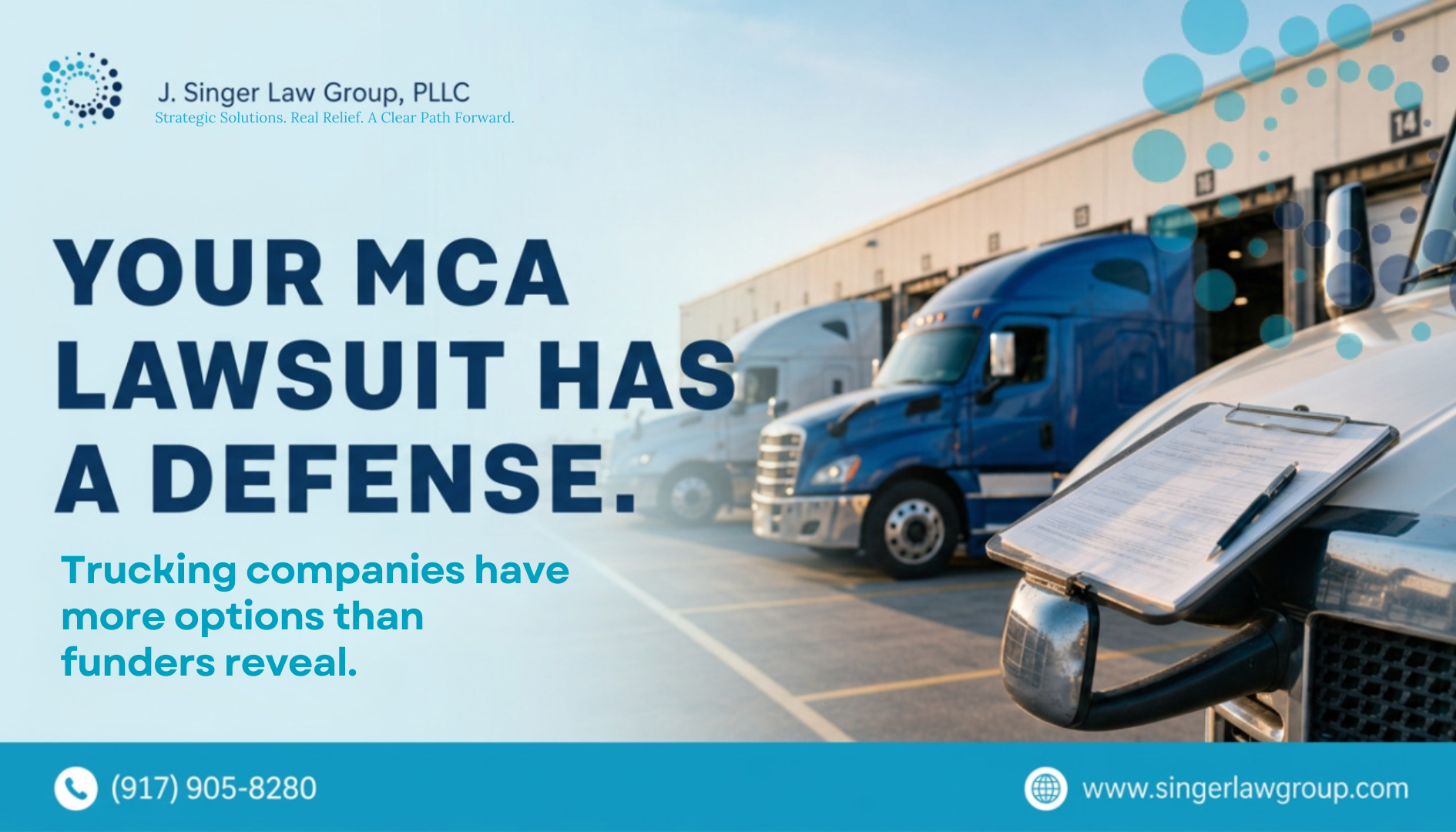
If your trucking company has been served with an
MCA lawsuit, or you woke up to a frozen operating account, the funder is already moving forward.
First, figure out exactly where the case stands and what the MCA agreement allows the funder to do next.
An MCA lawsuit against a trucking company is a legal action filed by a merchant cash advance funder to collect on an unpaid advance. Depending on the agreement and the facts, defenses can involve whether the MCA actually operated as a loan, whether a Confession of Judgment was properly used, and whether other contractual or statutory issues affect the funder’s claim.
This guide is for owner-operators and fleet companies, whether based in New York or another state, with an MCA agreement that requires disputes to be handled in New York.
If you have already received legal papers, don't wait to learn what happens next.
What Is an MCA Lawsuit and Why Are Trucking Companies Targeted?
An MCA lawsuit is a legal action filed by a merchant cash advance funder to collect on an unpaid advance.
Trucking companies can be especially vulnerable to MCA debt because their cash flow is uneven, operating costs are high, and short-term financing can become attractive when freight revenue drops or expenses spike.
The same financial pressure that leads a trucking business to take an MCA can make the daily or weekly payment difficult to sustain later.
How Merchant Cash Advances Work for Trucking Businesses
A merchant cash advance is a commercial financing arrangement in which a business receives an upfront lump sum in exchange for a portion of future receivables.
It is generally structured as a purchase of future revenue rather than a traditional loan.
That distinction matters because New York law treats a genuine purchase of receivables differently from a loan.
MCA agreements typically use a factor rate instead of a traditional interest rate.
For example, a 1.35 factor on a $100,000 advance produces a $135,000 total payback amount.
But the factor rate by itself does not determine whether the MCA is legally a loan or whether a usury defense applies.
For trucking companies, the larger problem is often the payment structure.
Fuel prices change.
Freight rates change.
Seasonal shipping patterns create stronger and weaker months.
Equipment financing, insurance premiums, repairs, and driver payroll do not necessarily fall when freight revenue does.
If the MCA continues taking the same amount while business revenue drops, cash flow can tighten quickly.
Why MCA Funders Sue in New York Even If Your Trucks Never Cross State Lines
The answer can be in the agreement.
Many MCA contracts contain New York governing-law, forum-selection, or venue provisions.
That can result in a trucking company located outside New York facing litigation in a New York court.
But the effect and enforceability of a particular provision depend on the agreement, the parties, the facts, and applicable law.
Do not assume that being headquartered in Florida, Maryland, Virginia, New Jersey, Pennsylvania, or another state means you can ignore papers from a New York court.
Likewise, do not assume that a New York venue clause automatically answers every jurisdictional question.
You need to review the agreement and the lawsuit together.
The Speed of MCA Litigation: Why Time Matters
MCA litigation can move quickly, but no one response deadline applies to every case.
The deadline depends on the court, how service was made, and the type of proceeding involved.
Write down the exact date the papers were received.
Identify the court, county, index number, plaintiff, and method of service.
Then determine the actual response deadline.
If a business fails to respond as required, the funder can seek a default judgment.
Once a judgment exists, the creditor can pursue whatever enforcement remedies are legally available.
That puts the trucking company in a very different position from a business that responds before judgment.
How a Confession of Judgment Can Affect Your Trucking Company’s Accounts
A Confession of Judgment, or COJ, is a document that can authorize entry of a judgment without going through an ordinary contested lawsuit when New York’s requirements are satisfied.
If a judgment has already been entered, the first sign can be a bank restraint rather than a summons.
For a trucking company, that can create an immediate operating problem.
What a Confession of Judgment Can Mean for a Trucking Business
Once a creditor has a valid and enforceable judgment, it can pursue judgment-enforcement remedies available under New York law.
That can include proceedings involving bank accounts and other business assets.
For a trucking company, interruption of operating cash can affect fuel purchases, driver payroll, equipment payments, insurance, repairs, and freight operations.
That is why the first step after discovering a frozen account is not to start moving money.
Find out what caused the restraint.
Ask the bank for the creditor’s name, the court and county, the index number, and information about the underlying judgment.
Then pull the MCA agreement and any Confession of Judgment documents.
New York’s 2019 COJ Reform and Out-of-State Trucking Companies
New York changed CPLR § 3218 in 2019, significantly restricting the use of Confessions of Judgment involving defendants who were not New York residents when the affidavit was executed.
For an out-of-state trucking company, that can be an important issue.
But the analysis should not begin and end with the company’s mailing address.
The COJ itself, date of execution, parties, filing, venue, and statutory requirements all need to be examined.
If a COJ was entered against your trucking company, fighting a Confession of Judgment in New York starts with determining exactly how the judgment was obtained and whether there is a valid basis to challenge it.
How to Challenge a COJ Filed Against Your Trucking Company
Challenging an entered judgment requires a different approach than responding to a newly filed lawsuit.
Potential issues can involve the COJ’s execution, filing, venue, underlying agreement, amount claimed, fraud allegations, payment history, or other procedural and substantive grounds.
Not every COJ can be vacated.
But a signed COJ does not automatically mean there is no defense.
The documents and procedural history determine what arguments are available.
If the account is already restrained, counsel should promptly review the judgment and enforcement activity to determine whether emergency court relief is warranted.
Legal Defenses Available to Trucking Companies Facing MCA Lawsuits in New York
Trucking companies facing MCA lawsuits in New York can have several defenses depending on the agreement and facts.
These can include recharacterizing the MCA as a loan, challenges involving a Confession of Judgment, contract defenses, fraud or misrepresentation issues, and disputes involving commercial financing disclosures.
These are part of the broader analysis of MCA defenses for New York businesses.
The Recharacterization Defense: Is Your MCA Actually a Loan?
One of the central questions in New York MCA litigation is whether the transaction was genuinely a purchase of future receivables or functioned as a loan.
Courts can look beyond the contract label and examine the transaction's substance.
Important questions include:
- Are the daily or weekly payments genuinely tied to actual revenue?
- Does the funder bear meaningful risk if the trucking business fails?
- Is there a real reconciliation mechanism that allows payments to adjust when receivables fall?
For trucking companies, those questions can matter because revenue can change significantly from month to month.
Freight rates drop.
Fuel costs rise.
Loads slow down.
Equipment can be out of service.
If payments continue at the same amount regardless of what the business actually earns, that fact can become part of the recharacterization analysis.
But fixed payments alone do not automatically establish that the MCA is a loan.
The agreement and the transaction's actual operation must be considered together.
If the transaction is ultimately recharacterized as a loan, New York usury law may then apply if the other statutory requirements are satisfied.
A high factor rate or high annualized cost, by itself, does not automatically constitute a usurious loan.
New York Commercial Finance Disclosure Issues
New York imposes disclosure requirements on covered commercial financing transactions.
If those requirements applied when your MCA was entered, review the financing documents and disclosures as part of the overall case.
What was disclosed?
What amount did the company receive?
What was the total repayment obligation?
What fees were included?
How was the transaction described?
A disclosure problem does not automatically eliminate an MCA obligation or create a defense in every case.
Its legal effect depends on the transaction, applicable requirements, and claims being asserted.
Fraud, Misrepresentation, and Unconscionability Claims
The communications that led to the MCA can also matter.
A broker or funder representative could have made statements about payment flexibility, reconciliation, additional financing, or other terms that do not match the final agreement or how the transaction actually operated.
Preserve those communications.
Keep emails.
Save text messages.
Retain term sheets, proposals, and other written materials.
If a material difference existed between what the trucking company was told and what happened later, evaluate those facts along with the contract.
Step-by-Step: What Your Trucking Company Should Do After Being Served
If your trucking company has been served with an MCA lawsuit in New York, the goal is to protect the business’s position before a response deadline passes or the case progresses further.
Immediate Steps
- Do not ignore the lawsuit. Identify the court, county, index number, plaintiff, service date, and applicable deadline.
- Gather the MCA documents. Pull the original agreement, amendments, payment history, personal guarantee, security agreement, reconciliation requests, broker communications, and any Confession of Judgment documents.
- Identify what has already happened. Has the funder only filed a lawsuit, or is there already a judgment? Is a bank account restrained? Are freight receivables or factoring proceeds involved?
- Speak with New York counsel. The strategy depends on whether the business is facing an active lawsuit, judgment enforcement, multiple MCA funders, or a larger financial problem.
Building Your Defense
Counsel should review the agreement and payment history to determine which legal issues actually apply.
That can include recharacterization, reconciliation rights, the validity and use of a Confession of Judgment, disclosure issues, fraud or misrepresentation, UCC claims, and other contractual defenses.
If a judgment has already been entered, challenging it may take priority.
If the case is still at the summons and complaint stage, the immediate focus is preserving the company’s defenses and responding on time.
Bankruptcy should also be considered when the MCA lawsuit is part of a larger financial problem, and the company’s operating cash is under serious pressure.
The automatic stay can provide important protection once a bankruptcy case is filed, but bankruptcy is not automatically the right solution for every trucking company.
Out-of-State Trucking Companies: Special Considerations
If your company is located outside New York, don't assume you can ignore the case.
A New York judgment can potentially be recognized and enforced in another state through the procedures available there.
That can put home-state accounts, equipment, and other assets at risk.
At the same time, jurisdiction, venue, service, and contractual forum provisions can still require legal analysis.
An out-of-state trucking company should therefore have the New York case reviewed rather than making assumptions based on where the trucks operate.
Five Mistakes Trucking Companies Make After Receiving MCA Legal Papers
- Ignoring the lawsuit or assuming it will settle itself. A failure to respond can result in a default judgment. Once that happens, the trucking company is dealing with judgment enforcement rather than defending the claim before judgment.
- Contacting the MCA funder directly without understanding the legal position. Statements about the debt, revenue, payment ability, or proposed settlements can become part of the dispute. Before signing a new agreement or making admissions, know what defenses exist and what the business can realistically afford.
- Assuming the New York venue clause does not matter because the company operates somewhere else. A venue or forum-selection provision can be significant. Its effect depends on the agreement and applicable law, but geographic distance from New York should never be treated as a reason to ignore the lawsuit.
- Accepting the first settlement offer without reviewing the defenses. Settlement terms should be evaluated against the strength of the funder’s claim, available defenses, existing judgments, personal guarantees, and the trucking company’s financial condition.
- Confusing MCA defense with debt consolidation. A company offering consolidation is not necessarily providing legal representation or resolving the existing claims. Before entering another financing or settlement arrangement, understand exactly what the company is proposing and what happens to the original MCA obligations.
Settlement, Restructuring, and Bankruptcy Options for Trucking Companies
Even after an MCA lawsuit is filed, a trucking company can have several paths available.
The right one depends on the agreement, stage of litigation, overall debt load, cash flow, number of funders, and whether the underlying trucking operation remains viable.
Negotiating an MCA Settlement During Active Litigation
MCA funders can negotiate settlements during litigation.
No standard percentage applies to every case.
Possible outcomes depend on the amount claimed, payment history, legal defenses, judgment status, personal guarantees, collateral, the trucking company's financial condition, and the parties' willingness to negotiate.
A settlement can involve a reduced lump-sum payment, revised payment structure, or other negotiated terms.
Before signing, determine whether the agreement fully resolves the funder’s claims.
What happens to any judgment?
What happens to the UCC filing?
Is the personal guarantee released?
Can the trucking company realistically make the new payments while still covering fuel, payroll, insurance, repairs, equipment financing, and operating expenses?
Understanding how to negotiate a merchant cash advance settlement starts with understanding your legal and financial position before accepting new terms.
MCA Restructuring and Take-Out Financing
For trucking companies with viable operations but an unsustainable MCA payment structure, restructuring or replacement financing may be an option.
MCA take-out financing replaces MCA obligations with another financing structure when the business qualifies.
It is not a legal defense.
It is a financial restructuring option.
Whether it works depends on the trucking company’s revenue, credit, existing debt, liens, collateral, and available financing.
If multiple MCA agreements are involved, review those obligations and UCC filings together before assuming another loan will solve the problem.
Bankruptcy Protection for Trucking Companies
When MCA debt is one part of a broader debt problem, bankruptcy can offer tools that individual settlements do not.
Chapter 11 reorganization provides a framework for a business to restructure financial obligations while generally continuing operations.
For qualifying small business debtors, Subchapter V provides streamlined Chapter 11 procedures.
Eligibility depends on the statutory requirements and debt limit in effect at the time of filing.
A bankruptcy filing generally triggers an automatic stay, which restricts many covered collection and enforcement actions against the debtor and the bankruptcy estate.
The stay is important, but it is not absolute. Creditors can seek relief from it, and the filing does not automatically reverse every restraint or transfer that occurred before bankruptcy.
The right question is whether bankruptcy provides a workable restructuring path for this particular trucking business.
Jeb Singer, Esq. is the Managing Partner of J. Singer Law Group, PLLC. He was admitted to practice in New York in 2009 and founded the firm in November 2014. Earlier in his career, he clerked for the Honorable Stuart M. Bernstein of the U.S. Bankruptcy Court for the Southern District of New York. That bankruptcy and commercial litigation background informs the firm’s approach to MCA matters, particularly when a lawsuit is only one part of a larger restructuring problem.
Why Trucking Companies Facing New York MCA Matters Work With J. Singer Law Group for MCA Defense
J. Singer Law Group works with trucking companies and other businesses across the country on MCA disputes, judgments, commercial disputes, and restructuring issues. When the firm represents a business in an MCA lawsuit, that lawsuit must be filed in New York.
The firm’s approach considers the lawsuit and the business's financial condition together.
A trucking company may face an MCA lawsuit while also dealing with equipment debt, payroll pressure, tax obligations, multiple funders, UCC filings, and personal guarantee exposure.
Solving only the lawsuit does not necessarily solve the business problem.
MCA Defense Experience in New York Courts
J. Singer Law Group works with businesses across the country on MCA matters. When litigation is involved, the firm represents businesses in MCA lawsuits filed in New York, including businesses in Manhattan, Brooklyn, Queens, the Bronx, Long Island, and Westchester, as well as businesses located outside New York.
For an out-of-state trucking company, the first step is understanding what was filed in New York and what response is required.
A Full-Service Approach: Defense, Restructuring, and Bankruptcy
Some MCA cases can be resolved through litigation or settlement.
Others require a broader restructuring analysis.
That is why Singer Law Group evaluates MCA defense alongside Chapter 11, Subchapter V, and other financial restructuring options when appropriate.
The strategy should fit the business, not the other way around.
Contact J. Singer Law Group
If your trucking company’s account is frozen, you have received an MCA lawsuit, or several MCA obligations are pressuring the business, contact J. Singer Law Group or call us at (917) 905-8280.
Frequently Asked Questions
Why is my trucking company being sued in New York if we’re based in another state?
Many MCA agreements contain New York governing-law, forum-selection, or venue provisions.
Depending on the contract and applicable law, that can result in an out-of-state trucking company facing litigation in New York.
Don't ignore the case just because the company operates elsewhere.
You need to review the agreement for jurisdiction, venue, service, and response deadlines.
What is a Confession of Judgment and how does it affect my trucking company?
A Confession of Judgment can allow entry of a judgment without the ordinary process of a contested lawsuit when New York’s legal requirements are satisfied.
If a judgment has already been entered against your trucking company, the COJ itself, execution, filing, venue, amount claimed, underlying MCA agreement, and payment history should all be examined.
For certain out-of-state defendants, New York’s 2019 changes to CPLR § 3218 can also be relevant.
A signed COJ does not automatically eliminate every possible defense, but a challenge is also not guaranteed.
Can my trucking company’s MCA be recharacterized as a loan?
Potentially.
New York courts can look at the transaction's economic substance rather than simply accepting the MCA label.
Relevant issues can include whether payments genuinely adjust with actual receivables, whether there is a meaningful reconciliation process, whether the funder bears real risk if the business fails, and whether repayment effectively operates as a fixed obligation.
If the transaction is recharacterized as a loan, additional issues under New York law can become relevant.
The analysis depends on the agreement and actual payment history.
How long do I have to respond to an MCA lawsuit in New York?
There is no one response period that should be assumed for every MCA lawsuit.
The applicable deadline depends on the court, method of service, type of proceeding, and other procedural facts.
Look at the actual papers and determine the deadline based on how service occurred.
Do not wait until the deadline is close before having the case reviewed.
What happens if I ignore the MCA lawsuit against my trucking company?
If the company does not respond as required, the funder can seek a default judgment.
Once a judgment is entered, the creditor can pursue available enforcement remedies.
A New York judgment may also be recognized and enforced in another state under that state's procedures.
The better time to evaluate defenses is before a default judgment is entered.
Can I settle an MCA lawsuit after it has already been filed?
Yes.
Settlement discussions can take place after litigation begins and, in some circumstances, even after a judgment has been entered.
A lawsuit does not prevent negotiation.
But settlement should reflect the trucking company's actual legal and financial position.
Understand the defenses, amount claimed, judgment status, collateral, guarantees, UCC filings, and what the business can afford before signing new terms.
What Your Trucking Company Should Do Next
An MCA lawsuit does not have one standard solution.
The right response depends on where the dispute stands.
Is this a newly filed lawsuit?
Has a judgment already been entered?
Is the operating account restrained?
Are freight receivables affected?
Are several MCA funders involved?
Is the trucking business still viable before accounting for the MCA payments?
Start with the documents.
Pull every MCA agreement, payment history, reconciliation request, personal guarantee, security agreement, UCC filing, broker communication, default notice, and court paper.
Then determine what has actually happened and what needs attention first.
For one trucking company, the answer can be litigation.
For another, it can be settlement or restructuring.
When MCA debt is part of a larger financial problem, you may also need to consider Chapter 11 or Subchapter V.
J. Singer Law Group works with businesses across the country facing MCA disputes, bankruptcy, and restructuring matters. When the firm represents a business in an MCA lawsuit, that lawsuit must be filed in New York.
If your trucking company has received an MCA lawsuit, is dealing with a judgment or bank restraint, or has several MCA obligations putting pressure on operations, call (917) 905-8280 to discuss the situation.
J. Singer Law Group, PLLC
Strategy. Not just defense.