
MCA Lawsuit Against Your Business? Here’s What to Do Right Now
By Jeb Singer, Esq., Managing Partner, J. Singer Law Group, PLLC | 1 Liberty Street, Suite 2327, Manhattan Financial District
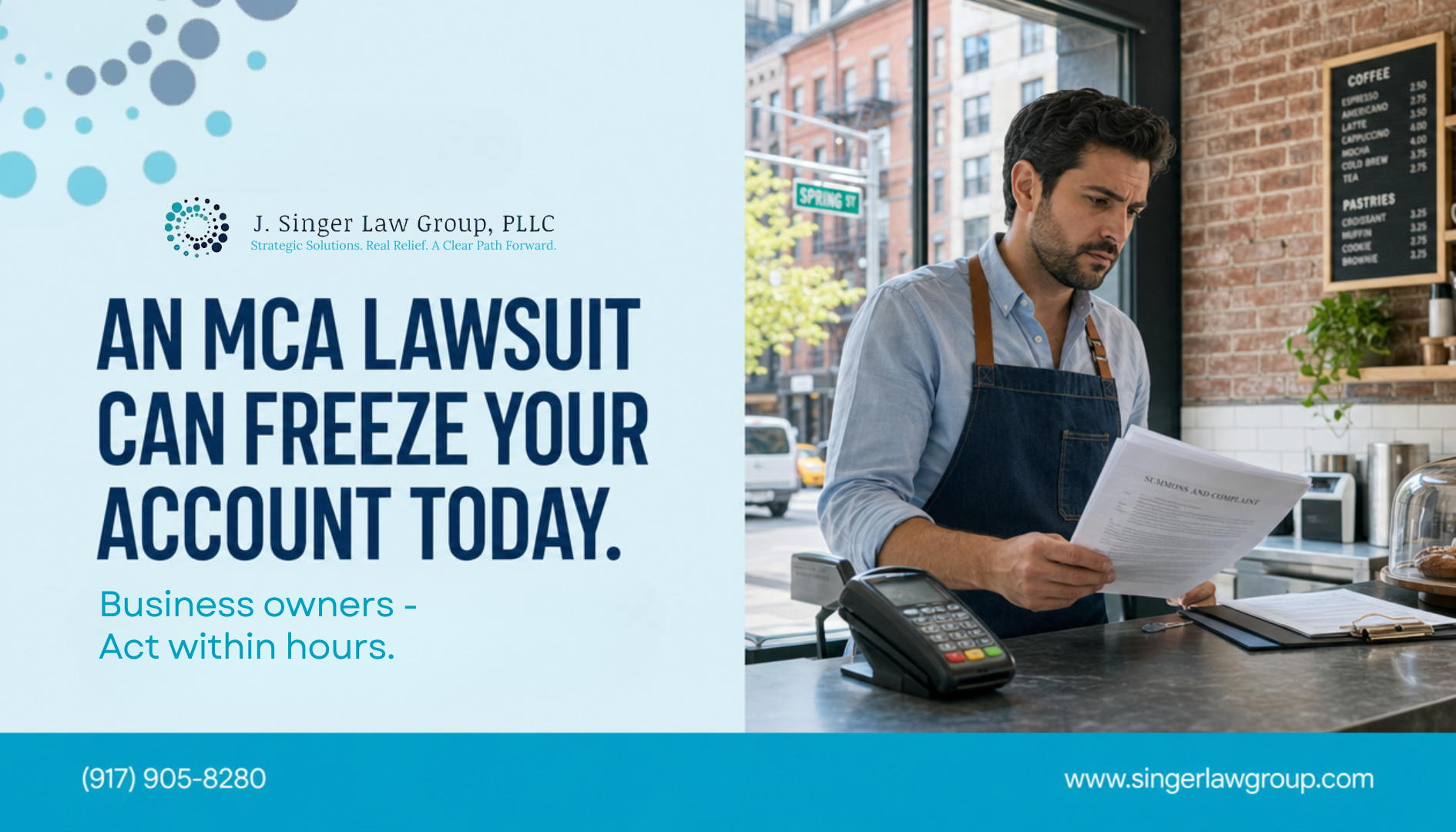
If your business was just served with an MCA lawsuit, or you woke up to a frozen operating account, the first thing to understand is where the case stands and what the funder has already done.
For the business owner facing an MCA lawsuit, one of the biggest mistakes is treating the case like an ordinary commercial dispute with plenty of time to respond.
The deadline depends on the court, how service was made, and the type of proceeding involved. If a judgment has already been entered, the issue changes.
This page explains what to do, what defenses may exist under New York law, and what outcomes are realistically possible.
A merchant cash advance (MCA) is generally structured as the purchase of a business’s future receivables in exchange for an upfront payment, rather than as a traditional loan. Funders rely on that distinction when arguing that loan-based usury laws do not apply.
But the label on the agreement does not necessarily end the legal analysis.
New York courts can look at how the transaction actually operates when deciding whether an MCA is a genuine purchase of future receivables or functions more like a loan.
A confession of judgment (COJ) is a document that can allow a creditor to obtain a judgment without going through the ordinary process of a contested lawsuit when New York’s legal requirements are satisfied.
A UCC-1 financing statement is a public filing that notifies the public that a creditor claims a security interest in specified business collateral. The filing itself does not automatically establish the validity, scope, or priority of that claimed interest.
What Is an MCA Lawsuit and Why Are Business Owners Facing New York MCA Litigation?
An MCA lawsuit is a legal action filed by a merchant cash advance funder to collect on an alleged default under an MCA agreement.
Business owners anywhere in the country can find themselves defending these cases in New York courts because many MCA agreements contain New York governing-law, forum-selection, or venue provisions.
But you still need to review the agreement.
The business's location alone does not determine where a case can be filed or whether a venue clause is enforceable.
How MCA Funders Initiate Lawsuits in New York County
An MCA dispute can begin after the funder claims the business defaulted.
Depending on the agreement, an alleged default can involve a missed ACH debit, a bank account change, additional financing, interference with receivables, or another contractual event.
If the funder files a standard lawsuit, the business needs to determine the response deadline based on the actual papers and method of service.
If a Confession of Judgment is involved, the situation can look very different because a judgment can already exist before the business understands what happened.
That is why the first question should always be:
Do you have an active lawsuit, an entered judgment, or a bank restraint?
These are different legal problems and shouldn't be handled the same way.
The Role of UCC-1 Filings in MCA Enforcement
Many MCA funders file a UCC-1 financing statement when the transaction begins.
The filing can put other creditors and potential lenders on notice that the funder claims a security interest in certain business collateral.
But a UCC-1 filing is only part of the picture.
The underlying security agreement determines what security interest was actually granted.
The collateral description, perfection, competing secured interests, filing history, amendments, assignments, and applicable priority rules can all matter.
An unresolved UCC filing can also complicate future financing or a sale of the business if it remains in the public record.
If the MCA is ultimately settled or otherwise resolved, address any related UCC filing directly.
Why Businesses Can Face Particular MCA Pressure
Businesses often operate with high fixed costs.
Commercial rent, payroll, inventory, insurance, taxes, and other expenses continue even when revenue temporarily falls.
That cash-flow pressure can make short-term financing attractive.
The problem can develop when daily or weekly MCA withdrawals continue during a slower period.
If another MCA is added to cover the first, the business can quickly find itself dealing with several payment obligations, multiple UCC filings, and more
than one funder asserting rights against the same operating revenue.
That is when a financing problem can become a litigation and restructuring problem.
Confessions of Judgment: A Fast Path to Judgment Enforcement
A Confession of Judgment can allow a creditor to obtain a judgment without going through the normal process of a contested lawsuit when New York’s statutory requirements are satisfied.
That can make a COJ especially important in an MCA dispute.
The business owner might first learn that a judgment exists when the bank receives a restraining notice.
What Changed After New York’s 2019 COJ Reform
New York changed CPLR § 3218 in 2019, significantly restricting the use of Confessions of Judgment involving defendants who were not New York residents when the affidavit was executed.
The change matters, but it should not be oversimplified.
A COJ is not automatically invalid simply because it appears in an MCA agreement.
Likewise, a signed COJ is not automatically beyond challenge.
The defendant’s residence, affidavit execution, venue, filing, amount claimed, procedural requirements, and underlying transaction all need to be examined.
How to Challenge or Vacate an Improper COJ
If a judgment has already been entered, start by reviewing the documents.
- How was the COJ signed?
- Where was it filed?
- Does the affidavit comply with the applicable requirements?
- Does the amount claimed match the agreement and payment history?
- Are there procedural issues?
- Are there separate defenses involving the underlying MCA transaction?
When the facts support a challenge, fighting a Confession of Judgment in New York can involve seeking relief from the court that entered the judgment.
The important point is timing.
Don't wait until the business has been operating under a bank restraint for weeks before finding out which judgment caused it.
Emergency Steps If Your Account Has Already Been Restrained
If the business account has already been frozen, start by finding out why.
Ask the bank for:
- The judgment creditor’s name
- The court and county
- The index number
- The amount of the restraint
- Information identifying the underlying judgment
Then gather the MCA agreement, Confession of Judgment documents, payment history, bank records, and any legal papers.
Do not move money between accounts to avoid the restraint.
Once the judgment and enforcement history are clear, counsel can evaluate whether grounds exist to challenge the judgment or seek emergency court relief.
A personal guarantee should also be reviewed separately because an individual guarantee can create exposure beyond the business entity itself.
Legal Defenses Available to Business Owners in MCA Lawsuits Filed in New York
Business owners facing MCA lawsuits filed in New York can have several defenses depending on the specific agreement and facts.
Potential issues can include recharacterization, reconciliation, fraudulent inducement, misrepresentation, Confession of Judgment defects, and other contractual or procedural defenses.
No single defense applies to every case.
The agreement and how the transaction actually operated determine what arguments are worth pursuing.
The Usury Defense: When an MCA Is Really a Loan
An MCA is not automatically subject to New York usury law simply because it is expensive.
The first question is whether the transaction is legally a loan.
New York courts can look beyond the name placed on the contract and examine the substance of the arrangement.
Important questions include:
- Is repayment genuinely tied to actual receivables?
- Is there a meaningful reconciliation process?
- Does the funder bear real risk if the business fails?
- Does the agreement operate like it has a fixed repayment obligation regardless of business performance?
If the transaction is recharacterized as a loan, New York usury law can then become part of the analysis if the other statutory requirements are satisfied.
A high factor rate or high annualized cost alone does not automatically establish criminal usury.
The Reconciliation Defense: Fixed Debits Despite Falling Revenue
Reconciliation is central to many MCA disputes.
A genuine purchase of receivables generally involves the funder accepting some risk that the business’s receivables will rise or fall.
If the agreement provides a reconciliation mechanism, ask how it worked in practice.
- Could the business request a reduction when revenue dropped?
- What documentation was required?
- Were properly submitted requests honored?
- Did the funder have broad discretion to deny reconciliation?
- Did the payment amount stay the same regardless of what the business earned?
The answers can become relevant when determining whether the transaction genuinely operated as a purchase of future receivables.
Document the ACH debits and compare them with the business’s actual revenue over the same period.
Payment history can be as important as the contract language.
Fraudulent Inducement and Deceptive Contract Terms
What the business was told before signing can also matter.
A broker or funder representative might have made statements about payment flexibility, reconciliation rights, additional financing, fees, or other important terms.
If those statements were materially different from the signed agreement or how the transaction later operated, preserve the communications.
Keep emails, text messages, term sheets, proposals, and other written records.
Whether those facts support fraud, misrepresentation, breach of contract, or another claim depends on the specific circumstances.
MCA Debt Consolidation Problems
A business already under MCA pressure can also become a target for companies offering consolidation or “debt relief.”
Before signing another agreement, find out what the company is actually doing.
- Is it negotiating existing MCAs?
- Is it offering another MCA?
- Where will your payments go?
- What fees are being charged?
- What happens if a funder files suit while the consolidation program is underway?
- Will existing UCC filings be resolved?
The firm’s MCA debt consolidation fraud practice addresses situations where a distressed business enters another arrangement that creates additional problems instead of resolving the existing MCA debt.
Step-by-Step: What to Do the Day You Are Served With an MCA Lawsuit in New York
If you are served with an MCA lawsuit, act promptly.
First, identify what was filed and what deadline applies.
Step 1: Do Not Ignore the Summons
A summons is not something to set aside while you decide whether the funder is serious.
Determine:
- The court
- County
- Index number
- Plaintiff
- Date and method of service
- Applicable response deadline
If the business fails to respond as required, the funder can seek a default judgment.
Once a judgment exists, the legal problem shifts from defending a lawsuit to enforcing the judgment.
Step 2: Gather Every MCA Document You Have
Pull every MCA agreement, addendum, amendment, personal guarantee, security agreement, reconciliation request, bank statement, payment history, broker communication, and email with the funder.
Your attorney needs the complete record.
The wording of the contract matters.
So does what actually happened after it was signed.
Step 3: Check for Frozen Accounts and UCC Filings
Check the business bank accounts and identify any unusual restraints or unavailable funds.
If an account is frozen, contact the bank and obtain information about the judgment or legal process behind the restraint.
Also identify any UCC financing statements connected to the business.
Do not assume a UCC filing means the funder owns every asset listed.
The security agreement and applicable law still matter.
Step 4: Determine Whether a COJ Was Filed
Ask counsel to determine whether a judgment has already been entered.
If a Confession of Judgment was used, review the COJ and its filing history for compliance with New York law.
Understanding Confessions of Judgment in merchant cash advance agreements is especially important when the first sign of the dispute is a bank restraint rather than a summons.
Step 5: Assess Your Recharacterization and Reconciliation Defenses
Do not begin with the assumption that a high factor rate automatically makes the MCA illegal.
Start with the transaction's structure.
- Did payments actually rise and fall with revenue?
- Was reconciliation meaningful?
- Did the funder assume a genuine risk that receivables would decline?
- Did the agreement operate like a fixed obligation?
If the MCA can be treated as a loan, transaction costs become relevant to the usury analysis.
Step 6: Explore Settlement Before Trial
Not every MCA lawsuit needs to go through full litigation.
Settlement can be considered when the terms make financial sense and adequately resolve the business’s exposure.
Singer Law Group’s merchant cash advance defense practice evaluates litigation and settlement together rather than assuming every case belongs on the same track.
The right path depends on the agreement, available defenses, judgment status, funder’s position, and the business’s ability to pay.
The Five Mistakes Business Owners Make After Receiving an MCA Lawsuit
- Ignoring the summons and allowing a default judgment to be entered. Once judgment is entered, the creditor can pursue available enforcement remedies. It is generally better to evaluate defenses before that happens.
- Calling the funder directly to negotiate without understanding your position. Statements about the debt, revenue, or ability to pay can become part of the dispute. Before signing new terms or making admissions, understand what defenses exist.
- Signing a settlement agreement before evaluating whether the MCA can be challenged. A settlement can waive defenses or replace the original agreement with new obligations. Review the MCA before giving up those rights.
- Assuming a Confession of Judgment cannot be challenged because you signed it. A signed COJ still needs to satisfy New York’s legal and procedural requirements. The underlying judgment and MCA agreement can also present separate issues.
- Engaging a debt consolidation company instead of understanding the legal problem. A consolidation company is not the same thing as litigation counsel. If a lawsuit or judgment already exists, legal representation can be necessary to protect the business’s position.
MCA Lawsuit Outcomes: What Business Owners Can Realistically Expect
MCA lawsuits can resolve in different ways.
Some cases settle.
Some involve challenges to a judgment or Confession of Judgment.
Some turn on whether the MCA is legally a purchase of receivables or a loan.
Others become part of a larger restructuring problem.
No reliable settlement percentage or guaranteed outcome applies across MCA cases.
The result depends on the agreement, payment history, available defenses, judgment status, guarantees, collateral, business finances, and the parties' willingness to negotiate.
Settlement vs. Full Litigation: Which Path Is Right for You?
Settlement can make sense when the business can obtain workable terms and avoid the cost and uncertainty of extended litigation.
But you should understand the strength of the defenses first.
A funder facing a meaningful recharacterization, reconciliation, or COJ issue can evaluate the case differently from one holding an agreement with fewer disputed terms.
Negotiating a merchant cash advance settlement starts with understanding the legal and financial position before making an offer.
A proposed settlement should also answer more than the dollar amount.
- What happens to the lawsuit?
- What happens to any judgment?
- What happens to the UCC filing?
- Is the personal guarantee released?
- Can the business realistically make the new payments?
Those details determine whether the settlement actually resolves the problem.
Can the Entire MCA Agreement Be Challenged?
Potentially.
If an MCA is legally recharacterized as a loan, additional defenses can become available depending on the agreement, borrower, rate, and applicable New York law.
But recharacterization does not happen automatically because an MCA is expensive or because the agreement includes fixed payments.
You need to analyze the entire transaction.
This includes the reconciliation provision, repayment structure, payment history, risk allocation, default terms, and the parties' actual conduct.
What Happens to UCC Filings After Resolution?
Resolving an MCA dispute does not automatically cause a UCC filing to disappear.
The settlement should clearly address what happens to any financing statement or claimed security interest associated with the resolved obligation.
If the business expects to seek new financing later, leaving an unresolved filing in place can create problems during underwriting or due diligence.
Do not assume that paying the settlement balance automatically clears the public record.
Frequently Asked Questions
What should I do first if an MCA funder sues my business in New York?
Start by identifying the lawsuit and the response deadline.
Do not ignore the papers.
Gather the MCA agreement, payment history, personal guarantee, security agreement, reconciliation requests, bank records, and any Confession of
Judgment documents.
Then determine whether you are dealing with an active lawsuit, an entered judgment, a bank restraint, or several problems at once.
Those distinctions determine what needs attention first.
Can I fight an MCA lawsuit even if I already signed the contract?
Yes, if the facts and agreement support a legal defense.
Signing the MCA does not automatically waive every possible argument.
The business can still have issues involving recharacterization, reconciliation, fraud, misrepresentation, a Confession of Judgment, or other contractual and procedural questions.
The contract is the starting point.
How the transaction actually operated also matters.
Can a New York MCA funder freeze my bank account without warning?
A creditor with an enforceable judgment can pursue judgment-enforcement remedies, including procedures that can result in a bank restraint.
If your account has been restrained, determine what judgment caused it.
Do not assume the restraint itself proves that every aspect of the underlying judgment is valid.
Review the judgment, COJ, agreement, payment history, and enforcement process together.
What is a reconciliation clause and why does it matter in an MCA lawsuit?
A reconciliation clause can allow MCA payments to adjust based on actual receivables.
That matters because a genuine purchase of future receivables should involve some risk that those receivables will fluctuate.
If payments remained fixed even when revenue declined, look at whether the agreement allowed reconciliation and whether that process actually worked.
Those facts can become important when deciding whether the MCA operated as a true receivables purchase or more like a loan.
Does the 2019 Confession of Judgment reform protect business owners?
The 2019 changes to CPLR § 3218 significantly restricted the use of Confessions of Judgment involving certain out-of-state defendants.
The effect on a particular business depends on the parties, execution, filing, venue, and statutory requirements.
The reform does not automatically invalidate every COJ.
But it can create important issues to examine once a judgment has been entered.
Can I settle an MCA lawsuit for less than the full amount claimed?
Yes, a settlement can be possible after an MCA lawsuit is filed.
No universal percentage applies to every funder.
The result depends on the agreement, the amount claimed, payment history, defenses, judgment status, guarantees, collateral, the business's financial condition, and negotiation.
The more important question is whether the proposed settlement actually resolves the dispute on terms the business can sustain.
Why Business Owners Facing New York MCA Litigation Work With
J. Singer Law Group for MCA Defense
J. Singer Law Group is located at 1 Liberty Street, Suite 2327, in Manhattan’s Financial District. It works with business owners across the country on MCA matters, including businesses facing MCA lawsuits, Confession of Judgment disputes, bank restraints, commercial litigation, bankruptcy, and restructuring matters. The business itself does not have to be located in New York. When the firm represents a business in an MCA lawsuit, that lawsuit
must be filed in New York.
The firm’s approach starts with identifying the actual problem rather than assuming every MCA case requires the same solution.
Jeb Singer, Esq. is the Managing Partner of J. Singer Law Group, PLLC. He was admitted to practice in New York in 2009 and founded the firm in
November 2014. Earlier in his career, he clerked for the Honorable Stuart M. Bernstein of the U.S. Bankruptcy Court for the Southern District of New York.
That bankruptcy and commercial litigation experience is particularly relevant when an MCA lawsuit is only one part of a larger financial problem.
The Firm’s MCA Defense Approach for Business Owners
The analysis begins with the documents.
- Is there a Confession of Judgment?
- Was a judgment entered?
- Does the MCA have a meaningful reconciliation provision?
- How did the actual payments compare with revenue?
- What personal guarantees were signed?
- What UCC filings exist?
- Are other MCA funders involved?
- Is settlement realistic?
- Does the business need a broader restructuring analysis?
Those questions help determine whether to consider litigation, settlement, restructuring, or bankruptcy.
Serving Businesses Across the Country in MCA Matters and New York MCA Litigation
J. Singer Law Group works with businesses across the country on MCA matters. When litigation is involved, the firm represents businesses in MCA lawsuits filed in New York, including businesses located outside New York.
The same basic rule applies regardless of location:
Do not ignore New York court papers simply because the business operates somewhere else.
Review the agreement, venue provisions, lawsuit, method of service, and applicable deadline before deciding what to do.
What Business Owners Should Do Next
An MCA lawsuit does not have one standard solution.
The right response depends on what has actually happened.
- Do you have a new summons and complaint?
- Has a judgment already been entered?
- Is the business account restrained?
- Is a UCC filing creating problems?
- Are several MCA funders involved?
- Is the underlying business still viable before MCA payments?
Start with the documents.
Gather every MCA agreement, payment history, reconciliation request, personal guarantee, security agreement, UCC filing, broker communication, default notice, and court paper.
Then determine what needs attention first.
For one business, that means defending a lawsuit filed in New York.
For another, it can be challenging a judgment.
Another business can benefit from settlement or restructuring.
When the MCA problem is part of a larger financial crisis, you may also need to consider bankruptcy alongside your litigation strategy.
If your business has been served with an MCA lawsuit filed in New York, has an entered judgment, or is dealing with a frozen account or another MCA-related issue, contact us or call J. Singer Law Group at (917) 905-8280.
Strategy. Not just defense.