
MCA Stacking Debt in New York: How to Stop Multiple Cash Advances From Destroying Your Business
By **Jeb Singer, Esq.**, Managing Partner, Singer Law Group
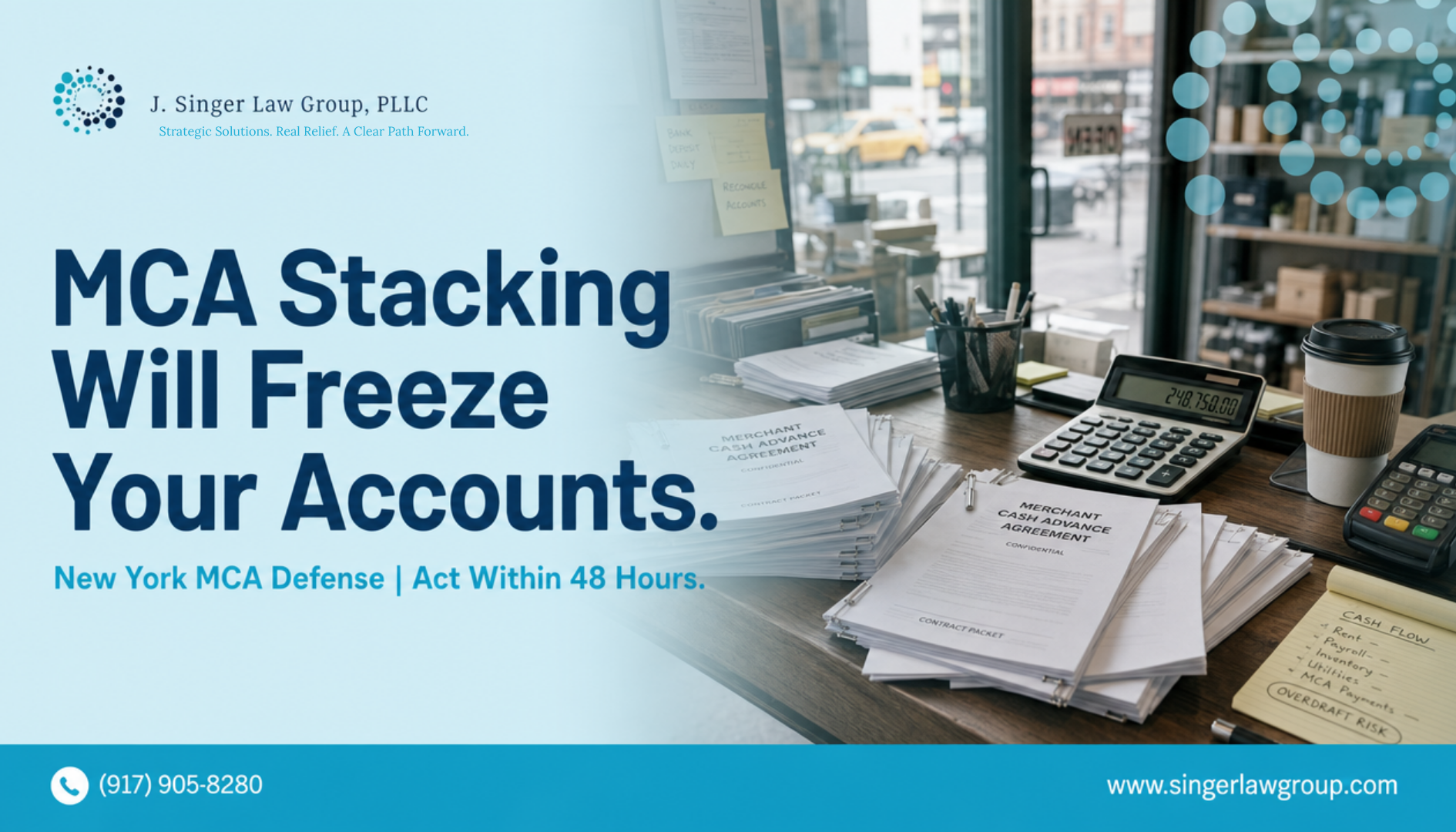
MCA stacking can turn a short-term financing problem into a much larger cash-flow crisis. A business may start with one merchant cash advance, then take a second or third advance because the first set of daily withdrawals has already reduced the cash available for payroll, rent, inventory, vendors, taxes, and other operating expenses.
The problem is not simply that several MCA agreements exist at the same time. The problem is what those agreements do to the business when each funder draws from the same revenue stream.
A company may still be generating sales and serving customers, but the combined withdrawals can leave too little cash available to support ordinary operations. When that happens, owners often feel pressure to take another advance, move money between accounts, stop payments, or agree to new terms before understanding the legal consequences.
That is where the situation can become more difficult.
The right response starts with the agreements, payment history, UCC filings, personal guarantees, and the business's financial condition. Depending on the facts, the business may need to evaluate reconciliation rights, MCA defenses, settlement, restructuring, replacement financing, a challenge to
enforcement, or bankruptcy.
Jeb Singer, Managing Partner of Singer Law Group, represents businesses in merchant cash advance disputes, commercial litigation, restructuring, and bankruptcy matters. His background includes clerking for Judge Stuart M. Bernstein in the U.S. Bankruptcy Court for the Southern District of New York.
That litigation and restructuring perspective matters in stacked MCA cases because the immediate dispute with one funder may be only one part of a larger financial problem.
Direct Answer: MCA stacking occurs when a business carries two or more merchant cash advances at the same time or takes them in rapid succession.
Each funder may collect daily or weekly payments from the same operating cash, leaving the business without enough money to cover ordinary expenses. New York businesses facing stacked MCA debt may have several options, depending on the agreements, enforcement status, and the company's financial condition, including reconciliation, legal defenses, settlement, restructuring, take-out financing, or bankruptcy. The right strategy depends on how the stack was structured and what has already happened.
What Is MCA Stacking and Why Is It a Debt Trap for New York Businesses?
MCA stacking happens when a business takes on multiple merchant cash advances before paying off earlier advances.
Each agreement may have looked manageable when it was signed. But when several funders begin withdrawing money from the same account, the combined burden can become much harder to sustain.
A business may still have healthy revenue on paper while struggling to meet payroll or buy inventory because too much operating cash leaves the account before those expenses are paid.
That is why stacking should be viewed as more than a financing issue.
Once the business has several MCA positions, UCC filings, personal guarantees, and withdrawal schedules, the legal and financial problems begin to overlap.
The business needs to understand which funder has what rights, how much is being withdrawn, whether the payments are tied to actual receivables, what happens if revenue falls, and whether the underlying business remains viable before MCA debt service.
How MCA Stacking Starts: The Survival Borrowing Cycle
A merchant cash advance is generally structured as a purchase of a portion of a business’s future receivables in exchange for an upfront payment.
The business receives capital now, and the funder collects the purchased amount through daily or weekly withdrawals tied to the merchant’s future revenue.
Stacking begins when the business takes on another MCA before the first is fully resolved.
This often happens because the first advance has already reduced the cash available for day-to-day operations.
A company may take one MCA during a slow period or to cover an immediate business need. The daily withdrawals begin. Cash becomes tighter. The owner then uses a second advance to cover payroll, rent, inventory, equipment, taxes, or another expense that the business can no longer comfortably
fund from operating revenue.
Now two funders are drawing from the same account.
If revenue drops or expenses increase, the business may take a third advance to cover the gap created by the first two.
At that point, the company can get trapped in a cycle where new financing supports payments on older financing rather than growing or stabilizing the business.
That is the danger of stacked MCA debt.
The issue is no longer one advance with difficult terms. It is the combined effect of several obligations competing for the same cash.
Why New York City Businesses Are Disproportionately Targeted
New York businesses can be especially vulnerable to MCA stacking because many industries that rely on steady working capital also operate with narrow margins and fluctuating revenue.
Restaurants, retail stores, contractors, trucking companies, medical practices, and other service businesses may have strong gross revenue but still experience periods when cash flow tightens.
That makes quick access to capital attractive.
A merchant may need money for payroll, equipment, supplies, inventory, a slow accounts-receivable cycle, or a temporary drop in sales. MCA financing solves that immediate problem because funding may be available quickly.
The difficulty begins when the payment structure does not match the business’s actual revenue.
If one MCA already consumes a meaningful portion of daily cash flow, adding another can make it harder to cover normal operating expenses. A third can make the business dependent on continued borrowing to remain current.
New York’s dense business environment can also mean that owners receive frequent financing offers from brokers and funders.
That does not mean every MCA offer is improper. It does mean business owners should understand the impact of adding another advance before committing.
The key question isn't simply whether the company qualifies for more funding.
It is whether the business can support the combined payments after accounting for payroll, rent, taxes, vendors, inventory, and other ordinary expenses.
The Math Behind Stacked MCA Debt: Factor Rates, Daily Debits, and Effective APR
The financial effect of stacking becomes clearer when you view the payments together.
Assume a business has one MCA with a daily withdrawal that represents a manageable portion of its revenue. If the company adds a second advance with another daily withdrawal, the burden doesn't stay the same. Both payments now come out of the same operating cash.
A third advance adds another layer.
The result can be a business that is still generating meaningful revenue but has too little cash left after MCA withdrawals to cover normal operations.
That is why the total payment burden matters more than looking at each agreement separately.
A business owner reviewing stacked MCA debt should calculate the combined daily or weekly withdrawals across every funder and compare that figure with actual revenue.
Then compare what remains with the company’s ordinary expenses.
If the business cannot consistently cover payroll, rent, inventory, taxes, vendors, insurance, utilities, and other operating costs after the MCA withdrawals, the current structure may not be sustainable.
The factor rate should also be reviewed in context.
A factor rate describes the relationship between the amount advanced and the amount the funder expects to receive. It does not, by itself, establish whether the transaction is a loan or determine whether a usury defense applies.
That legal analysis depends on how the agreement actually operates, including reconciliation, the collection period, and the funder’s risk if future receivables decline.
For a stacked business, the first financial question is therefore straightforward: how much of the company’s real operating revenue is being consumed by all MCA payments combined?
The answer can help determine whether the business faces a temporary cash-flow issue or a debt structure that requires a more comprehensive solution.
How UCC-1 Liens Compound the Stacking Problem
Stacked MCA debt can become more difficult when several funders claim security interests in the same business assets.
An MCA agreement may include a security agreement, and the funder may file a UCC-1 financing statement identifying receivables or other business property as collateral.
When the business has several MCA positions, it may also have several UCC filings.
Those filings can affect what the company can do next.
A business seeking replacement financing may encounter a lender unwilling to proceed while existing funders claim liens on receivables or other assets.
A sale of business property may also require review of existing security interests.
If the company is considering restructuring or bankruptcy, lien priority and the scope of the claimed collateral can become important parts of the analysis.
The existence of a UCC-1 financing statement does not automatically answer every question about the validity, scope, or priority of the funder’s claimed security interest.
You should still review the underlying security agreement and filing history.
That is especially important in a stack.
One funder may have filed first. Another may claim overlapping collateral. A third may have a judgment or personal guarantee in addition to its UCC filing.
Looking at one lien in isolation may not reveal the company’s actual financial position.
The stronger approach is to map the entire stack.
Identify every MCA funder, outstanding balance, payment amount, reconciliation provision, personal guarantee, judgment, and UCC filing.
Then evaluate how those obligations interact with one another and with the business’s current revenue.
That complete picture lets the company determine whether the next step should involve negotiation, MCA defense, restructuring, replacement financing, or another strategy.
What Legal Protections Does New York Law Provide Against MCA Stacking?
When a New York business is carrying several merchant cash advances, the fact that the agreements are labeled as purchases of future receivables does not end the legal analysis.
You need to review the agreements individually and as part of the larger stack. That means looking at how payments were structured, whether reconciliation was meaningful, what happened when revenue declined, what default provisions apply, whether Confessions of Judgment were signed, what personal guarantees exist, and what enforcement activity has already occurred.
New York law can become relevant in several ways. Depending on the facts, a business may need to evaluate whether an MCA functioned as a true purchase of future receivables or as a loan, whether a Confession of Judgment was properly used, whether required commercial financing disclosures were provided, and whether the funder’s conduct matched the terms of the agreement.
Those issues become particularly important in a stacked MCA situation because one funder’s enforcement can affect the business’s ability to deal with every other obligation. A bank restraint, judgment, or aggressive collection effort involving one MCA may quickly create problems with the rest of the stack.
The strongest approach is therefore not to assume that every MCA is enforceable exactly as written or, conversely, that every expensive MCA is automatically unlawful. The documents and actual conduct of the parties need to be reviewed before determining which defenses may be available.
New York’s Criminal Usury Cap: When MCA Becomes an Illegal Loan (Penal Law § 190.40)
Usury can become an important issue in an MCA dispute, but the analysis does not begin with the factor rate or whether it appears too high.
The first question is whether the transaction was actually a loan.
Merchant cash advances are generally structured as purchases of future receivables. In a genuine receivables purchase, the amount and timing of collection should depend to some degree on the revenue the business actually generates, and the funder assumes meaningful risk that those
receivables may not materialize as expected.
If the transaction instead operates like an absolute repayment obligation, counsel may need to examine whether the MCA should be treated as a loan despite the language used in the agreement.
Reconciliation is an important part of that review. If revenue declined, could the merchant obtain a meaningful adjustment to its payments? Was reconciliation actually available in practice? Did the business request it? If so, how did the funder respond?
The collection period also matters. A true purchase of future receivables generally contains uncertainty about how long it will take the funder to receive the purchased amount because the timing depends on the merchant’s future revenue. A payment structure that effectively creates a fixed repayment period may warrant closer examination.
The funder’s recourse is another important consideration. Counsel should review what happens when the business experiences a legitimate decline in revenue or can no longer generate the anticipated receivables. The question is whether the funder bears the risk of purchasing future receivables or whether the merchant remains effectively responsible for paying a fixed amount regardless of business performance.
If the facts support treating the MCA as a loan, New York’s usury laws may then become relevant. New York’s criminal usury provisions address annual interest exceeding 25% when the applicable statutory requirements are met.
That does not mean every MCA with a high factor rate is automatically criminally usurious or unenforceable. The transaction's legal character comes first, and whether a usury defense applies depends on the agreement, the parties, and the facts.
With a stacked portfolio, perform this analysis separately for each MCA. One agreement may operate differently from another, even when both funders are withdrawing money from the same business account.
The 2019 Confession of Judgment Reform Under CPLR § 3218
A Confession of Judgment can significantly change the enforcement posture of an MCA dispute.
A COJ is a written instrument that can allow a judgment to be entered without the ordinary process of litigating the underlying contract dispute to judgment first. For a business already struggling with several MCA payments, discovering that a judgment has been entered can make an existing cash-
flow problem considerably more serious.
New York amended CPLR § 3218 in 2019 and restricted the use of Confessions of Judgment involving certain out-of-state debtors.
For New York businesses, however, a COJ may still require careful review.
The important question is not simply whether the MCA documents contain a Confession of Judgment. Counsel should determine when it was executed, who signed it, where the debtor was located, where the judgment was filed, what the confession says, and whether the procedural requirements applicable to that particular judgment were followed.
If a judgment has already been entered, obtain the complete court record.
Review the COJ, affidavit, judgment, MCA agreement, enforcement documents, and court docket together. This can help identify whether procedural grounds exist for relief and whether the underlying MCA raises separate substantive defenses.
Understanding how a Confession of Judgment operates in MCA agreements can be especially important when several funders are involved.
One judgment may affect the company’s bank account and operating cash while payments to other MCA funders are still due. That can create a chain reaction in which enforcement by one funder contributes to defaults with the others.
The existence of a judgment does not mean it can automatically be vacated. It also does not mean the business should assume there is nothing left to review.
The procedural history, underlying agreement, and available defenses need to determine the response.
New York’s 2023 Commercial Finance Disclosure Law
New York’s commercial financing disclosure requirements are another part of the legal framework surrounding merchant cash advances.
For business owners, the practical lesson is to preserve the complete origination file rather than keeping only the final MCA agreement.
That file may include disclosures, applications, funding summaries, broker communications, emails, term sheets, payment schedules, and other documents showing how the transaction was presented before the business signed.
Those materials can become important when several MCAs have been stacked.
A business owner may remember being told that a second advance would improve cash flow, consolidate an earlier obligation, or create additional working capital. The written documents may tell a different story.
Counsel can compare the disclosures and origination materials with the final agreement and how the transaction actually operated.
Counsel should still analyze disclosure issues carefully rather than treat them as an automatic path out of an MCA.
A disclosure problem does not necessarily make an agreement unenforceable, nor does compliance with disclosure requirements establish that the transaction was a genuine purchase of future receivables.
Reconciliation, payment structure, collection period, default provisions, and risk allocation remain separate issues.
For a stacked business, preserving these documents can also help reconstruct how the company moved from one MCA into several.
That history matters.
If each new advance was obtained because an earlier MCA was already consuming too much operating cash, the origination records can help explain how the stack developed and what representations were made along the way.
The $1.065 Billion Yellowstone Capital Settlement: What It Means for New York Merchants
Broader scrutiny of merchant cash advance practices matters to New York business owners. Still, another funder’s regulatory or litigation outcome should not replace analysis of the merchant’s own agreements.
For a business carrying stacked MCA debt, the more useful question is what the company’s documents and payment history show.
- Were the advances genuine purchases of future receivables?
- Could payments adjust when revenue declined?
- Was reconciliation meaningful in practice?
- Did the funders assume real risk tied to the company’s future receivables?
- Were the business’s obligations effectively fixed regardless of performance?
- What representations were made when each new advance was originated?
- And what happened when the business could no longer support the combined withdrawals?
Those questions determine whether the business has defensible defenses.
A development involving another MCA company does not automatically invalidate a merchant’s agreement, eliminate a personal guarantee, remove a UCC filing, or create a right to a particular settlement.
The same caution applies to personal liability.
A business owner should not assume that an LLC or corporation automatically protects the individual if a personal guarantee was signed. At the same time, a guarantee should not simply be accepted at face value without reviewing its scope, the events that allegedly triggered liability, and any judgment or enforcement activity involving the guarantor.
Singer Law Group’s guidance on personal liability for merchant cash advances explains why the business obligation and the owner’s individual exposure need to be evaluated separately.
That distinction becomes even more important in a stack.
A business may have three MCA agreements with three different guarantees, several UCC filings, and one or more funders already pursuing enforcement. The owner needs to understand the exposure created by each agreement, rather than assuming one defense or settlement will resolve everything.
The practical takeaway for New York merchants is that the substance of each MCA matters more than the label.
Review the agreement, origination documents, reconciliation history, payment records, personal guarantees, UCC filings, and enforcement activity together. Once those facts are clear, the business can determine which legal protections are available and how they fit into a broader strategy for
managing the entire MCA stack.
What Are the Five Legal Defenses Against Stacked MCA Debt in New York?
A New York business carrying several merchant cash advances may have more than one issue worth reviewing. The strongest defense strategy depends on the language of each agreement, how the transactions actually operated, what happened when revenue changed, and what enforcement steps the funders have already taken.
That is why stacked MCA debt should not be treated as though every agreement presents the same defense.
One funder may have a meaningful reconciliation provision and another may not. One MCA may already be tied to a judgment or Confession of
Judgment. Another may involve questions about origination representations, disclosure documents, or UCC filings. A third may be better addressed through negotiation or restructuring rather than litigation.
Singer Law Group’s merchant cash advance defense approach starts by reviewing each MCA individually and then examining the stack as a whole. The objective is to determine which defenses the documents actually support and how they fit into the business’s broader financial position.
Defense 1: Reclassifying the MCA as a Usurious Loan
An MCA is generally structured as a purchase of future receivables rather than a traditional loan. That distinction matters because New York’s usury laws apply differently depending on the transaction's legal character.
The first question, therefore, is not whether the factor rate appears high. It is whether the MCA actually operated like a genuine purchase of receivables.
Reconciliation is one of the most important areas to examine. If the business’s revenue declined, could the merchant obtain a meaningful adjustment to the amount being withdrawn? Did the agreement provide a practical reconciliation process? Did the business request an adjustment? If so, did the
funder respond and actually change the payment?
The collection period matters too. A true purchase of future receivables generally involves some uncertainty because the amount of time required to collect the purchased receivables depends on how much revenue the business generates. If the payment structure effectively creates a fixed repayment schedule regardless of business performance, that may support closer review.
The funder’s risk is another important part of the analysis. If the business experienced a legitimate revenue decline or could no longer generate the anticipated receivables, did the funder bear that risk, or was the merchant effectively required to pay a fixed amount no matter what happened?
These questions should be answered from the agreement and the actual payment history.
If the facts support treating the transaction as a loan, New York’s usury laws may become relevant, including the criminal usury provisions under Penal Law § 190.40 when the applicable legal requirements are satisfied.
A high-cost MCA is not automatically a usurious loan. The transaction must first be examined based on how it was structured and how it actually operated.
In a stacked situation, analyze each agreement separately. Two MCAs signed by the same business can create different legal issues depending on their reconciliation provisions, payment structure, default terms, and the funder's conduct.
Defense 2: Vacating an Improper Confession of Judgment
A Confession of Judgment can turn a difficult MCA payment problem into an immediate enforcement issue.
If a funder has already obtained a judgment based on a COJ, counsel should review how that judgment was entered before assuming that the business has no remaining options.
The analysis may include when the confession was executed, who signed it, where the parties were located, where the judgment was filed, what factual
statements supported it, and whether the procedural requirements applicable to that filing were satisfied.
The underlying MCA should also be reviewed at the same time.
A procedural challenge involving the judgment and a substantive challenge involving the MCA are not necessarily the same issue. The business may have questions concerning the COJ while also having separate defenses involving reconciliation, recharacterization, default, or the funder’s conduct.
Singer Law Group’s guide on how to fight a Confession of Judgment in New York explains the types of issues business owners may need to evaluate once a COJ has been filed.
Prompt review matters when the judgment has already led to a bank restraint or other enforcement activity.
But speed should not replace analysis.
The existence of a procedural defect does not automatically mean the judgment will be vacated. The court record and applicable requirements need to
support the challenge.
For a business with several stacked MCAs, one COJ can also affect the rest of the stack. If one funder restrains the operating account, the company may suddenly be unable to pay other funders, creating additional defaults.
That is why the judgment should be evaluated as part of the broader financial problem, not in isolation.
Defense 3: Deceptive Sales Practices and Misrepresentation at Origination
The way an MCA was sold can also matter.
A business owner may have been told that payments would adjust automatically with revenue, that a new MCA would replace an earlier obligation, that the business would receive meaningful reconciliation, or that taking another advance would improve cash flow without materially increasing the
payment burden.
Compare those statements with the written documents.
Preserve emails, text messages, funding proposals, applications, term sheets, broker communications, payment illustrations, and any other materials exchanged before the MCA was signed.
The purpose is to understand what the business was told and whether those representations match the final agreement and the way the transaction actually operated.
This becomes particularly important in a stacked MCA situation.
The second or third advance may have been originated while the business was already struggling under earlier payments. If a broker or funder represented that the new transaction would solve the existing cash-flow problem, counsel should review what was promised and what actually
happened after funding.
A disagreement over a contract does not automatically establish misrepresentation.
The stronger analysis focuses on specific statements, the information available to the parties, and how those statements affected the business’s decision to enter the transaction.
For stacked MCA debt, the origination history can help explain how the company moved from one advance into several and whether the later transactions created additional legal issues.
Defense 4: Violations of the 2023 Commercial Finance Disclosure Law
Review commercial financing disclosures in the origination file for each MCA.
That means preserving more than the signed funding agreement.
The business should keep any financing disclosures, term sheets, funding summaries, broker communications, applications, payment schedules, and other documents provided before closing.
In a stacked portfolio, those records can help show what the merchant understood about the cost and structure of each new advance.
A company may have entered a second or third MCA believing it was obtaining additional working capital when the combined payment obligations left the business with less usable cash than before.
The origination materials can help establish whether the written disclosures and the actual transaction were consistent.
Still evaluate disclosure issues carefully.
A possible disclosure problem does not automatically eliminate the business’s obligation or prove that the MCA was a loan. Likewise, receiving the required documentation does not answer every question about reconciliation, recharacterization, default, or enforceability.
The disclosure review is one part of the larger analysis.
For a stacked business, it can also help reconstruct the sequence of events that led from the first advance to the current debt structure.
Defense 5: Enforcing the Reconciliation Clause
Reconciliation can be one of the most important provisions in an MCA agreement because it goes directly to the relationship between the funder’s payment and the merchant’s actual receivables.
A genuine reconciliation provision should allow the payment amount to adjust when the business’s revenue changes.
If the business generated stronger revenue when the MCA was originated and later experienced a meaningful decline, the merchant should review the
agreement to determine whether it has the right to request a corresponding adjustment.
First, read the clause itself.
What documentation does the agreement require? How must the request be submitted? How often can reconciliation be requested? What does the funder have to do after receiving the information?
Then look at what happened in practice.
If the business requested reconciliation, preserve the written request, supporting revenue records, and the funder’s response. If the funder did not respond or refused to adjust the payment, keep those communications, too.
For a business with several stacked MCAs, review reconciliation with every active funder rather than assuming one adjustment will solve the problem.
One MCA may provide a workable process. Another may use different language or impose different requirements.
If a business’s revenue has declined while several funders continue collecting the same amounts, even one meaningful payment adjustment can affect the company’s short-term cash flow.
But reconciliation should not be viewed only as a temporary cash-flow tool.
How a funder responds to a legitimate reconciliation request may also matter to the broader legal analysis of whether the MCA functioned as a true purchase of future receivables.
If the contract says the payment should move with revenue but the funder treats the payment as fixed regardless of business performance, that difference deserves closer review.
That is why you should make and document reconciliation requests carefully.
A written request supported by bank statements, POS records, financial statements, or other revenue information creates a clearer record than an informal phone conversation.
If the funder refuses to follow the reconciliation process required by the agreement, counsel can evaluate what contractual or other remedies may be available.
For a stacked business, that record may also become important during settlement negotiations or a broader restructuring.
The five defenses discussed above should not be treated as interchangeable arguments.
A business may have strong reconciliation facts but no meaningful COJ issue. Another company may have a serious judgment problem but little support for recharacterization. A third may need to focus on origination conduct or the overall debt structure rather than litigating the MCA itself.
The strongest defense is the one the documents support.
That is why the process begins with a complete review of every agreement, payment history, reconciliation record, UCC filing, guarantee, judgment, and enforcement action connected with the stack.
How Do You Get Out of Stacked MCA Debt in New York? A Step-by-Step Exit Strategy
Getting out of stacked MCA debt requires more than deciding which funder to pay first. By the time a business has two, three, or more advances drawing from the same operating account, the agreements have become part of one larger financial problem. The business needs to understand the full stack
before making decisions that could affect cash flow, legal defenses, personal exposure, or its ability to keep operating.
The right sequence depends on the facts, but the process generally begins by identifying every MCA obligation and determining how much of the business’s current revenue the combined payments consume. From there, the company can evaluate reconciliation rights, potential defenses, settlement opportunities, restructuring options, replacement financing, and, when necessary, bankruptcy.
The goal is not simply to reduce tomorrow’s withdrawals. It is to determine whether the underlying business is viable and, if so, what needs to change for it to operate without relying on another MCA to cover the last one.
Step 1: Audit Every MCA Agreement and Run a UCC Lien Search
Start by gathering every active MCA agreement and the related documents. That includes funding agreements, amendments, payment histories, reconciliation provisions, personal guarantees, Confessions of Judgment, broker communications, default notices, settlement communications, and any other documents exchanged with the funders.
Then identify the actual payment burden. Calculate how much each funder is withdrawing daily or weekly and what those payments total across the entire stack. Compare that amount with the business’s current revenue and ordinary operating expenses.
The objective is to determine what the company looks like before and after MCA payments.
A business may appear profitable based on gross revenue but have very little usable cash remaining once several funders have withdrawn their payments. Understanding that difference helps determine whether payment adjustments can realistically address the problem or whether the company needs more substantial restructuring.
The business should also identify UCC financing statements associated with the MCA agreements and review the underlying security documents. With several funders involved, claims against receivables or other business assets may overlap.
A UCC-1 filing should not automatically be treated as proof that every claimed lien is valid, properly perfected, or entitled to the priority asserted by the funder. The filing history, debtor information, collateral description, security agreement, amendments, and continuation statements may all need review.
By the end of the audit, the business should have one clear picture of the stack: who the funders are, what remains outstanding, how much is being withdrawn, what collateral is claimed, which guarantees were signed, whether any judgments exist, and what enforcement activity has already occurred.
That information becomes the foundation for every decision that follows.
Step 2: Invoke Reconciliation Rights in Writing Immediately
If an MCA agreement contains a reconciliation provision and the business’s revenue has declined, the company should determine what the contract requires to request an adjustment.
Do not rely on a phone conversation with the funder.
Review the actual reconciliation language and follow the process described in the agreement. If the contract requires bank statements, POS reports, financial statements, tax information, or other evidence of current revenue, provide the appropriate documentation with the request.
Request in writing so you have a clear record of what the business asked for, when it submitted it, what information it provided, and how the funder responded.
In a stacked situation, review each MCA agreement separately. The reconciliation provision in one contract may be different from the provision in another. Documentation requirements, timing, and the adjustment process may also vary between funders.
That makes it important to avoid sending one generic request to every company without first reviewing the agreements.
Reconciliation can serve two purposes. First, an appropriate adjustment may reduce the immediate payment burden if revenue has genuinely declined.
Second, the funder’s response can inform the broader analysis of how the transaction actually operates.
If an agreement is presented as a purchase of future receivables but the payment does not meaningfully adjust when those receivables decline, counsel may need to examine that conduct more closely.
A reconciliation request is therefore not simply a hardship request. When the contract provides a reconciliation right, treat the request as part of the agreement and document it accordingly.
Step 3: Assess Legal Defenses Before You Default
Business owners often wait until they can no longer make the scheduled payments before speaking with counsel. By then, the funder may already be preparing or pursuing the remedies provided in the MCA documents.
A better time to evaluate the agreements is when the business first recognizes that the current payment structure is becoming unsustainable.
That allows counsel to review reconciliation rights, personal guarantees, Confessions of Judgment, UCC filings, origination documents, disclosure issues, and possible recharacterization arguments before enforcement changes the company’s position.
Default should not be used as a strategy by itself.
Stopping payments may trigger contractual remedies and can lead a funder to pursue collection, a judgment, claimed collateral, or a personal guarantor depending on the agreement and circumstances. Changing bank accounts or blocking ACH withdrawals does not eliminate the underlying obligations and may create additional default issues.
If a funder has already obtained a Confession of Judgment, prompt review becomes especially important. Singer Law Group’s guidance on how to fight a Confession of Judgment in New York explains some of the issues that may need to be evaluated when a judgment has already been entered, or
enforcement has begun.
The purpose of pre-default review is not to manufacture defenses. It is to understand the rights and risks that already exist before the business makes a decision that may change the dispute's legal posture.
In a stacked MCA case, that analysis should include every active funder. A decision on one agreement can affect the rest of the stack, especially when all payments depend on the same operating account.
Step 4: Negotiate Lump-Sum Settlements With MCA Funders
Settlement can effectively resolve one or more MCA obligations, but no standard percentage applies across funders.
The result depends on the agreement, the funder, the outstanding balance, the company’s financial condition, the strength of any defenses, the enforcement status, and the amount of money realistically available to resolve the obligation.
That is why a settlement strategy should begin with the legal and financial review rather than an arbitrary target percentage.
A funder may approach negotiations differently when the merchant can document a genuine revenue decline, identify a reconciliation issue, raise a supported contract defense, or demonstrate that the current payment structure cannot continue.
The business also needs to understand how settling one MCA affects the remaining stack.
Paying a large lump sum to one funder may make little sense if doing so leaves the company without enough working capital to address two other advances. The settlement sequence should therefore be evaluated as part of the broader restructuring plan.
Singer Law Group’s guide on how to negotiate a merchant cash advance settlement explains why resolving MCA debt requires more than asking a funder for a discount.
Document any agreement with a funder carefully. The business should understand the settlement amount, payment schedule, release language, treatment of guarantees, judgment obligations, and what happens to any claimed security interest or UCC filing after it satisfies the settlement requirements.
For some businesses, settlement may be only one part of the solution.
If the company remains viable but the existing MCA structure is the primary reason cash flow has become unsustainable,MCA restructuring may also be necessary. The objective is to determine whether the existing obligations can be reorganized into a payment structure the business can actually support.
In appropriate circumstances, MCA take-out financingmay offer another path to replace expensive short-term obligations with a different financing structure. Evaluate that option carefully, because replacing one unsustainable obligation with another does not solve the underlying problem.
The business needs to know what the new financing costs, which existing obligations it will actually resolve, what liens need to be addressed, and whether the resulting payment fits the company’s real cash flow.
Step 5: When Bankruptcy Is the Right Answer — Chapter 7, Chapter 11, and Subchapter V
Bankruptcy should not be viewed as either an automatic failure or an automatic solution to stacked MCA debt.
It is one of several legal tools to evaluate when the company’s obligations can no longer be resolved through reconciliation, settlement, restructuring, or other out-of-court options.
The first question is whether the underlying business is worth preserving.
If the company has a viable operation but the debt structure has become unsustainable, a reorganization may provide a way to address multiple obligations in a single court-supervised process.
If the business is no longer viable, a different bankruptcy strategy may be appropriate.
Chapter 7 generally involves liquidation rather than reorganization. For a business that cannot continue operating and has assets that need to be
administered, Chapter 7 may be part of the analysis.
Chapter 11 allows a debtor to reorganize its financial obligations while continuing to operate, subject to the Bankruptcy Code and the facts of the case.
For qualifying small-business debtors, Subchapter V bankruptcy provides a streamlined form of Chapter 11. Eligibility depends on the requirements and debt limit in effect when the case is filed, so you need to review the company’s debt structure and circumstances before assuming Subchapter V is available.
A bankruptcy filing generally triggers the automatic stay, which can stop many collection actions against the debtor involving prepetition obligations. But you need to understand the scope of the stay correctly.
A business bankruptcy does not automatically protect a separate individual guarantor from collection simply because the company filed for bankruptcy.
If the owner has personally guaranteed one or more MCA obligations, evaluate business and personal exposure separately.
That distinction can be critical in a stacked MCA case.
The company may have several funders pursuing the business while one or more of those funders also claim rights against the owner personally. A restructuring strategy that addresses only the company without examining the guarantees may leave a significant part of the problem unresolved.
Singer Law Group evaluates bankruptcy alongside MCA litigation and restructuring rather than treating it as a separate issue that begins only after every other option has failed.
Jeb Singer previously served as a law clerk to Judge Stuart M. Bernstein in the U.S. Bankruptcy Court for the Southern District of New York. Ira Reid served as a law clerk to Judge Cecelia H. Goetz in the U.S. Bankruptcy Court for the Eastern District of New York and later spent approximately two decades as a restructuring partner at Baker McKenzie.
That background matters because the decision to file for bankruptcy should come from the business's economics and the available legal options. Some companies need an out-of-court resolution. Others need a court-supervised restructuring. The right answer depends on what gives a viable business the strongest path forward.
Five Mistakes New York Merchants Make When Stacked MCA Debt Hits
1. Defaulting without consulting an attorney first.
Waiting until the business has already stopped making payments can reduce the amount of time available to evaluate the agreements before enforcement begins. A default may trigger remedies under the MCA documents, including collection efforts, enforcement against claimed collateral, litigation, or action involving a personal guarantee.
Business owners who see the problem developing should have the agreements reviewed before unilaterally stopping payments. This allows you to evaluate reconciliation provisions, COJs, guarantees, UCC filings, and other potential defenses while the company still has a chance to plan its response.
2. Switching banks as a primary strategy.
Moving the operating account or blocking ACH withdrawals may interrupt payments, but it does not resolve the MCA agreements.
Depending on the contract, interfering with the designated account may also trigger a default or additional enforcement rights.
The larger problem remains the same: the business still owes whatever obligations are enforceable under the agreements, and the funders may pursue other collection remedies.
Changing banks should therefore not be confused with a debt-resolution strategy. The company needs a plan for the underlying stack, not a temporary way to interrupt withdrawals.
3. Hiring a non-attorney debt settlement company.
A settlement company and a law firm serve different roles.
A non-attorney company may be able to communicate with creditors and attempt to negotiate payment arrangements. Still, it cannot provide the same legal representation when the dispute involves litigation, a Confession of Judgment, questions about contract enforceability, UCC issues, or bankruptcy.
That difference matters when an MCA funder moves from negotiation to enforcement.
Business owners should also be careful when a company promises to “consolidate” several MCAs without clearly explaining how it will resolve the existing obligations. Singer Law Group has identified warning signs of MCA debt consolidation fraud, including situations where a supposed solution leaves the merchant with another expensive obligation instead of eliminating the underlying stack.
Before paying a settlement or consolidation company, understand what service is actually being offered, whether the company can represent you if litigation begins, and whether the proposed transaction genuinely reduces the debt burden.
4. Assuming bankruptcy is the only option.
Stacked MCA debt does not automatically mean the business must file for bankruptcy.
Depending on the agreements and the company’s financial condition, there may be opportunities involving reconciliation, settlement, restructuring, contract defenses, or other out-of-court solutions.
At the same time, business owners should not avoid considering bankruptcy simply because they view it as a last resort.
If the company has a viable operation but cannot realistically service its current debt, a bankruptcy reorganization may provide a more durable solution than negotiating separately with several funders.
The purpose of the analysis is to compare the options rather than begin with a predetermined answer.
5. Waiting for the funder to “work with you” informally.
An informal conversation with a funder may be useful, but it should not replace the rights and procedures contained in the agreement.
If the business is entitled to request reconciliation, request it according to the contract and document it.
If the company is seeking a payment modification or settlement, understand exactly what is being proposed and get any final agreement in writing.
If a funder has threatened enforcement, do not assume that continuing informal conversations means those efforts have stopped.
For a business with several stacked MCAs, waiting can also create problems beyond the funder involved in the conversation. While the owner works something out with one company, payments to other funders may continue draining the operating account.
The better approach is to understand the entire stack, decide which obligations require immediate attention, and address them in a deliberate sequence.
Stacked MCA debt rarely develops from one decision, and it usually cannot be solved with one either. The business needs a strategy that considers the agreements, cash flow, legal defenses, settlement opportunities, liens, guarantees, and long-term viability together.
That is what turns a series of short-term responses into an actual exit plan.
Which New York Industries and Boroughs Face the Highest MCA Stacking Risk?
MCA stacking is not limited to one type of New York business. The problem can develop anywhere a company depends on steady working capital, experiences uneven revenue, or needs quick access to cash to cover short-term operating expenses.
Restaurants, medical practices, trucking companies, construction businesses, retailers, and other small businesses can be especially vulnerable to this cycle because revenue and expenses don't always move together.
A business can be profitable over the course of a year and still experience a difficult month. Payroll still has to be made. Rent is still due. Inventory needs to be purchased. Vendors need to be paid. A contractor may be waiting on customer payment, or a medical practice may be waiting on insurance receivables.
An MCA can solve that immediate cash-flow problem.
The risk develops when the first advance reduces available cash enough that the business needs another advance to keep operating. Once several funders are collecting from the same revenue stream, a temporary financing need can become a much larger debt problem.
For New York businesses, the more useful question is not whether a particular industry or borough is automatically at higher risk. It is whether the company’s revenue pattern, operating margins, existing debt, and MCA payment structure make another advance sustainable.
Industries Most Targeted by MCA Stackers in NYC
Businesses with frequent cash-flow needs can be especially susceptible to repeated MCA financing.
Restaurants and food-service businesses, for example, may generate revenue every day while also carrying significant payroll, rent, food, insurance, and vendor expenses. A strong sales month does not necessarily mean the business has significant free cash after paying those expenses.
Medical and dental practices can face a different problem. The practice may have substantial receivables but experience delays between providing services and receiving payment. An MCA may bridge that gap, but repeated advances can create another fixed drain on cash while the practice waits for receivables.
Trucking and construction businesses can experience similar timing problems. Revenue may depend on completing jobs or collecting invoices while fuel, equipment, labor, materials, and insurance expenses must be paid much sooner.
Retail businesses face their own pressures, including inventory purchases, rent, payroll, seasonal revenue changes, and unexpected declines in sales.
The common thread is not the industry itself.
It is the gap between when the business needs cash and when revenue becomes available.
MCA financing can provide money quickly, which is why it can be attractive when a company is under pressure. But when a business uses new advances to cover the cash-flow burden created by existing advances, the financing no longer solves the original problem.
It is adding to it.
Borough-by-Borough Risk Profile
The legal issues surrounding an MCA do not disappear because a business operates in one New York City borough rather than another.
Businesses in Manhattan, Brooklyn, Queens, and the Bronx, as well as companies on Long Island and in Westchester, may face the same basic problems when several MCA obligations compete for the same operating cash.
The legal and factual context can change.
The business’s location, the funder’s location, the language of the agreement, the governing-law provision, the forum provision, where a judgment was entered, and where the business’s assets or accounts are located can all become relevant when a dispute moves from payment problems into enforcement.
That is why a New York MCA analysis should begin with the documents rather than assumptions about geography.
A Manhattan restaurant with three MCAs may present a very different legal problem from a Queens contractor with the same number of advances. One may already have a judgment. Another may have a significant reconciliation issue. One owner may have signed several personal guarantees. Another business may be dealing primarily with overlapping UCC filings and an unsustainable payment structure.
The borough tells you where the business operates.
The agreements and enforcement history tell you what the legal problem actually is.
Out-of-State Businesses With New York MCA Contracts
A business does not necessarily need to operate in New York to find itself dealing with a New York MCA dispute.
Commercial financing agreements may contain New York governing-law, forum-selection, or other provisions connecting a dispute to New York. Review those provisions alongside the parties' locations, the nature of the transaction, and any enforcement activity that has already occurred.
This can become particularly important when the business is located outside New York, but the MCA funder is attempting to enforce contractual rights through a New York proceeding.
Confessions of Judgment require especially careful review because New York changed CPLR § 3218 in 2019 in a way that affects the use of COJs involving certain out-of-state debtors.
An out-of-state business should not assume that every New York provision in an MCA agreement is automatically enforceable exactly as written. It also should not assume that being located outside New York prevents a New York funder from pursuing available contractual remedies.
The agreement and the specific enforcement action need review.
If a company outside New York has several stacked MCAs containing New York provisions, the same broader strategy still applies. Identify every agreement, determine what law and forum provisions apply, review any guarantees and UCC filings, determine whether a judgment has been entered, and understand how each funder’s position affects the rest of the stack.
Why Do You Need a New York MCA Attorney — Not a General Debt Settlement Firm?
Stacked MCA debt can quickly move beyond settlement negotiations.
Once the dispute involves a Confession of Judgment, bank restraint, a lawsuit, a UCC issue, a personal guarantee, a contract defense, or potential bankruptcy, the business faces legal rights that a general debt settlement company cannot litigate on its behalf.
That distinction matters because the strategy that makes sense at the beginning of an MCA problem may change as the facts develop.
A business may initially need help negotiating payments with several funders. If one funder then obtains a judgment or begins enforcement, the company may need litigation counsel. If the combined debt remains unsustainable even after settlement discussions, the company may need to evaluate restructuring or bankruptcy.
Moving between several unrelated providers during that process can make an already complicated situation harder to manage.
The better approach is to evaluate the legal and financial problem together.
What an MCA Attorney Does That a Debt Settlement Company Cannot
An MCA attorney can evaluate the enforceability of the agreements, determine whether the facts support legal defenses, represent the litigation business, address a Confession of Judgment, analyze UCC issues, evaluate personal guarantees, negotiate directly with funders, and determine whether
bankruptcy or another restructuring strategy should be considered.
A non-attorney settlement company cannot represent the business in court or provide the same legal analysis.
That difference may not seem important while everyone is still negotiating voluntarily.
It becomes very important when a funder stops negotiating.
If a judgment has been entered, an account has been restrained, litigation has begun, or the funder is pursuing a guarantor, the company needs to understand what legal remedies are actually available.
That is also why MCA experience matters.
A lawyer evaluating a stacked MCA situation needs to understand more than ordinary debt settlement. The analysis may involve the distinction between a receivables purchase and a loan, reconciliation provisions, Confessions of Judgment, security interests, personal guarantees, commercial litigation, and bankruptcy.
For a business owner trying to understand what kind of representation is needed, Singer Law Group’s explanation of what an MCA lawyer in New York does provides a useful starting point.
The objective should not be to find someone who promises the largest discount.
It should be to find counsel capable of handling the problem if negotiation is not enough.
Questions to Ask Before Hiring an MCA Defense Lawyer in New York
Before hiring counsel, a business owner should understand whether the firm can handle the full range of issues the stack may create.
Ask whether the attorney has experience reviewing and litigating MCA agreements under New York law. Ask whether the firm handles Confessions of
Judgment and related enforcement issues. Ask how the attorney evaluates reconciliation provisions, UCC filings, personal guarantees, and potential recharacterization arguments.
The business should also ask what happens if an out-of-court resolution does not work.
Can the same firm evaluate Chapter 11 or Subchapter V? Can it address litigation while restructuring discussions are underway? Can it evaluate the owner’s personal exposure separately from the company’s obligations?
Those questions matter because stacked MCA cases do not always stay in one lane.
A settlement matter can become litigation. Litigation can create a restructuring problem. A business restructuring can expose separate issues involving personal guarantees.
Owners should also be cautious when someone proposes a new financing product as the immediate answer to the stack.
A new advance is not necessarily consolidation simply because the proceeds are being used to pay another funder. The business needs to understand which obligations will actually be satisfied, whether existing liens will be released, what the new payment will be, and whether the replacement financing
improves the company’s cash flow.
Singer Law Group’s guidance on MCA debt consolidation fraud explains why business owners should examine these offers carefully before replacing several difficult obligations with another expensive transaction.
The most important question to ask any MCA lawyer is simple: What happens if the first strategy does not work?
The answer should account for negotiation, litigation, restructuring, and bankruptcy rather than assuming every case will follow the same path.
How J. Singer Law Group Approaches Stacked MCA Debt Cases
Singer Law Group treats stacked MCA debt as both a legal and business problem.
The first step is understanding the stack itself.
That means reviewing the MCA agreements, payment histories, reconciliation provisions, personal guarantees, UCC filings, judgments, origination documents, and any current enforcement activity. It also means understanding the company’s actual financial condition and whether the underlying
business remains viable, even after accounting for MCA payments.
From there, the firm can evaluate the available paths.
Some businesses may have defenses that need addressing before a funder takes further action. Others may benefit from reconciliation or negotiated settlements. A viable company with an unsustainable debt structure may need a broader restructuring. In some cases, bankruptcy may provide the more effective way to address several competing obligations in one process.
The important point is that those options should not be evaluated in isolation.
A settlement that resolves one MCA but leaves the business unable to pay the others may not solve the problem. A litigation strategy that ignores the company’s deteriorating cash flow may succeed on one issue while the business continues to struggle. A bankruptcy filing that addresses the company without considering the owner’s personal guarantees may leave significant exposure unresolved.
Singer Law Group’s MCA and restructuring practices allow it to consider those issues together.
Jeb Singer, Managing Partner of Singer Law Group, previously served as a law clerk to Judge Stuart M. Bernstein in the U.S. Bankruptcy Court for the
Southern District of New York. His practice brings together commercial litigation, MCA defense, restructuring, and bankruptcy when a business’s financial problem crosses those areas.
Ira Reid adds decades of restructuring experience to that analysis. He previously served as a law clerk to Judge Cecelia H. Goetz in the U.S. Bankruptcy
Court for the Eastern District of New York. He spent approximately two decades as a restructuring partner at Baker McKenzie.
That background is particularly relevant when stacked MCA debt has moved beyond a simple payment dispute.
The question is not whether the firm can fit the business into a particular service.
It is what combination of legal and financial strategies gives that business the clearest path forward.
For one company, that may mean addressing a Confession of Judgment and negotiating the remaining advances. For another, it may mean restructuring several obligations while the business continues operating. For a company whose debt can no longer be addressed outside court, it may mean
evaluating Chapter 11 or Subchapter V.
Singer Law Group represents businesses facing MCA disputes and restructuring issues in New York, including businesses in Manhattan, Brooklyn,
Queens, the Bronx, Long Island, and Westchester, as well as companies outside New York dealing with New York MCA agreements.
The starting point is the same in each case: understand the agreements, understand the business, and choose the strategy based on the facts rather than waiting for the next funder to determine what happens.
Frequently Asked Questions
Q: What is MCA stacking and why is it dangerous for New York businesses?
MCA stacking occurs when a business takes on two or more merchant cash advances at the same time or in rapid succession. Each advance may require daily or weekly payments from the same operating revenue, leaving the business with less cash for payroll, rent, inventory, taxes, vendors, and other ordinary expenses.
The problem often builds gradually. A business takes the first MCA to address a short-term need. Once those payments begin reducing available cash, the company takes another advance to cover operating expenses. If the combined payments become difficult to sustain, a third advance may follow.
At that point, the business may be using new financing to manage the burden created by existing financing.
For New York businesses, stacked MCA debt can also create legal issues involving reconciliation provisions, personal guarantees, UCC filings, Confessions of Judgment, and other enforcement rights contained in the agreements. That is why you should review the entire stack together rather than treating each payment as a separate cash-flow problem.
Q: Is MCA stacking illegal in New York?
Having more than one MCA does not, by itself, make the arrangement illegal.
The more important question is what the individual agreements require and how each transaction actually operates.
Some MCA agreements may restrict the merchant from taking additional financing or granting competing security interests without the funder’s consent. Taking another advance in violation of those provisions can create a contractual default issue.
The MCA may also raise separate legal questions. If an agreement labeled as a purchase of future receivables operates more like a fixed repayment obligation, counsel may need to examine whether it should be treated as a loan. Reconciliation, the collection period, and the risk the funder actually
assumes can all matter in that analysis.
A business should therefore avoid assuming either that stacking is automatically unlawful or that every agreement is enforceable exactly as written.
Each MCA needs to be evaluated based on its own terms and the facts surrounding the transaction.
Q: Can I challenge the legality of my MCA contracts in New York?
Potentially. Whether an MCA can be challenged depends on the agreement and how the transaction operated in practice.
A review may include whether the MCA functioned as a true purchase of future receivables, whether reconciliation was meaningful, whether the payment obligation changed with business performance, whether the funder assumed genuine risk, what representations were made when the agreement was originated, and whether any judgment or enforcement action followed the applicable requirements.
If a Confession of Judgment has already been entered, that creates another area that may need prompt review. Singer Law Group’s guidance on how to fight a Confession of Judgment in New York explains some issues businesses may need to evaluate when a COJ moves into the enforcement stage.
The existence of a possible defense does not guarantee that the MCA will be invalidated or that a judgment will be vacated. The documents and facts
have to support the argument.
For a business carrying several MCAs, analyze each agreement separately before determining how the defenses fit together as part of a broader strategy.
Q: What is a reconciliation clause and how can it reduce my MCA payments?
A reconciliation clause generally provides a process for adjusting the merchant’s payment when actual receivables differ from the amount used to calculate the original withdrawal.
This concept matters because an MCA is typically structured as a purchase of future receivables. If the business’s revenue materially declines, a meaningful reconciliation provision may allow the payment to be adjusted to reflect the company’s actual performance.
The specific contract controls the process.
A business should review what documentation must be submitted, how to make the request, how often reconciliation is available, and what the funder must do after receiving the request.
If reconciliation is available, request it in writing and preserve the supporting financial information and the funder’s response.
That documentation can matter beyond immediate cash flow. How a reconciliation provision operates in practice may also matter when counsel evaluates whether the transaction functioned as a genuine purchase of future receivables.
With stacked MCA debt, review each agreement independently. An adjustment from one funder may help, but it does not automatically change the
obligations owed to the others.
Q: How much can I realistically settle stacked MCA debt for in New York?
No reliable settlement percentage applies to every MCA dispute.
The amount a funder may accept depends on several factors, including the outstanding balance, the funder involved, the merchant’s financial condition, the status of enforcement, the strength of any supported legal defenses, and the amount the business can realistically offer.
That is why settlement should be approached as a legal and financial negotiation rather than as a promise that the balance can be reduced to a particular percentage.
A business with several advances also needs to think beyond settling one MCA. Using most of the company’s available cash to resolve one funder may create a new problem if two other advances remain outstanding.
The settlement sequence matters.
Singer Law Group’s guide on how to negotiate a merchant cash advance settlement explains why the agreement, available defenses, business finances, and settlement terms should be considered together.
Any settlement should also be documented carefully so the business understands what happens to the remaining balance, personal guarantees, judgments, and claimed liens once the agreed terms have been satisfied.
No particular settlement result can be guaranteed.
Q: Do I need to file bankruptcy to escape stacked MCA debt in New York?
Not necessarily.
Bankruptcy is one possible tool for addressing stacked MCA debt, but it is not the right answer for every business.
Some companies may be able to address the problem through reconciliation, settlement, contract defenses, restructuring, or other out-of-court
solutions. Others may have a viable underlying business but too much debt to resolve one funder at a time.
In those circumstances, bankruptcy may need to be evaluated as part of the strategy.
Chapter 11 allows qualifying businesses to reorganize their financial obligations through a court-supervised process while continuing to operate. For eligible small-business debtors, Subchapter V bankruptcy can provide a more streamlined Chapter 11 process.
Base the decision on the company’s financial condition, debt structure, legal exposure, and long-term viability, not on the assumption that bankruptcy is always necessary or should always be avoided.
Personal guarantees also require separate attention. A bankruptcy filing by the business does not necessarily resolve an owner’s individual liability under a personal guarantee. When several MCA agreements include guarantees, evaluate the company’s obligations and the owner’s exposure together before deciding on a restructuring strategy.
The Next Step
Stacked MCA debt rarely becomes unmanageable because of one agreement or one bad month.
More often, the problem develops over time. One advance creates a daily payment obligation. A second is used to restore working capital. Another follows when the combined withdrawals leave too little cash for ordinary operations. By the time the business recognizes how serious the stack has become, several funders may be collecting from the same revenue. At the same time, UCC filings, personal guarantees, and potential enforcement rights
create additional pressure.
The answer is not another short-term fix.
The business needs to understand the entire financial and legal picture before deciding what to do next.
That starts with the agreements. Review every active MCA alongside payment history, reconciliation provisions, personal guarantees, UCC filings, origination documents, judgments, and current enforcement activity. Then evaluate the company’s actual cash flow to determine whether the underlying business remains viable once you separate the MCA burden from normal operating expenses.
From there, you can build the strategy around the facts.
For some businesses, the first step may be enforcing reconciliation rights or addressing a funder that has already taken enforcement action. Others may need negotiated settlements across several MCA positions. A viable company with an unsustainable payment structure may need to restructure its merchant cash advance. When the debt cannot realistically be resolved outside court, consider Chapter 11 or Subchapter V.
The important point is sequencing.
Resolving one funder without considering the rest of the stack may move the problem. Stopping payments without understanding the agreements may trigger enforcement. Taking another advance may provide temporary cash while worsening the underlying debt structure.
Singer Law Group approaches these matters by looking at the business and the legal problem together.
Jeb Singer, Managing Partner of Singer Law Group, previously served as a law clerk to Judge Stuart M. Bernstein in the U.S. Bankruptcy Court for the Southern District of New York. His practice includes merchant cash advance disputes, commercial litigation, restructuring, and bankruptcy.
That combination matters when an MCA problem can move from negotiation to litigation or from litigation into a broader restructuring.
The objective is not to force every business into the same solution. It is to determine which strategy gives that particular company the strongest path forward based on its agreements, cash flow, legal defenses, and ability to continue operating.
If your business is carrying multiple merchant cash advances, the best time to evaluate those options is before the next default, judgment, or enforcement action limits what the company can do.
Call Singer Law Group at (917) 905-8280 or *contact the firm directly to schedule a consultation.