
Chapter 13 Wage Earner Plan in New York: Stop Foreclosure & Repay Debt on Your Terms
By Jeb Singer, Esq., Managing Partner, J. Singer Law Group | Admitted: New York | Former law clerk to the Honorable Stuart M. Bernstein, U.S. Bankruptcy Court, Southern District of New York
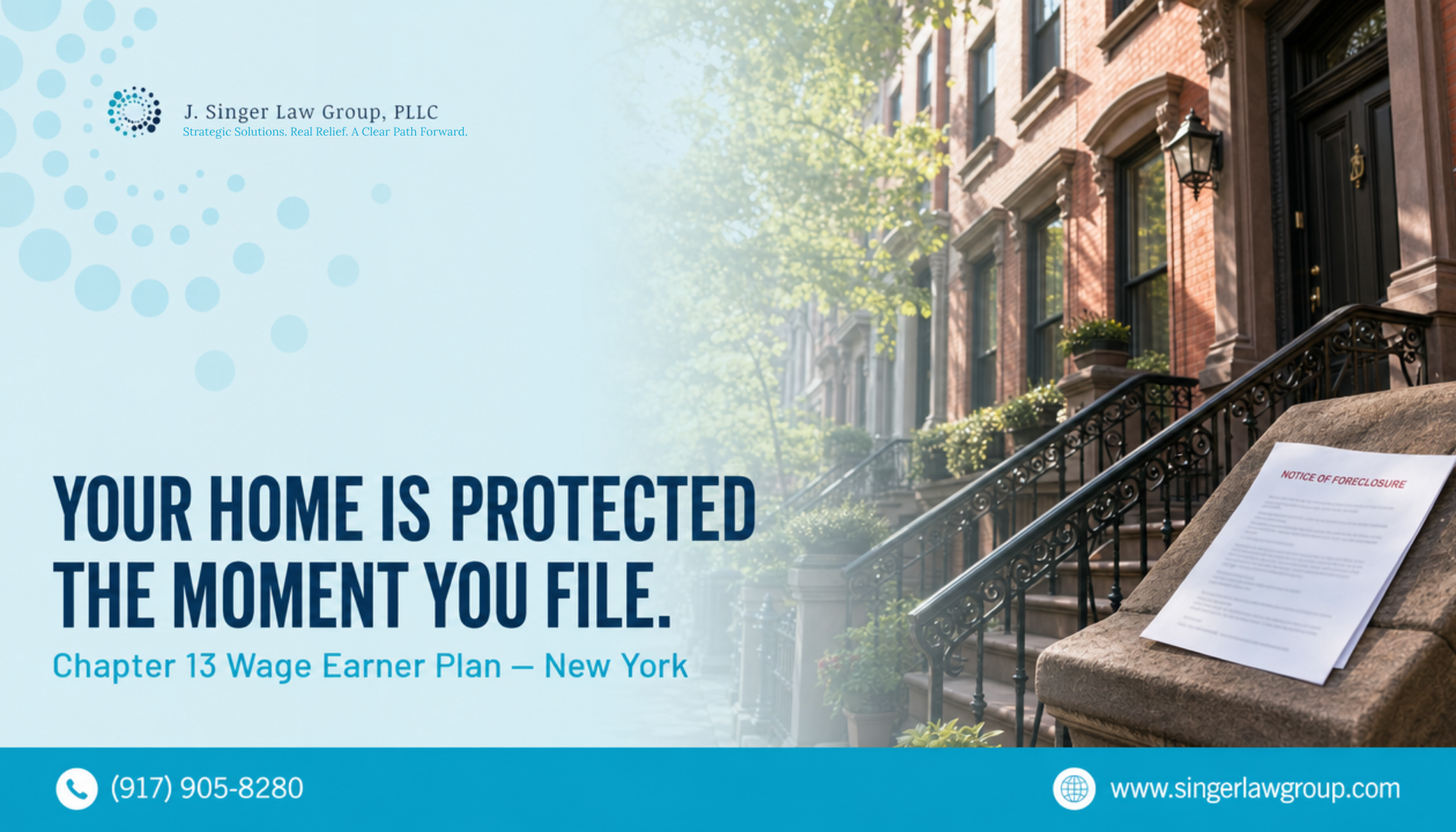
The Chapter 13 wage earner plan gives eligible New York individuals with regular income a way to reorganize debt through a court-supervised repayment plan that generally lasts three to five years.
For homeowners facing foreclosure, Chapter 13 can provide an opportunity to stop covered foreclosure activity through the automatic stay and address mortgage arrears through a repayment plan while keeping the home, provided the debtor meets the bankruptcy requirements and stays current on required payments.
Chapter 13 can also help self-employed individuals and business owners with personal debt, personal guarantees, mortgage arrears, tax obligations, or other financial problems that Chapter 7 cannot address effectively.
The automatic stay generally takes effect when the bankruptcy petition is filed and can stop many collection actions against the debtor or property of the bankruptcy estate.
But the stay is not unlimited.
Certain actions fall within statutory exceptions, and creditors may ask the bankruptcy court for relief from the stay.
That is why Chapter 13 should not begin with one question about stopping a foreclosure or collection action.
The larger question is whether the repayment plan gives the individual a realistic way to address the debt and move forward.
What Is the Chapter 13 Wage Earner Plan in New York?
Chapter 13 is a federal bankruptcy option for eligible individuals with regular income.
Instead of using a liquidation process to address debt, the debtor proposes a repayment plan that generally lasts three to five years. Payments go through the Chapter 13 trustee and are distributed to creditors according to the Bankruptcy Code and the confirmed plan.
The phrase “wage earner’s plan” can be misleading.
A traditional paycheck is not the only potential source of income for Chapter 13.
Depending on the circumstances, an individual may fund a Chapter 13 plan with wages, self-employment income, retirement income, rental income, or another sufficiently regular income source.
That makes Chapter 13 relevant to more than W-2 employees.
A self-employed contractor, consultant, professional, landlord, or small business owner may be able to use Chapter 13 personally if they meet the eligibility requirements.
The important question is whether the income is regular and sufficient to support a feasible repayment plan.
Chapter 13 can provide significant protection, but the debtor still needs to make the numbers work.
Chapter 13 vs. Chapter 7: The Property-Retention Axis
One of the most important differences between Chapter 13 and Chapter 7 is how each chapter handles property.
Chapter 7 bankruptcy in New York is generally a liquidation process. A Chapter 7 trustee administers the property of the bankruptcy estate, and nonexempt assets may be available for liquidation for the benefit of creditors.
Chapter 13 works differently.
The debtor generally remains in possession of property while making payments under the Chapter 13 plan. That can make Chapter 13 particularly important for a homeowner who needs time to cure mortgage arrears or an individual who owns property that could create a problem in Chapter 7.
But Chapter 13 should not be described as an automatic guarantee that every debtor keeps every asset regardless of value, exemptions, secured claims,
plan terms, or other bankruptcy requirements.
Property still matters to the Chapter 13 analysis.
The value of the debtor’s assets, available exemptions, secured claims, disposable income, and what creditors would receive in a Chapter 7 liquidation can all affect what the Chapter 13 plan must provide.
That's why you should evaluate the difference between Chapter 7 and Chapter 13 bankruptcy before deciding which chapter fits the debtor’s situation.
For a New York homeowner with substantial equity, the exemption analysis can be especially important.
For a business owner, the analysis may involve personal guarantees, business interests, real estate, equipment, or other assets that could be affected differently depending on the bankruptcy chapter selected.
The right question is not simply, “Which bankruptcy lets me keep my property?”
It is, “What happens to my income, property, secured debt, and unsecured debt under each option?”
Chapter 13 also uses income calculations to determine important parts of the repayment plan.
Income can affect the applicable commitment period and the amount you may need to pay to unsecured creditors. Household size, current monthly
income, allowable expenses, secured debt, priority obligations, and other factors can all factor into the calculation.
That means a higher-income debtor should not assume Chapter 13 automatically requires one particular result based solely on income.
The complete financial picture matters.
Who Qualifies for Chapter 13 Bankruptcy in New York?
Chapter 13 is available to eligible individuals with regular income who meet the debt and other requirements that apply when the bankruptcy case is filed.
The debtor does not need to have a traditional W-2 paycheck.
A self-employed individual, freelancer, business owner, retiree, or landlord may be able to file Chapter 13 if there is enough regular income to support a feasible repayment plan.
Eligibility generally comes down to several important questions:
- Regular income: The debtor needs a sufficiently regular income source to make the payments required under the Chapter 13 plan. Depending on the circumstances, that may include wages, self-employment income, retirement income, rental income, or other recurring income.
- Debt limits: Chapter 13 has statutory debt limits that are adjusted periodically. Determine eligibility using the limits in effect when you file, rather than an older figure.
- Individuals only: Chapter 13 is designed for individuals. A corporation, LLC, or partnership does not file Chapter 13. If the business entity itself needs to reorganize, Chapter 11 or, when the eligibility requirements are satisfied, Subchapter V may need to be considered instead.
- Prior bankruptcy filings: A recent bankruptcy dismissal can affect whether and when you may file another case. Before filing a new petition, you must review the reason for the prior dismissal, the timing, and what happened in the earlier case.
For a small business owner, the distinction between the individual and the company matters especially.
Suppose an individual owns an LLC that is still operating but has personally guaranteed the company’s lease, MCA obligations, or other business debt.
The LLC itself cannot file Chapter 13.
The owner may qualify for an individual Chapter 13 case. Still, the filing's effect on the business, the guaranteed obligations, and the company's creditors requires separate analysis.
The same applies to a self-employed individual operating without a separate business entity.
Chapter 13 may help address personal and business-related obligations, but the plan still needs to be supported by regular income and meet the requirements of the Bankruptcy Code.
New York State Median Income and Plan Length
Income is a key factor in determining how a Chapter 13 case will work.
The debtor’s current monthly income, household size, allowable expenses, and other financial information can affect the applicable commitment period and how much the debtor may need to pay through the plan.
A debtor whose income falls below the applicable median may be able to propose a three-year commitment period, subject to case requirements.
An above-median debtor will generally face a longer applicable commitment period, often five years, unless the requirements for a shorter plan are otherwise satisfied.
But median income should not be the only factor determining the plan.
The debtor’s secured debt, priority obligations, disposable income, assets, exemptions, mortgage arrears, vehicle debt, tax obligations, and other circumstances can all affect what the plan needs to accomplish.
That is why Chapter 13 begins with a full financial review.
The question is not simply how much the debtor earns.
It is how much money is available after reasonable and necessary expenses, which debts the plan must address, and whether the proposed payment can realistically be maintained.
How the Chapter 13 Repayment Plan Works in New York
A Chapter 13 repayment plan generally lasts three to five years and provides a structured way to address debt under bankruptcy court supervision.
The debtor proposes the plan and makes required payments to the Chapter 13 trustee. The trustee then distributes plan funds to creditors according to the confirmed plan and applicable bankruptcy law.
The monthly payment is not determined by simply adding up every debt and dividing the total by the number of months in the plan.
Several factors affect what the debtor must pay.
Income matters.
Expenses matter.
The value of assets matters.
The type of debt matters.
Mortgage arrears, secured claims, priority debts, disposable income, exemptions, and what unsecured creditors would receive in a Chapter 7 liquidation
can all affect the plan.
That is why two New York debtors with the same amount of credit card debt can have very different Chapter 13 payments.
One may have substantial mortgage arrears that the plan must cure. Another may owe priority taxes. A third may have significant nonexempt equity in property that affects what unsecured creditors must receive.
The plan needs to be built around the debtor’s actual financial situation.
The Priority Waterfall
Not every creditor is treated the same way in Chapter 13.
Different types of claims receive different treatment under the Bankruptcy Code and the confirmed plan.
1. Priority Debts
Certain debts receive priority treatment.
Depending on the circumstances, this can include certain tax obligations, domestic support obligations, and administrative expenses associated with the bankruptcy case.
Priority claims can significantly affect the required Chapter 13 payment because bankruptcy law generally requires certain priority obligations to be treated in a specific way during the plan.
A debtor with substantial tax debt may therefore have a very different Chapter 13 plan from someone with the same income but primarily credit card debt.
2. Secured Debts
Secured claims are backed by collateral.
For many Chapter 13 debtors, the most important secured debts are a mortgage and vehicle financing.
A homeowner who files Chapter 13 to stop a foreclosure may use the plan to address prepetition mortgage arrears while also maintaining required ongoing mortgage payments.
How those ongoing payments are handled can depend on the plan and local practice.
Vehicle loans and other secured claims may be treated differently depending on the debt, the collateral, when the obligation was incurred, and the requirements that apply to the particular claim.
Chapter 13 can provide useful tools for dealing with secured debt, but the treatment is not identical for every secured creditor.
3. Unsecured Debts
General unsecured debts can include credit cards, medical bills, personal loans, and other obligations not secured by collateral and not receiving priority treatment.
These creditors do not necessarily receive payment in full in every Chapter 13 case.
The amount they receive depends on the debtor’s circumstances and the plan's requirements.
Disposable income can matter.
So can the value of the debtor’s nonexempt property.
The debtor generally cannot use Chapter 13 to provide unsecured creditors with less than bankruptcy law requires based on the facts of the case.
That is why the amount paid to unsecured creditors may range considerably from one Chapter 13 case to another.
What Is a 100% Chapter 13 Repayment Plan, and Is It Actually Bad?
A 100% Chapter 13 plan generally means allowed claims that are required to be paid through the plan will receive full payment under the terms of the confirmed plan.
At first, that may sound like there is little benefit to filing bankruptcy.
But the analysis should not stop there.
A debtor may be using Chapter 13 for reasons other than reducing the principal balance of unsecured debt.
For a homeowner, the plan may provide time to cure mortgage arrears while the automatic stay restricts covered foreclosure activity.
For someone dealing with several creditors, Chapter 13 can replace multiple collection demands with a structured court-supervised payment process.
For another debtor, the benefit may be addressing tax debt, vehicle financing, or other obligations within one plan.
The claims process also matters.
Creditors generally need to follow the bankruptcy claims process to receive distributions on claims that require a proof of claim. The amount ultimately administered through the plan can therefore depend on which claims are properly filed and allowed.
A 100% plan should not automatically be viewed as a bad outcome.
The better question is what the debtor receives in exchange for making those payments.
Does the plan stop a foreclosure long enough to cure the arrears?
Does it provide a manageable structure for dealing with several debts at once?
Does it allow the debtor to retain property that could be at risk in another bankruptcy chapter?
Can the debtor realistically maintain the required payments for the life of the plan?
Chapter 13 is ultimately a cash-flow plan.
The payment has to work in the real world, not just on the bankruptcy schedules.
What Powerful Tools Does Chapter 13 Offer That Chapter 7 Does
Not?
Chapter 13 offers several tools for dealing with secured debt, foreclosure, and certain co-signed consumer obligations that can make it a better fit than
Chapter 7 for some New York debtors.
For a homeowner trying to keep a home or someone dealing with secured debt, those differences can matter.
Chapter 13 may let you cure mortgage arrears over time, address certain liens, modify the treatment of some secured claims, and protect certain co-debtors while the repayment plan is active.
But each tool has its own requirements.
Chapter 13 does not automatically eliminate liens, reduce every secured loan, or permanently stop every foreclosure simply because a petition was filed.
The facts of the debt and the Bankruptcy Code's requirements determine what is available.
Lien Stripping: Eliminating a Second Mortgage in New York
Lien stripping can potentially allow a Chapter 13 debtor to treat a junior mortgage as unsecured when there is no value in the property supporting that junior lien.
The numbers matter.
Suppose a home is worth less than the balance owed on the first mortgage. If no remaining equity is available to secure a second mortgage, the junior lien may be treated as unsecured through the Chapter 13 process, subject to applicable legal requirements and court approval.
Consider a Queens homeowner with a first mortgage that exceeds the property's current value and a $40,000 second mortgage.
If the property’s value does not provide any collateral value for the second mortgage, the debtor may have a basis to seek unsecured treatment of that junior claim.
That does not happen automatically.
The debtor must establish the property's value, review the mortgage balances, and follow the required bankruptcy procedure.
The distinction can matter a lot for a homeowner trying to build a Chapter 13 plan that works.
However, if the junior mortgage has any value, different rules may apply.
That is why lien stripping starts with the actual numbers rather than the label attached to the loan.
What is the property worth?
How much is owed on the first mortgage?
Does any remaining value support the junior lien?
Those questions determine whether lien stripping is even worth considering.
Cramdowns: Reducing Certain Secured Claims
Chapter 13 may also allow a debtor to modify the treatment of certain secured claims through what is commonly called a cramdown.
Vehicle financing is one area where this issue can arise.
If a debtor owes more on a vehicle than the vehicle is worth, Chapter 13 may, in qualifying circumstances, allow the secured portion of the claim to be based on the value of the vehicle rather than the full outstanding loan balance.
The plan may treat the remaining portion differently.
The interest rate may also be determined under the rules that apply to Chapter 13 plan treatment rather than simply continuing under the original
contract rate.
But not every vehicle loan qualifies for this treatment.
The timing of the purchase and the collateral matter.
For example, special rules can limit a debtor’s ability to reduce the secured balance of certain vehicle loans incurred within the statutory period before filing.
So a debtor with a $25,000 loan on a vehicle worth $15,000 should not assume Chapter 13 automatically reduces the secured debt to $15,000.
The loan documents, purchase date, vehicle use, value, and other facts need to be reviewed first.
When cramdown treatment is available, it can change how a secured obligation is handled through the Chapter 13 plan.
When it is not available, the debtor still needs a plan for dealing with that debt.
The Co-Debtor Stay: Protecting Certain Co-Signers
Chapter 13 also includes a co-debtor stay for certain consumer debts.
This protection can matter when another person co-signed an obligation with the debtor.
While the Chapter 13 case is active, the co-debtor stay can restrict a creditor from pursuing an individual who is liable with the debtor on a qualifying consumer debt.
That protection is different from the automatic stay that protects the Chapter 13 debtor.
It also has limits.
The co-debtor stay applies to consumer debt, not every obligation involving more than one person.
That distinction can matter for business owners.
A business-related obligation should not automatically be treated as consumer debt simply because an individual co-signed it.
If a business owner and another person are jointly liable on a commercial loan or business obligation, the availability of the Chapter 13 co-debtor stay requires a closer look at the debt's nature.
Creditors may also seek relief from the co-debtor stay in circumstances permitted by bankruptcy law.
The protection is useful, but it should not be treated as a blanket shield for every co-signer throughout every Chapter 13 case.
The Automatic Stay Can Stop Foreclosure When the Case Is Filed
For many New York homeowners, the most immediate reason to consider Chapter 13 is foreclosure.
Filing a Chapter 13 petition generally triggers the automatic stay, which can stop covered foreclosure activity while the stay remains in effect.
That can be especially important when a foreclosure case is already pending or a sale is approaching.
But timing matters.
A homeowner should not assume a Chapter 13 petition can reverse every foreclosure-related event regardless of when the filing occurs.
The foreclosure stage, what happened before bankruptcy, prior bankruptcy filings, and whether a creditor later obtains relief from the stay can all affect the result.
When Chapter 13 is filed at a point where the automatic stay can stop foreclosure, the repayment plan may allow the homeowner to cure prepetition
mortgage arrears over time while maintaining required ongoing mortgage payments.
That combination is what makes stopping foreclosure with Chapter 13 an important option for some New York homeowners.
The stay addresses the immediate collection pressure.
The repayment plan addresses the arrears.
The homeowner still needs enough income for the plan to work.
If the regular mortgage payment is no longer affordable, spreading the arrears over several years may not solve the underlying problem.
Before filing, the homeowner should understand the full monthly cost of keeping the property.
That includes the ongoing mortgage payment, the Chapter 13 plan payment, property taxes when applicable, insurance, and ordinary household
expenses.
The numbers have to work together.
Chapter 13 can create time and structure for a homeowner facing foreclosure.
The goal is not simply to stop the next foreclosure event.
It is to determine whether the homeowner can use that time to keep the property on financially sustainable terms.
Filing Chapter 13 in New York: Courts, Districts, and Local Rules
New York Chapter 13 cases are filed in the appropriate federal bankruptcy district based on the debtor’s circumstances and the applicable venue rules.
For individuals in New York City and the surrounding counties, that will often mean the U.S. Bankruptcy Court for the Southern District of New York or the
U.S. Bankruptcy Court for the Eastern District of New York.
The district matters because local rules, forms, procedures, and Chapter 13 trustee practices can affect how a case moves from filing through confirmation and, ultimately, completion of the repayment plan.
Southern District of New York
The Southern District of New York includes Manhattan, the Bronx, Westchester, Rockland, Putnam, Orange, Sullivan, and Dutchess Counties.
For an individual whose proper bankruptcy venue is in the Southern District, the Chapter 13 case proceeds under the federal Bankruptcy Code, along with the rules and procedures that apply in that district.
Jeb Singer, Managing Partner of J. Singer Law Group, previously served as a law clerk to the Honorable Stuart M. Bernstein of the U.S. Bankruptcy Court
for the Southern District of New York.
That bankruptcy experience is relevant when evaluating the practical issues that can arise in a Chapter 13 case, including plan feasibility, secured debt, mortgage arrears, creditor claims, and confirmation.
Eastern District of New York
The Eastern District of New York includes Brooklyn, Queens, Staten Island, Nassau County, and Suffolk County.
For homeowners in these areas, Chapter 13 may become particularly important when mortgage arrears and foreclosure are part of the financial problem.
The same federal bankruptcy law applies, but local procedures and practices for administering a Chapter 13 case can differ by district.
That is one reason a New York debtor should know where to file the case before preparing the petition and repayment plan.
The filing district is not simply an address on the petition.
It determines where the bankruptcy case will proceed and which local procedures will apply throughout.
New York State Exemptions
Exemptions are another important part of the pre-filing analysis.
New York debtors may choose between the New York exemption system and the federal bankruptcy exemptions, depending on the applicable
requirements.
The right choice depends on what the debtor owns.
For a homeowner, the homestead exemption can be particularly important because the amount of protection available under New York law can vary based on where the property is located.
For another debtor, the more important assets may be cash, a vehicle, retirement funds, personal property, a business interest, or other property.
Choosing an exemption system should therefore begin with a complete asset review.
- What does the debtor own?
- What is each asset worth?
- Is there a loan or lien against it?
- How much equity remains?
- Which exemption system provides the appropriate protection based on the debtor’s circumstances?
Answer those questions before filing.
The exemption analysis can also affect the Chapter 13 repayment plan.
Chapter 13 debtors generally remain in possession of their property, but the value of nonexempt assets can affect the minimum amount that unsecured creditors must receive through the plan.
That is why property retention and plan payments cannot be analyzed separately.
The value of the debtor’s property may directly affect what the plan needs to provide.
The Filing Process
A Chapter 13 filing involves more than submitting a bankruptcy petition.
The debtor must prepare financial information, complete the required steps, propose a repayment plan, and continue meeting obligations after the case begins.
The process generally includes:
- Review income, expenses, assets, and debts. Before filing, the debtor should identify all income sources, monthly expenses, property, secured debt, unsecured debt, mortgage arrears, tax obligations, judgments, lawsuits, and other financial obligations.
- Complete required pre-filing credit counseling. An eligible debtor generally must complete the required credit counseling within the applicable period before filing, subject to limited statutory exceptions.
- Prepare and file the bankruptcy documents. The petition, schedules, statements, and other required documents provide the bankruptcy court, trustee, and creditors with information about the debtor’s financial situation.
- The automatic stay generally takes effect when you file. Once you file, the automatic stay generally restricts many covered collection and enforcement actions. The stay has statutory exceptions, and creditors may seek relief from the bankruptcy court.
- Begin making required plan payments. Chapter 13 payments generally begin before the plan is formally confirmed. A debtor should therefore be prepared to fund the proposed plan from the beginning of the case.
- Attend the Meeting of Creditors. The debtor must attend the required meeting and answer questions about the bankruptcy petition, schedules, income, assets, debts, and proposed repayment plan.
- Address objections and confirmation issues. The trustee or creditors may raise objections to the proposed plan. Those issues may involve feasibility, claim treatment, disposable income, asset values, secured debt, exemptions, or other plan requirements.
- Complete the repayment plan. Once the plan is confirmed, the debtor must continue making required payments and complying with the plan's terms for the applicable period.
- Complete the requirements for discharge. A debtor who completes the plan and satisfies the applicable requirements may receive a Chapter 13 discharge of qualifying debts.
Filing Is the Beginning, Not the Finish Line
For someone facing foreclosure or aggressive creditor collection, filing the petition can feel like the most important moment in the case.
It is important, but it is only the beginning.
The debtor still needs to make the Chapter 13 payment.
The ongoing mortgage payment still needs to be addressed.
The trustee may have questions.
Creditors may file claims or objections.
A secured creditor may seek relief from the automatic stay.
Income or expenses may change during a three-to-five-year plan.
A Chapter 13 case therefore needs to work beyond the filing date.
Before filing, the debtor should understand what the monthly budget will look like after bankruptcy begins and whether that budget is realistic.
Stopping a foreclosure today does not solve the problem if the homeowner cannot make the ongoing mortgage and Chapter 13 payments next month.
The same applies to self-employed individuals and business owners.
The plan needs to account for the income that actually comes in, the expenses that need to be paid, and the financial obligations that will continue throughout the case.
Chapter 13 provides a structure for dealing with debt over time.
The structure only works when the repayment plan is built around numbers the debtor can realistically maintain.
Common Myths About Chapter 13 Bankruptcy in New York
Many people avoid Chapter 13 because they assume it means giving up control of their finances, losing their home, or committing to repay every dollar they owe.
Those assumptions can lead someone to dismiss Chapter 13 before understanding how the repayment plan actually works.
For New York homeowners, self-employed individuals, and business owners dealing with personal debt, the better approach is to look at what Chapter
13 can accomplish based on the specific financial situation.
Myth: “Chapter 13 Is Only for People With a Traditional W-2 Job.”
The term “wage earner’s plan” can make Chapter 13 sound as though it is limited to employees receiving a regular paycheck.
It is not.
Chapter 13 may be available to individuals with a sufficiently regular source of income, including self-employed individuals, freelancers, small business owners, retirees, and landlords receiving rental income.
For self-employed people, the income analysis may require a closer look because monthly earnings can fluctuate.
The question is whether regular income is sufficient to support the proposed repayment plan.
A business owner also needs to distinguish between personal bankruptcy and bankruptcy for the business entity.
An individual business owner may qualify for Chapter 13.
A corporation, LLC, or partnership does not file Chapter 13.
If the company needs bankruptcy protection or restructuring, you may need to consider a different bankruptcy chapter.
Myth: “Filing Chapter 13 Means I Will Lose My Home.”
For many homeowners, keeping their home is a primary reason they consider Chapter 13.
When a Chapter 13 petition is filed, the automatic stay generally restricts covered foreclosure activity against the debtor while the stay remains in effect.
The repayment plan may then allow the homeowner to cure prepetition mortgage arrears over time while continuing to make required ongoing mortgage payments.
But filing Chapter 13 does not make the mortgage disappear.
A homeowner still needs enough income to support the ongoing cost of the property and the Chapter 13 plan.
If the homeowner cannot afford the regular mortgage payment going forward, curing the arrears over several years may not solve the underlying problem.
The goal is not simply to stop the foreclosure.
It is to determine whether Chapter 13 provides a realistic way to keep the home.
Myth: “A 100% Repayment Plan Is the Worst Possible Outcome.”
A Chapter 13 plan that requires full payment of allowed claims may still provide meaningful benefits.
The value of Chapter 13 is not measured only by how much unsecured debt is reduced.
A debtor may be using the case to stop covered foreclosure activity, cure mortgage arrears, address secured debt, manage tax obligations, or replace
several separate collection problems with one structured repayment process.
The bankruptcy claims process also determines which claims are allowed and entitled to payment through the plan.
That means the debtor should evaluate the actual claims filed in the case rather than assume every amount on a pre-bankruptcy statement will be paid through the plan exactly as stated.
The practical question is what the debtor receives from the Chapter 13 structure.
If the plan lets a homeowner cure arrears, keep the home, and manage other debts in a manageable way, fully repaying allowed claims may still make financial sense.
The numbers have to work for the debtor.
Myth: “Chapter 13 Only Helps With Mortgage Debt.”
Foreclosure is one of the most common reasons people consider Chapter 13, but the chapter is not limited to mortgage problems.
A repayment plan can address several types of debt at once.
Depending on the circumstances, that may include mortgage arrears, vehicle financing, credit cards, medical bills, personal loans, certain tax obligations, and other secured or unsecured debts.
Chapter 13 may also provide specific tools for dealing with qualifying junior liens and certain secured claims.
Those tools depend on the facts.
A debtor should not assume that every second mortgage can be stripped or every vehicle loan can be reduced.
But when the requirements are met, Chapter 13 may offer options for secured debt that aren't available in the same way under Chapter 7.
For someone dealing with several different financial problems, that broader restructuring ability can be one of Chapter 13’s most useful features.
Myth: “My Co-Signer Will Still Be Pursued While I Am in Chapter 13.”
Chapter 13 includes a co-debtor stay that can protect certain individuals who are jointly liable with the debtor on qualifying consumer debt.
This can matter when a family member or another person co-signed a consumer obligation.
But the protection does not automatically apply to every co-signed debt.
The nature of the obligation matters.
Consumer debts and business debts are not necessarily treated the same way.
That distinction matters for business owners who may have jointly signed commercial loans, business credit lines, leases, or other company obligations.
The co-debtor stay should therefore be evaluated based on the specific debt rather than assumed to protect every co-signer.
Creditors may also seek relief from the co-debtor stay when they meet the applicable requirements.
The protection can be valuable, but you need to understand its scope before relying on it.
Myth: “I Can File Chapter 13 Anytime, Even After a Recent Dismissal.”
A prior bankruptcy case can affect a later filing.
In some circumstances, a debtor may be temporarily ineligible to file another bankruptcy case following a dismissal, including certain situations involving willful failure to follow court orders or appear before the court, or a voluntary dismissal after a creditor sought relief from the automatic stay.
Prior filings can also affect how the automatic stay operates in a new case.
That makes the debtor’s complete bankruptcy history important.
Before filing another Chapter 13 petition, the debtor should identify every prior bankruptcy case, when it was filed, when it ended, and why it was dismissed.
Do not assume a new filing will produce the same protection as the previous case.
Timing matters.
The reason for the earlier dismissal matters.
Review the debtor’s filing history before submitting another petition.
Look at the Numbers Before Ruling Out Chapter 13
Chapter 13 should not be chosen because of a general promise that it will save a home or reduce debt.
You also shouldn't reject it based on assumptions about what bankruptcy means.
Start with the actual financial picture.
How much income is coming in?
What does it cost to maintain the home?
How much is owed in mortgage arrears?
Which debts are secured?
Are there tax obligations?
Are there personal guarantees or business-related debts?
What property does the debtor need to protect?
And what monthly payment can realistically be maintained for the life of the plan?
Those answers tell you far more about whether Chapter 13 makes sense than the words “wage earner’s plan.”
The right plan is one the debtor can actually complete.
Frequently Asked Questions
What is the Chapter 13 wage earner plan in New York?
The Chapter 13 wage earner plan is a federal bankruptcy option that allows eligible New York individuals with regular income to reorganize their debts through a court-supervised repayment plan that generally lasts three to five years.
Chapter 13 is not limited to someone receiving a traditional paycheck. Depending on the circumstances, regular income may come from wages, self-employment, retirement income, rental income, or another recurring source that can support the repayment plan.
When a Chapter 13 petition is filed, the automatic stay generally takes effect and restricts many covered collection and enforcement actions against the debtor and the bankruptcy estate's property.
For a New York homeowner, that protection can be particularly important when a foreclosure is pending. Chapter 13 may provide an opportunity to stop covered foreclosure activity and cure prepetition mortgage arrears through the repayment plan while maintaining required ongoing mortgage payments.
The plan must still be feasible.
Before deciding whether Chapter 13 is the right option, consider the debtor’s income, expenses, assets, secured debt, priority obligations, mortgage arrears, and other financial circumstances.
Who qualifies for Chapter 13 bankruptcy in New York?
Chapter 13 is available to eligible individuals with regular income who meet the debt and other requirements in effect when they file.
That can include W-2 employees, self-employed individuals, freelancers, retirees, landlords, and small business owners filing personally.
Corporations, LLCs, and partnerships do not file Chapter 13.
That distinction matters for business owners.
An individual who owns an LLC may qualify for Chapter 13 personally, but the LLC itself would require a different bankruptcy analysis if the company
needs to restructure its own debts.
Chapter 13 also has statutory debt limits that are adjusted periodically. Eligibility should therefore be determined using the requirements in effect when the petition is filed rather than relying on an older dollar amount.
Prior bankruptcy cases can matter too.
A recent dismissal may affect eligibility to file another case or how the automatic stay operates after a new petition is filed. Review the debtor’s bankruptcy history before starting another case.
The practical question is whether the individual qualifies and has enough regular income to support a repayment plan they can realistically complete.
Can Chapter 13 stop a foreclosure in New York?
Chapter 13 can be an important tool for a New York homeowner facing foreclosure.
When the petition is filed, the automatic stay generally restricts covered foreclosure activity while the stay remains in effect.
The Chapter 13 plan may then allow the homeowner to cure prepetition mortgage arrears over time while continuing to make required ongoing mortgage payments.
But timing matters.
A homeowner should not assume that Chapter 13 can reverse every foreclosure event regardless of what occurred before the bankruptcy petition was filed.
The stage of the foreclosure proceeding, prior bankruptcy cases, the status of the property, and any request by the lender for relief from the automatic stay can affect what happens next.
The homeowner also needs enough income to maintain the property after filing.
Stopping the foreclosure does not solve the problem if the homeowner cannot keep up with the regular mortgage payment, Chapter 13 plan payment, taxes, insurance, and ordinary living expenses.
For someone trying to save a home, the analysis should therefore go beyond the foreclosure date.
The question is whether Chapter 13 provides a financially workable way to keep the property over the long term.
What is the difference between Chapter 7 and Chapter 13 bankruptcy in New York?
Chapter 7 and Chapter 13 address debt differently.
Chapter 7 is generally a liquidation process. A trustee administers the bankruptcy estate, and nonexempt assets may be liquidated for the benefit of creditors.
Chapter 13 is a reorganization process for eligible individuals with regular income. Instead of liquidating the case, the debtor proposes a repayment plan
that generally lasts three to five years.
Chapter 13 can be particularly useful for a homeowner who needs time to cure mortgage arrears or an individual whose property creates concerns in a Chapter 7 case.
But you shouldn't choose either chapter based on one factor alone.
Income matters.
Property matters.
Exemptions matter.
The type of debt matters.
Mortgage arrears, tax obligations, secured claims, personal guarantees, and the debtor’s ability to make ongoing payments can all affect the decision.
For a business owner, the analysis may have another layer. The individual may qualify for Chapter 7 or Chapter 13 personally while the business entity has separate debts and restructuring needs.
The right chapter depends on the complete financial picture.
How long does a Chapter 13 plan last in New York?
A Chapter 13 repayment plan generally lasts three to five years.
The applicable commitment period can depend on the debtor’s income and other case requirements.
Income below or above the applicable median can affect the required plan period, but income is not the only factor that determines what the debtor must pay or how the plan will work.
The debtor’s disposable income, secured debt, priority obligations, assets, exemptions, and treatment of creditor claims can all affect the plan.
A Chapter 13 plan can't be stretched indefinitely just because the debtor needs more time.
The repayment period must stay within the limits set by bankruptcy law.
That makes feasibility important from the beginning.
A payment that looks manageable for the first month still needs to work later in the case.
For a homeowner, that usually means maintaining the Chapter 13 payment along with the required ongoing mortgage payment and ordinary household expenses.
For a self-employed debtor, it may require planning around income that changes from month to month.
Chapter 13 is a multi-year commitment.
The plan should be built around a budget the debtor can realistically maintain.
Can Chapter 13 eliminate a second mortgage in New York?
Potentially, depending on the property's value, the mortgage balances, and the requirements that apply to the junior lien.
A Chapter 13 debtor may be able to seek unsecured treatment of a junior mortgage when there is no value in the property supporting that lien.
For example, if the balance owed on the first mortgage exceeds the home’s fair market value, there may be no remaining collateral value supporting a second mortgage.
That can create a potential basis for treating the junior claim as unsecured through the Chapter 13 process.
But lien stripping is not automatic.
The property’s value needs to be established.
The mortgage balances need to be reviewed.
The debtor needs to follow the required bankruptcy procedure.
And the treatment of the lien depends on the specific facts and applicable requirements of the case.
If there is value supporting the junior lien, even partially, the analysis may be different.
That is why the starting point is the property itself.
What is the home worth?
What is owed on the first mortgage?
What is owed on the second mortgage?
Does any equity support the junior lien?
Those numbers determine whether lien stripping is an option worth pursuing.
For a New York homeowner with a second or third mortgage, that analysis should happen before finalizing the Chapter 13 plan.
Before You Decide, Understand Your Options
Chapter 13 can give New York homeowners and individuals with regular income a structured way to address debt, stop covered foreclosure activity, and protect property while making payments over time. But the plan must still work with your income, expenses, assets, and long-term financial goals.
J. Singer Law Group helps clients look at the full picture before filing, including Chapter 13, Chapter 7, foreclosure concerns, personal guarantees, and other debt issues that may affect the right strategy.
If creditor pressure or foreclosure is making it difficult to see the next step, speak with J. Singer Law Group before making a filing decision.
Call (917) 905-8280 or contact J. Singer Law Group to discuss your options.
Strategy. Not just defense.