
Debt Consolidation Company Lawsuit: What New York Victims Need to Know
By Jeb Singer, Esq. (https://www.singerlawgroup.com/about-us), Managing Partner, J. Singer Law Group, PLLC
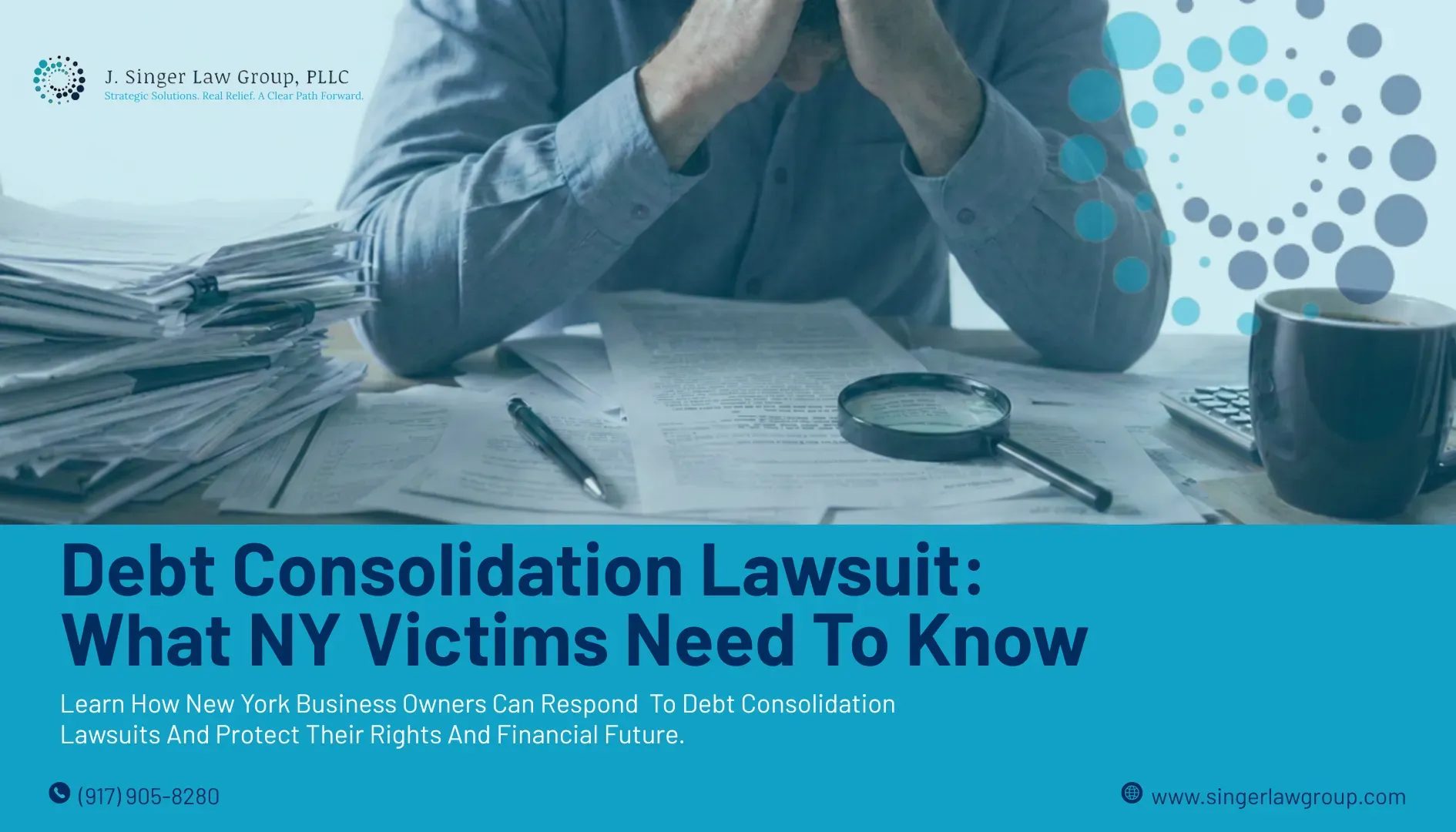
If you paid a debt consolidation or debt relief company and received little or nothing in return, the problem may be more serious than poor service.
Debt relief companies are subject to rules governing when they may collect fees and what they can promise consumers. Problems often begin when a company takes money upfront, promises results it cannot deliver, or markets one type of service while putting the customer into something entirely different.
For people already struggling with debt, the damage can add up quickly.
You may have paid thousands of dollars in fees while creditors continued calling. Accounts may have fallen further behind. Lawsuits may have been filed. Interest and penalties may have continued to grow while the company told you everything was being handled.
When that happens, the first question isn’t whether the program “worked.”
It’s what the company promised, what you paid, what it actually did, and whether those actions violated the law.
For business owners caught in similar programs involving merchant cash advances, Singer Law Group’s MCA Debt Consolidation Fraud practice addresses the separate problems that arise when companies promise to consolidate MCA obligations and instead leave the business deeper in debt.
Three terms are useful to understand from the beginning.
A debt consolidation company lawsuit is a legal action alleging that a debt relief company charged unlawful fees, made misleading representations, or used other improper practices.
The Telemarketing Sales Rule, commonly called the TSR, places restrictions on how debt relief services marketed through telemarketing may charge consumers.
An advance fee is money collected before the company has performed the debt relief work required before payment may lawfully be collected under the applicable rule.
What Is a Debt Consolidation Company Lawsuit?
A debt consolidation company lawsuit usually begins with a simple problem: the customer paid for debt relief that never arrived.
The company may have promised to reduce balances, negotiate with creditors, combine several debts into one payment, or provide legal assistance.
Instead, the customer discovers that creditors were never contacted, settlements were not reached, or fees were taken before any work was complete.
Some cases involve more complicated schemes.
A company advertises a consolidation loan but enrolls the customer in debt settlement.
A supposed law firm appears on the paperwork, but the customer never speaks with an attorney who actually represents them.
Several related companies move money between different accounts while responsibility for the service remains unclear.
Whatever the structure, the legal analysis comes back to the facts.
What was advertised?
What did the contract say?
What fees were charged?
When were they charged?
What work was performed?
And what financial harm followed?
Those questions determine whether the matter is simply a disappointing business relationship or something that may support a legal claim.
How Debt Consolidation Differs from Debt Settlement
Debt consolidation and debt settlement are not the same thing.
Debt consolidation generally means replacing several debts with a new obligation, often to have one payment instead of many.
Debt settlement takes a different approach. The company attempts to negotiate with creditors so they will accept less than the full balance.
Consumers get into trouble when those two products are presented as interchangeable.
Someone may respond to an advertisement promising a consolidation loan and later discover that no loan was ever being offered.
Instead, the company instructs the customer to stop paying creditors, place money into another account, and wait while settlements are supposedly negotiated.
That difference should be clear before the customer signs anything or pays a fee.
If it isn’t, the representations used to sell the program deserve closer review.
What Did the 2024 CFPB Lawsuit Against Strategic Financial Solutions Reveal?
The Strategic Financial Solutions matter showed how complicated a debt relief operation can become.
The source article describes allegations involving a network of related companies, law firms, service businesses, and financial entities that allegedly collected substantial fees from consumers before delivering the promised debt relief.
For victims, the important lesson is that it is not limited to one company.
A sophisticated website, multiple corporate entities, or the presence of a law firm name does not automatically mean the service is legitimate.
You still need to know who is actually representing you.
Who receives your money?
Who is negotiating with creditors?
What fees are being taken?
And what happens if no settlement is reached?
The source article also describes allegations that consumers were attracted with offers involving debt consolidation and then moved into settlement programs.
That type of switch matters.
If you agreed to one financial product and received another, save the advertisements, emails, recorded calls, contracts, and payment records that show what was originally promised.
Those documents may become more important than the company’s later explanation of what it says the program was supposed to do.
What Federal and New York Laws Govern Debt Consolidation Companies?
Debt relief companies can be subject to more than one set of rules.
Federal law may regulate the way services are marketed, how fees are charged, and what representations may be made to consumers.
New York law provides additional protections against deceptive business practices.
The specific laws that apply depend on the type of company, how the service was marketed, what the customer purchased, and whether the customer is an individual consumer or a business owner.
That distinction matters.
A consumer dealing with personal credit card debt may have protections that do not apply in the same way to a business owner dealing with commercial obligations.
Before assuming a particular statute applies, the contract and the nature of the debt should be reviewed.
Federal Protections
Federal rules governing debt relief services are designed in part to prevent companies from collecting money before doing the work they promised.
The source article focuses heavily on advance fees.
For a customer who believes a company charged fees too early, the payment history should be compared with the services actually performed.
When was the first payment taken?
Had any debt been settled at that point?
Had the creditor agreed to new terms?
Had the customer made a payment under those terms?
Those dates can be critical.
Other federal protections may also become relevant depending on who was collecting the debt and what conduct occurred.
The important point is not to assume every federal consumer law automatically applies to every debt-related dispute.
The facts control the analysis.
New York State and NYC Protections
New York also prohibits deceptive acts and practices in business dealings.
For a consumer who was misled about what a debt consolidation company would do, that can become an important part of the case.
New York may also impose requirements on certain debt settlement providers, including rules involving fees, disclosures, and how services are offered.
New York City residents may have additional protections under local consumer rules.
If the dispute involves a business rather than consumer debt, the legal framework can be different.
In those situations, Commercial Litigation may provide the better framework when the claim involves fraud, breach of contract, misrepresentation, or other business-related misconduct.
What Red Flags Signal That a Debt Consolidation Company Is Breaking the Law?
The biggest warning sign is money disappearing before anything meaningful happens with your debts.
But it isn’t the only one.
Watch for patterns like these:
- Large fees collected before any settlement is reached
- Guaranteed promises about how much debt will be eliminated
- Advertising a “consolidation loan” when no new loan is actually being offered
- Instructions to stop speaking with your creditors completely
- A law firm name attached to the program without meaningful attorney involvement
- Multiple companies handling different pieces of the same account
- Difficulty getting clear answers about where your money is going
- Monthly withdrawals that continue even though no creditor settlements are being completed
- Refusal to provide written information showing what work has actually been performed
One red flag does not automatically prove fraud.
Several of them together deserve attention.
How to Verify a Company’s Status Before Enrolling
Before sending money to a debt relief company, find out who you’re dealing with.
Look up the company’s legal name, not just the brand used in advertisements.
Find out whether it operates under other names.
Ask who will actually negotiate with creditors.
If the program claims attorneys will represent you, find out who those attorneys are and whether they represent you individually.
Read the fee agreement.
Ask when the company gets paid and what has to happen before those fees are earned.
Search for enforcement actions, lawsuits, regulatory complaints, and disciplinary history.
And don’t treat a company’s continued operation as proof that everything is legitimate.
Businesses can continue operating while disputes or investigations are pending.
What Should You Do If a Debt Consolidation Company Defrauded You in New York?
The first thing to do is preserve the evidence.
Don’t rely on memory.
Gather the contract, advertisements, emails, text messages, bank records, fee statements, creditor notices, and anything showing what the company promised.
Create a timeline.
When did you enroll?
What were you told?
When did payments start?
How much was taken?
Which debts were supposedly being addressed?
Were any settlements actually reached?
Did creditors continue collecting or filing lawsuits while you were enrolled?
That timeline will help an attorney understand what happened much faster.
Be careful about simply stopping payments without first understanding where the money is going and what contractual consequences may follow.
If funds are being held in a separate account, determine who controls it and what rights you have to those funds.
You may also consider making complaints to the appropriate regulators.
But a regulatory complaint and a private legal claim are not necessarily the same thing.
If significant money has been lost, or the program has left you facing lawsuits and worsening debt, legal counsel can help determine whether your options include litigation, contract claims, fraud claims, or another form of relief.
For business owners, especially those whose problem involves MCA obligations, broader financial restructuring may also need to be considered.
Common Mistakes New York Consumers Make After Debt Consolidation Fraud
Continuing to Make Payments While “Waiting to See What Happens”
This is understandable.
You have already paid into the program for months.
The company keeps telling you a settlement is almost done.
Stopping now feels like throwing away the money you already spent.
But continuing to pay simply because you’ve already invested money can make the loss larger.
If you’re concerned the program isn’t legitimate, get the contract and payment history reviewed.
Find out what work has actually been completed.
Then decide what to do with the benefit of that information.
Assuming a CFPB Enforcement Action Means Automatic Personal Recovery
A government enforcement action does not necessarily mean every customer receives money automatically.
Some cases may result in a process for identifying eligible consumers or submitting claims.
Others may not produce full repayment for everyone who was affected.
If the company you used is involved in a regulatory action, don’t assume your individual problem has been resolved.
Find out whether there is a claims process and whether your rights need to be preserved separately.
Contacting the Debt Consolidation Company Directly to Demand a Refund
Calling the company and demanding your money back may feel like the obvious first move.
Sometimes it is better to review the contract first.
The agreement may contain arbitration provisions, release language, dispute-resolution requirements, or other terms that affect how the claim should be handled.
You also don’t want to sign a refund agreement or settlement that releases broader claims before understanding what those claims may be worth.
A lawyer can review the contract and help determine the strongest way to approach the company.
How Does MCA Debt Consolidation Fraud Differ, and Why Does It Matter for Business Owners?
MCA debt consolidation fraud creates a different kind of problem because the underlying obligations are commercial.
A business may already have several Merchant Cash Advances pulling money from its operating account.
Then a company promises to combine those obligations into one manageable payment.
The owner signs up expecting relief.
Instead, the consolidation company takes fees while the original funders continue collecting.
Some businesses are encouraged to stop paying the MCA funders while no meaningful settlement has been reached.
Others are pushed into new financing that adds another obligation to the stack.
By the time the owner realizes the program is failing, lawsuits may already have been filed, and business accounts may be under pressure.
This is why MCA consolidation needs to be treated differently from ordinary consumer debt relief.
A company facing several MCA obligations may need Merchant Cash Defense, direct claims against the consolidation company, or a broader restructuring plan.
If the business remains viable but cannot continue under its current debt load, Chapter 11 Bankruptcy or Subchapter V Bankruptcy may also need to be evaluated.
The right answer depends on whether the business can survive once the problem debt is addressed.
Singer Law Group approaches these matters by looking at the entire financial picture rather than treating the consolidation company, the MCA funders, and the business’s other creditors as separate problems.
The goal is to determine what actually gives the business a path forward.
Frequently Asked Questions
Can I sue a debt consolidation company that charged me fees before settling my debts?
Potentially.
The answer depends on the type of debt relief service, how it was marketed, when fees were charged, what services were performed, and which laws apply to the transaction.
If money was taken before any meaningful debt relief work occurred, preserve your records and have the arrangement reviewed.
The contract, payment history, advertisements, and communications with the company will usually be the starting point.
How do I know if a debt consolidation company has been sued or banned by regulators?
Search for the company’s legal name as well as any trade names or affiliated companies.
Look for government enforcement actions, lawsuits, consumer complaints, and disciplinary records.
If several companies were involved in your program, search each one.
Do not assume a business is in good standing simply because its website is still active or representatives are still answering the phone.
What is the difference between a CFPB enforcement action and a private lawsuit against a debt consolidation company?
A regulator brings a government enforcement action.
A private lawsuit is brought by an individual or group seeking relief for their own losses.
The two can involve the same company and similar conduct, but they serve different purposes.
A regulatory case may result in penalties, injunctions, or consumer relief.
A private case focuses on the harm suffered by the person bringing the claim.
The existence of one does not necessarily eliminate the need to consider the other.
What New York laws protect consumers from predatory debt consolidation companies?
Several laws may apply depending on the facts.
New York prohibits deceptive business practices and regulates certain debt-related services.
Federal rules may also govern debt relief fees and marketing.
New York City residents can have additional local protections.
The exact claims available depend on how the service was sold, what type of debt was involved, and what the company actually did.
What should I do if I’m currently enrolled in a debt consolidation program I think is fraudulent?
Start by gathering the records.
Get the contract, fee schedule, bank statements, creditor correspondence, and communications with the debt relief company.
Find out how much money has been paid and what services have actually been completed.
Do not sign a new agreement or release without understanding what it does.
And before making major changes to payments, consider having the contract reviewed so you understand the consequences.
Is it illegal for a debt consolidation company to charge upfront fees?
Federal rules restrict advance fees for covered debt relief services.
Whether a particular payment violates those rules depends on the transaction and the services involved.
The important dates are when the fee was charged and what had happened with the customer’s debts before that fee was collected.
If substantial money was taken before any debt was resolved, that deserves closer review.
Final Thoughts
Debt consolidation fraud can leave people in a worse position than when they started.
You may have paid thousands in fees, fallen further behind with creditors, or discovered that the company promising relief never delivered what it said it would. For business owners dealing with MCA debt, the damage can move even faster, especially when several funders, lawsuits, UCC filings, or personal guarantees are involved.
The important thing is not to assume the situation is beyond repair.
Start with the documents. Review the contract, the fees you paid, the promises that were made, and what the company actually did. From there, the next step may involve pursuing the consolidation company directly, defending against creditor claims, restructuring business debt, or considering bankruptcy when the larger financial picture calls for it.
At J. Singer Law Group, we look at the entire situation before recommending a strategy. That means understanding how the debt consolidation program affected you, what legal claims may exist, and what needs to happen next to protect your business or your finances.
If you believe a debt consolidation company misled you, charged improper fees, or left you in a worse financial position, Contact Singer Law Group to discuss your options.
Call (917) 905-8280 to schedule a confidential consultation.
Strategy. Not just defense.