
The Reconciliation Clause in Your New York MCA Contract: What It Means, How to Use It, and Why It Could Void Your Agreement
By Jeb Singer, Esq., Managing Partner, J. Singer Law Group, PLLC | Admitted: New York State Bar | Last Updated: July 2025
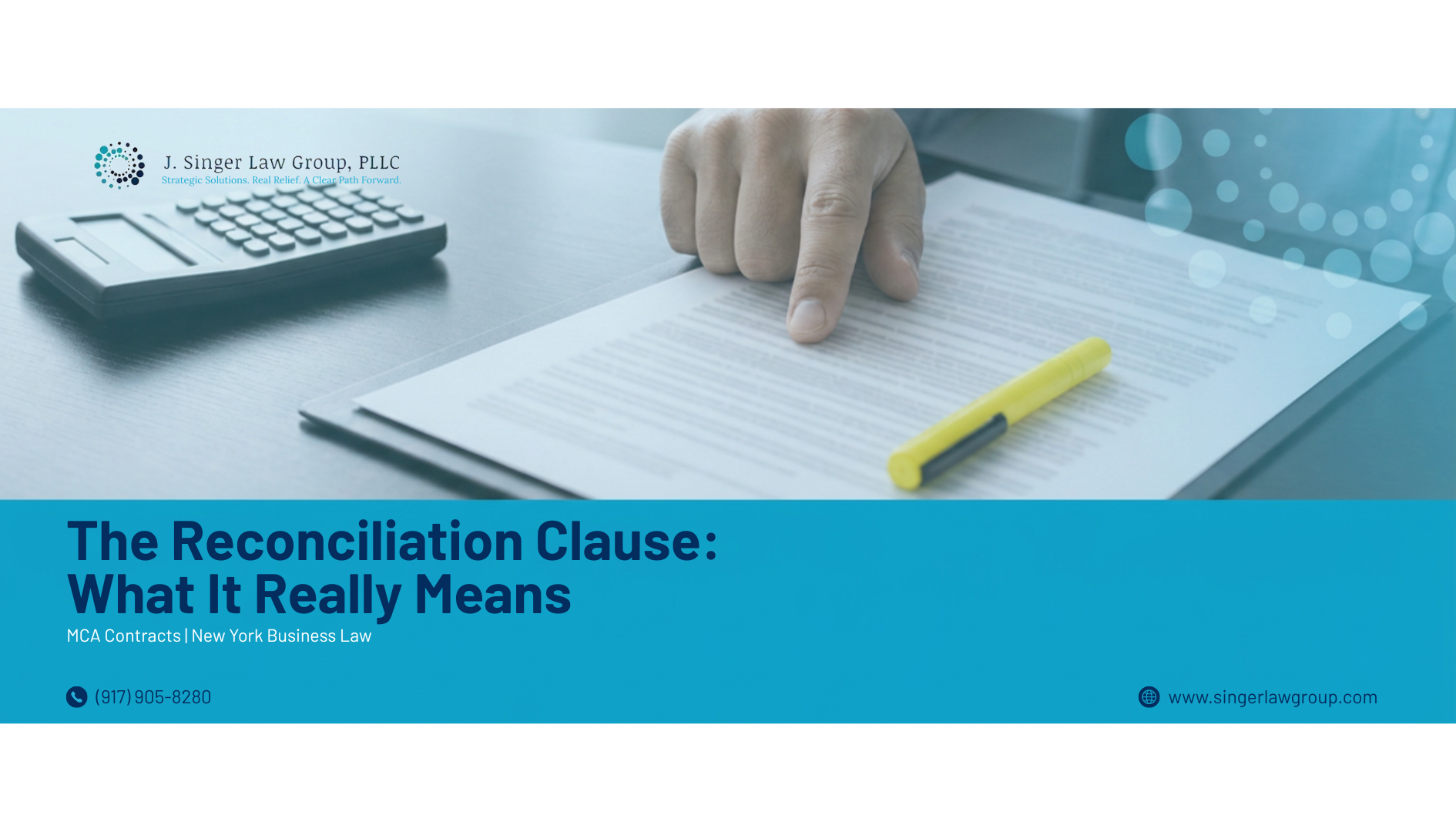
If your business has a Merchant Cash Advance, there is one section of the agreement you should find and read carefully: the reconciliation clause.
This provision addresses what happens when your actual revenue doesn’t match the revenue used to calculate your daily or weekly MCA payment.
That matters because an MCA is supposed to operate as a purchase of future receivables, not as a traditional loan with a fixed repayment obligation.
If business revenue drops, a genuine reconciliation provision should allow the payment to be adjusted based on actual receivables.
But having the words “reconciliation” or “adjustment” somewhere in the contract doesn’t necessarily answer the question.
You need to know what the clause actually requires.
Can you request an adjustment when revenue falls?
What documents do you have to provide?
Does the funder have discretion to reject the request?
And, just as important, what happens when you actually ask the funder to honor the provision?
Those details can become significant if the MCA later ends up in litigation.
New York courts look at how an MCA is structured and whether repayment is genuinely tied to receivables when determining whether the transaction operates as a true receivables purchase or may instead be treated as a loan.
The reconciliation clause is an important part of that analysis.
For a business owner already falling behind, facing collection pressure, or dealing with a funder that won’t adjust payments after revenue drops, this isn’t simply contract language buried in the agreement.
It may affect what options are available next.
What Is a Reconciliation Clause in a Merchant Cash Advance Agreement?
A reconciliation clause is the part of an MCA agreement that provides a process for adjusting the merchant’s payments based on actual business revenue.
To understand why that matters, start with how an MCA is supposed to work.
A merchant cash advance is generally structured as a purchase of future receivables. The funder provides money to the business upfront in exchange for an agreed amount of future business receipts.
The total amount to be remitted is commonly determined through a factor rate.
For example, if a business receives $37,500 and the agreement uses a 1.35 factor rate, the total amount to be remitted would be $50,625.
The funder may then collect toward that amount through daily or weekly ACH withdrawals.
But there is an important difference between purchasing receivables and requiring fixed loan payments.
Business revenue changes.
A restaurant can have a slow month.
A contractor can lose a major project.
A retailer can experience a seasonal decline.
A company can lose a customer that represented a significant part of its monthly revenue.
If an MCA is truly tied to future receivables, the payment structure should account for the possibility that those receivables won’t arrive exactly as projected.
That’s where reconciliation comes in.
A genuine reconciliation process gives the merchant a way to show that actual revenue has fallen and request an adjustment to the remittance based on what the business is really bringing in.
If payments remain fixed regardless of revenue, the legal analysis can become more complicated.
That’s why Singer Law Group’s Merchant Cash Defense work includes reviewing not only whether a reconciliation provision exists, but what the agreement actually requires and how the funder handled reconciliation in practice.
How the Reconciliation Clause Distinguishes an MCA from a Loan
The title on an MCA agreement doesn’t necessarily resolve how the transaction will be treated if it is challenged.
An agreement may call itself a “Purchase and Sale of Future Receivables Agreement.”
The funder may describe the transaction as a purchase rather than a loan.
Those words matter, but so does the substance of the deal.
The source article explains that New York courts look at several features of the transaction when deciding whether an MCA operates as a true purchase of receivables or more like a loan.
One of the most important is reconciliation.
Does the business have a genuine ability to adjust payments when actual revenue changes?
Another is risk.
If the business performs poorly, does the funder actually bear the risk that collection will slow?
And finally, is repayment truly contingent on receivables, or is the merchant effectively required to pay a fixed amount regardless of what the business earns?
Those questions work together.
If the funder receives the same payment no matter how much revenue the business generates, there may be less economic risk to the funder than you would expect in a true purchase of future receivables.
The reconciliation clause helps show whether that risk is real.
But the clause needs to do more than exist on paper.
How it is written and how it works in practice can matter.
What a Reconciliation Clause Typically Says
Reconciliation language varies from one MCA agreement to another.
Generally, the provision will explain that the regular remittance is based on an estimate of the business’s anticipated receivables and provide a procedure for adjusting that payment based on actual revenue.
Read that procedure carefully.
Some clauses use mandatory language requiring an adjustment when the contractual conditions are satisfied.
Others give the funder more discretion.
Some require the merchant to submit bank statements, processing records, or other financial documents before an adjustment will even be considered.
There may also be strict deadlines or notice requirements.
Those details shouldn’t be treated as boilerplate.
If you later need reconciliation, they tell you exactly what you must do to preserve the request.]
Pay particular attention to language explaining:
- Who may request reconciliation?
- How the request should be submitted
- Where the notice needs to be sent
- What financial documents are required
- How quickly those documents must be provided
- How the adjusted payment is calculated
- Whether the funder has discretion to approve or deny the request
- What happens to payments while the request is being reviewed
A clause can sound useful until you read the conditions attached to it.
That’s why the entire provision needs to be reviewed rather than relying on a salesperson’s explanation of how reconciliation supposedly works.
Factor Rates, Remittance Percentages, and Why the Distinction Matters
Factor rates and remittance percentages describe two different parts of an MCA transaction.
The factor rate helps determine the total amount of receivables the funder expects to collect.
The remittance percentage addresses how much of the merchant’s receivables should be going toward that purchased amount.
That distinction becomes important when revenue changes.
Suppose the business’s payment was calculated when deposits were significantly higher.
Revenue then falls, but the same ACH amount continues coming out of the account every day.
The payment now represents a much larger share of the company’s actual receipts than it did when the MCA began.
For a business already dealing with lower revenue, that can create immediate cash-flow pressure.
Payroll still has to be made.
Rent still has to be paid.
Taxes, vendors, inventory, insurance, and ordinary operating expenses don’t disappear because the MCA withdrawal stayed the same.
This is the practical purpose of reconciliation.
If the agreement ties remittances to actual receivables, a meaningful reconciliation process should address what happens when the original estimate no longer matches reality.
If the funder refuses to make an adjustment that the contract actually requires, that conduct may become important in a later dispute.
The business should not assume, however, that it can simply change or stop payments on its own.
The contract’s notice and reconciliation procedures matter.
Before taking action, understand exactly what the agreement requires and create a written record of the request.
That record becomes especially important if the funder refuses to honor the provision and the dispute moves toward settlement, Merchant Cash Advance Restructuring, or litigation.
How New York Courts Treat the Reconciliation Clause
When a New York court looks at an MCA agreement, the reconciliation clause can be an important part of deciding what the transaction really is.
The funder may call the agreement a purchase of future receivables.
But the court can look beyond the label and examine how the deal actually works.
That includes whether the funder took on a real risk that the business’s receivables could fall.
A meaningful reconciliation provision can support the argument that the transaction is a true receivables purchase. If revenue drops, payments can adjust. The funder’s collection depends, at least in part, on how the business performs.
A reconciliation provision that exists only on paper presents a different issue.
If the merchant has no practical way to obtain an adjustment, or the funder can disregard a proper request without meaningful limits, the agreement may deserve closer scrutiny.
The same is true when the funder refuses to honor the reconciliation process the contract itself provides.
That doesn’t mean one disputed request automatically decides the entire case.
It means the reconciliation clause, the language surrounding it, and the funder’s conduct can become part of the larger analysis of whether the MCA operates as a receivables purchase or as something closer to a loan.
The Three-Factor Test: Reconciliation, Finite Term, and Recourse
The source article identifies three issues New York courts consider when evaluating whether an MCA is a true purchase of future receivables or a disguised loan.
1. Reconciliation
The first question is whether the agreement contains a genuine reconciliation process.
Can the merchant request a payment adjustment when actual revenue changes?
Is the process clear?
Does the contract explain what documents must be submitted?
If the merchant satisfies those requirements, is there a meaningful path to an adjustment?
A reconciliation clause that works as written can support the funder’s position that repayment depends on future receivables.
A provision that is practically unavailable or entirely discretionary may support a different argument.
2. Finite term
The second issue is whether the transaction has what is effectively a fixed repayment period.
A true purchase of future receivables carries uncertainty.
If revenue falls, collection should take longer.
If revenue increases, collection may happen faster.
That makes the timing dependent on the performance of the business.
A transaction that instead requires a predetermined amount to be repaid over a predictable period can look more like a traditional loan.
The source article frames this as the difference between a term that adjusts with revenue and one that functions like a fixed repayment schedule.
3. Recourse
The third issue is who bears the risk if the business fails.
In a genuine receivables purchase, the funder is supposed to accept the risk that the receivables it purchased may not materialize as expected.
If the agreement makes the merchant absolutely responsible for repayment regardless of business performance, that can weigh in the other direction.
The source article also points to bankruptcy provisions as part of this analysis.
If bankruptcy automatically triggers default or acceleration, that language may be relevant to whether the funder truly assumed the risk associated with purchasing future receivables.
These factors should be considered together.
One contract provision should not be pulled out and treated as the entire case.
The question is how the transaction operates as a whole.
What Makes a Reconciliation Clause “Illusory” or “Unenforceable”?
A reconciliation provision may look useful when you first read it.
The real test is whether the merchant can actually use it.
The source article identifies several warning signs.
One is complete funder discretion.
If the contract says the funder “may” adjust payments but leaves the decision entirely to the funder even when the merchant provides the required financial records, the reconciliation right may be less meaningful than it first appears.
Another issue is impossible or impractical conditions.
A contract may offer reconciliation but impose requirements that make obtaining an adjustment extremely difficult in practice.
That can raise questions about whether the right is genuine.
A third issue is the funder’s conduct after a proper request.
If the merchant follows the contract, submits the required documents, and asks for reconciliation based on lower revenue, the funder’s response matters.
Was the request reviewed?
Was additional information requested?
Was the adjustment calculated under the contract?
Or was the request ignored or rejected without reference to the agreement?
Those facts can become important if the dispute later reaches court.
This is why business owners should document reconciliation requests carefully.
The contract tells you what the funder promised.
The correspondence shows what happened when you tried to use that promise.
New York Case Law on Reconciliation Clauses
The source article discusses several New York cases to show how courts have approached reconciliation provisions and MCA recharacterization.
The important takeaway isn’t that one case automatically determines the outcome of every MCA dispute.
The agreements and facts differ.
What the cases show is that courts can look closely at whether reconciliation is genuine and whether the transaction places real risk on the funder.
In LG Funding, LLC v. United Senior Properties of Olathe, LLC, the source article explains that the court treated reconciliation as an important part of
distinguishing a true receivables purchase from a loan.
The source article also discusses Principis Capital, LLC v. I Do, Inc. as another example of a court looking at the actual operation of the agreement rather than relying only on the contract’s title.
For a New York business owner, that is the point worth remembering.
The analysis doesn’t stop because the first page says “purchase and sale.”
The reconciliation language matters.
The payment structure matters.
The allocation of risk matters.
And what the funder actually did when revenue changed may matter too.
If those issues lead to a lawsuit, Singer Law Group’s Commercial Litigation practice may become relevant alongside the MCA-specific defenses raised under the agreement.
The Usury Connection: When a Failed Reconciliation Clause Exposes the MCA
Reconciliation can also matter because of the larger question of whether the MCA should be treated as a loan.
If the transaction is a genuine purchase of future receivables, traditional usury rules generally aren’t analyzed the same way they would be for a loan.
If the transaction is recharacterized as a loan, the interest-rate analysis becomes much more important.
The source article identifies New York’s criminal usury threshold as 25% per year.
But that threshold doesn’t mean every MCA with a high cost is automatically criminally usurious.
The order of the analysis matters.
First, determine whether the MCA may actually function as a loan.
Then evaluate the applicable annualized rate.
A reconciliation provision can become important at that first stage because it helps show whether repayment truly depends on receivables.
If the merchant’s payments never adjust when revenue falls, reconciliation isn’t realistically available, and the business remains obligated to pay a fixed
amount regardless of performance, those facts may support an argument that the transaction operates more like a loan.
If a court accepts that characterization, the interest rate can then become part of the defense.
That is why a reconciliation dispute shouldn’t be treated as a minor servicing problem.
Depending on the contract and the facts, it may affect the larger question of what the MCA legally is.
And that can materially change the business’s position when defending a collection action or negotiating with the funder.
How to Invoke the Reconciliation Clause as a New York Business Owner
If your revenue has dropped and your MCA payment no longer reflects what the business is actually bringing in, don’t start with a phone call asking the funder for a favor.
Start with the contract.
A reconciliation request should follow the procedure in your MCA agreement and create a clear written record of what you requested, when you requested it, and the financial information you provided.
That record can become important later if the funder refuses to adjust the payment and the dispute moves toward settlement or litigation.
The details matter here.
A casual email saying, “Business is slow. Can you lower my payment?” may not satisfy the requirements in your agreement.
Before sending anything, find the reconciliation provision and follow it carefully.
Step 1 — Locate the Reconciliation Provision in Your MCA Contract
Pull the complete MCA agreement.
The document may be called a “Purchase and Sale of Future Receivables Agreement,” a “Revenue Purchase Agreement,” or something similar.
Don’t stop at the payment schedule.
Read the provisions dealing with reconciliation, remittance adjustments, notices, default, and the documents the merchant must provide.
The reconciliation section may be labeled:
- Reconciliation
- Adjustment of Remittance
- True-Up
- Adjustment of Daily Remittance
- Reconciliation of Receivables
Once you find it, note the section number and read the language carefully.
Pay attention to the words the agreement uses.
Does it say the funder shall make an adjustment when the merchant satisfies the stated requirements?
Does it say the funder may adjust?
Does the funder retain discretion to approve or deny the request?
How much financial documentation must be submitted?
Is there a deadline?
Does the agreement require notice to be sent to a particular email address or physical address?
And what happens if the merchant is already in default?
Those details can affect both the request itself and any later dispute over whether reconciliation was actually available.
If you cannot find a reconciliation provision at all, don’t simply assume that means you can reduce the payments yourself.
The absence of a meaningful reconciliation mechanism may become important when the agreement is analyzed to determine whether the MCA operates as a genuine purchase of receivables or more like a fixed repayment obligation.
Document what the agreement says, or doesn’t say, before taking the next step.
Step 2 — Submit a Formal Written Reconciliation Request with Financial Documentation
Once you know what the contract requires, put the request in writing.
Your request should identify the reconciliation provision and explain why an adjustment is being requested.
The source article recommends including four basic pieces of information:
- The specific reconciliation provision and section number in the MCA agreement
- A statement explaining that actual business revenue has declined from the level used to establish the existing remittance
- Recent financial records showing that decline, such as bank statements or merchant processing records
- The adjusted remittance you believe reflects the business’s actual receipts under the contract.
The exact documentation and calculation should follow the language of your particular agreement.
Don’t guess.
If the contract requires three months of bank statements, provide what it requires.
If it requires merchant processing statements, include them.
If notices must be sent to a specific address, use that address.
And keep copies of everything.
The source article recommends sending the request through both email and a trackable form of mail so there is evidence showing when it was delivered.
That paper trail matters.
If the funder later says no reconciliation request was received, you want more than your memory of a phone conversation.
You want the request.
The supporting records.
The email.
And proof showing when it was sent and received.
The written record also makes it much easier to determine later whether the funder followed the reconciliation process contained in its own agreement.
Step 3 — What to Do If the Funder Ignores or Refuses Your Request
A refusal doesn’t necessarily mean the merchant should immediately stop payments.
And silence from the funder doesn’t mean you should assume the payment has been adjusted.
Document what happened.
If the funder responds in writing, preserve the response.
If someone calls and denies the request over the phone, follow up in writing. Identify when the conversation occurred, who you spoke with, and your
understanding of what was said.
If the funder doesn’t respond at all, consider sending a written follow-up referencing the original request and delivery date.
The objective is to create a clean record.
You want to be able to show:
- What the agreement required
- What you submitted
- When you submitted it
- What financial information supported the request
- How the funder responded
- Whether the existing withdrawals continued despite the request
That history can matter if the agreement is later challenged.
A documented refusal to follow a reconciliation provision may become part of a larger argument about whether the MCA genuinely operated as a purchase of receivables.
But don’t jump from a denied reconciliation request to taking unilateral action without understanding the consequences.
Stopping ACH payments can trigger default provisions.
The funder may begin collection activity.
A personal guarantee may become an issue.
A UCC filing may become relevant.
Litigation may follow.
At that point, the business needs to evaluate the contract and the larger financial picture rather than reacting to one denied request.
Depending on the circumstances, the next step may involve settlement, Merchant Cash Advance Restructuring, or defending the MCA agreement.
The right choice depends on what the contract says, what the funder did, and whether the business is dealing with one MCA or a larger debt problem.
Common Mistakes That Forfeit Your Reconciliation Rights
A reconciliation clause only helps if the business understands how to use it.
Some mistakes can make it much harder to show that the merchant properly requested an adjustment.
Submitting only a verbal request.
A phone conversation creates a weak record.
The funder may dispute what was requested, when it was requested, or whether reconciliation was discussed at all.
If you speak with the funder by phone, follow up in writing.
Your contract may also specify exactly how formal notices must be delivered.
Follow those instructions.
Waiting until after payments have already been missed.
Timing can matter.
The source article notes that some MCA agreements contain default provisions that may affect reconciliation rights once the merchant is already in default.
That’s why the reconciliation provision and default section should be read together.
If you know revenue has fallen and the existing remittance is becoming unsustainable, review the agreement before simply allowing the next payment to fail.
You want to understand what rights exist while the account is still current and what may change after default.
Sending financial records without clearly identifying the contractual request.
Bank statements alone don’t necessarily tell the funder what you’re asking it to do.
A reconciliation request should make the purpose clear.
Identify the applicable contract provision.
State that you are requesting reconciliation under that provision.
Explain that actual receipts have declined.
Then provide the financial records required by the agreement.
Make it difficult for anyone reviewing the file later to claim that the business merely sent financial documents without making a reconciliation request.
Relying on a verbal promise that the payment has been adjusted.
If a funder representative tells you the payment is being reduced, ask for written confirmation.
You should know the new amount, when it takes effect, how long it remains in place, and whether any additional documents or reviews will be required.]
Don’t assume a telephone conversation changed the written agreement or the existing ACH instructions.
Get the adjustment documented.
That is especially important if the business later faces a dispute about whether it complied with the MCA agreement.
The goal throughout this process is simple:
Follow the contract.
Put the request in writing.
Keep the financial records.
Preserve the funder’s response.
And know what the agreement allows before making a move that could trigger default.
If the funder refuses to follow a reconciliation provision after you’ve complied with the contract, that record may become much more important than the original phone call asking for help.
What Happens If Your MCA Has No Reconciliation Clause (or It Was Never Honored)?
A missing reconciliation clause can raise an important question about how the MCA actually works.
So can a reconciliation clause the funder refuses to honor.
Neither situation should be looked at in isolation.
The larger issue is whether the funder truly purchased future receivables and accepted the risk that comes with the business earning less than expected, or whether the merchant was effectively required to repay a fixed amount no matter what happened to revenue.
That distinction can become important if the MCA is challenged in court.
If your agreement has no meaningful way to adjust payments when revenue falls, the contract should be reviewed with the payment structure, default provisions, term of the agreement, and the funder’s rights if the business fails.
The same is true when reconciliation language exists but doesn’t work in practice.
A clause on paper is one thing.
What happens when the business actually tries to use it can tell a different story.
No Reconciliation Clause: The Agreement May Be a Loan
If an MCA agreement does not contain a reconciliation provision, that can factor into the analysis of whether the transaction operates as a true purchase of receivables.
The reasoning is practical.
A receivables purchase is supposed to depend on receivables.
If the business earns less, the funder’s collection should reflect the fact that fewer receivables are being generated.
If the merchant must continue making the same payment regardless of revenue, the transaction may begin to look more like a fixed repayment obligation.
That does not mean the absence of a reconciliation clause automatically turns every MCA into a loan.
The entire agreement still matters.
A court may look at whether there is a fixed term, what happens if the business fails, whether repayment is absolute, and who actually bears the risk that future receivables may never materialize.
Reconciliation is one important part of that larger analysis.
If the facts support recharacterizing the MCA as a loan, other legal issues may then become relevant, including New York’s criminal usury rules.
But the order matters.
First comes the question of what the transaction actually is.
Then comes the question of what laws apply to it.
Reconciliation Clause Exists, but Funder Refuses to Honor It
This situation can be important because there is a difference between having a contractual reconciliation right and having one the merchant can actually use.
Suppose the agreement says the merchant may request an adjustment when revenue declines.
The business follows the procedure.
It submits the required financial records.
It provides the information the contract asks for.
And the funder still refuses to adjust the payment.
That history matters.
The source article treats a funder’s refusal to honor reconciliation as potentially significant evidence in a later dispute over whether the MCA genuinely functioned as a receivables purchase.
The written record becomes critical.
Keep:
- The original MCA agreement
- The reconciliation request
- Bank statements and other financial records submitted with the request
- Proof showing when the request was delivered
- Emails with the funder
- Written denials
- Follow-up requests
- Records showing ACH withdrawals that continued after the request
If the funder denied the request over the phone, document that too.
Write down the date, the person you spoke with, and what was said. Follow up with an email confirming your understanding of the conversation.
The stronger the record, the easier it is to show what actually happened.
Don’t rely on a general statement that “they wouldn’t reconcile.”
Show the request. Show the documents. Show the response.
That evidence may become important if the funder later files a collection action and claims the agreement operated as a genuine purchase of receivables.
Recharacterization and the Criminal Usury Defense
If an MCA is ultimately treated as a loan rather than a purchase of receivables, New York’s usury laws may become part of the analysis.
The source article identifies 25% per year as New York’s criminal usury threshold.
That does not mean a high-cost MCA automatically violates the criminal usury law. The MCA first has to be analyzed to determine whether it can properly be characterized as a loan. Reconciliation can be important to that question.
If there is no meaningful reconciliation right, the payment obligation is effectively fixed, and the funder does not appear to bear the risk of the merchant’s declining receivables, those facts may support a recharacterization argument.
If the transaction is treated as a loan, the annualized cost can then be evaluated under the applicable usury rules.
For a business already facing an MCA collection action, this type of analysis may become part of a broader Merchant Cash Defense strategy.
The defense should be based on the actual agreement and payment history, not simply on the fact that the MCA was expensive.
UCC Lien Challenges When the MCA Is Recharacterized
Many MCA funders file UCC financing statements covering business assets or receivables.
Those filings can create real problems for a company trying to refinance, obtain new working capital, sell assets, or restructure its obligations.
If the MCA is being challenged, the UCC filing should be reviewed as part of the same analysis.
What collateral does the underlying agreement actually cover? What does the financing statement say? Does the filing accurately reflect the security interest granted under the contract? And if the underlying MCA obligation is disputed, what does that mean for the funder’s claimed lien rights?
The source article takes the position that recharacterization of the MCA may affect the enforceability of the related UCC filing.
The specific result, however, will depend on the agreement, the filing, and the legal posture of the dispute.
For the business owner, the practical point is simpler:
Don’t overlook the UCC filing.
If the MCA is being negotiated, defended, or restructured, determine what needs to happen to that filing as part of the resolution.
A deal that reduces the MCA balance but leaves a problematic UCC filing unresolved may not give the business the clean result it expected.
Personal Guarantee Exposure
A personal guarantee can make an MCA dispute much more serious for the owner.
If the business defaults, the funder may attempt to pursue the guarantor as well as the company, depending on the terms of the agreement.
That is why the guarantee needs to be reviewed together with the MCA contract.
What exactly did the owner guarantee? When does liability under the guarantee arise? Does the funder claim that a missed payment automatically triggers personal liability? How does the guarantee interact with reconciliation and the merchant’s obligations under the agreement?
Those questions matter.
The source article argues that if the underlying MCA is recharacterized and successfully challenged, that may also affect enforcement of the personal guarantee.
But business owners should not assume the guarantee disappears automatically.
The specific language and legal arguments need to be reviewed.
This is particularly important before signing a settlement.
A settlement with the business does not necessarily release the guarantor unless the agreement says so.
If a personal release is part of the negotiated deal, put it in writing.
Don’t assume the funder will treat the business settlement as a release of every claim against the owner.
The MCA, UCC filing, and personal guarantee are connected pieces of the same transaction and should be reviewed that way.
If several funders, guarantees, liens, and collection claims are putting pressure on the business at the same time, the problem may have moved beyond a single contract dispute.
At that point, a broader restructuring, including Chapter 11 Bankruptcy, may need to be evaluated alongside the business’s MCA defenses.
The question is not whether one clause can be challenged.
It’s what strategy gives the business the best chance to deal with the entire problem.
Reconciliation Clause Issues for NYC, Long Island, and Westchester Business Owners
The reconciliation language in an MCA agreement matters wherever a New York business is located. But the financial pressure behind these disputes can look very different from one business to another.
A restaurant in Manhattan may be dealing with high rent, payroll, and food costs while daily MCA withdrawals continue at the same amount after revenue falls. A contractor on Long Island may have several outstanding advances and uneven cash flow tied to project schedules.
A Westchester business may have a funder refusing to adjust payments even after the owner submits records showing that revenue has dropped. The legal analysis still starts in the same place.
What does the MCA agreement say?
Is there a reconciliation provision?
Can the merchant actually use it?
Did the business follow the required procedure?
And what did the funder do after receiving the request?
Those questions matter more than the business’s ZIP code. But location can still affect where a lawsuit is filed and how quickly a business needs to respond once litigation begins.
New York City (Manhattan, Brooklyn, Queens, Bronx, Staten Island)
New York City businesses often operate with little room for an unexpected hit to cash flow. Rent, payroll, inventory, insurance, taxes, and other operating costs continue even when revenue slows. Add a fixed daily or weekly MCA withdrawal, and the pressure can build quickly.
That’s why reconciliation should be addressed before the payment becomes impossible to make. If revenue has dropped, find the reconciliation provision and determine what the agreement requires.
Don’t wait until several ACH withdrawals have already failed before looking at the contract. If the business follows the reconciliation procedure and the funder refuses to make an adjustment the agreement appears to require, preserve the record.
Keep the request, financial documents, delivery confirmation, emails, and payment history. If the dispute later turns into litigation, those documents can help show what happened before the lawsuit was filed.
New York City MCA disputes may be brought in New York state courts, including the Commercial Division when the applicable requirements are met. The specific court and procedure depend on the case.
For the merchant, the important point is that once court papers arrive, the reconciliation dispute is no longer only a servicing issue.
It has become part of a litigation strategy.
Long Island (Nassau and Suffolk Counties)
Long Island businesses can face the same MCA pressure with a different operating cycle.
Construction companies, contractors, medical practices, restaurants, retailers, and other businesses may experience revenue that changes considerably from month to month.
That can create problems when an MCA withdrawal was established during a stronger period and remains unchanged after receipts decline.
The first question should be whether the agreement provides a real way to reconcile the payment.
If it does, follow that process before assuming the funder will voluntarily reduce the withdrawal.
If it doesn’t, or if the funder refuses to honor a proper request, the agreement may need a broader review.
For a business with several MCA obligations, the issue can become more difficult.
One funder may agree to reduce payments while another continues taking the full amount.
A third may already be threatening litigation.
At that point, solving one MCA at a time may not provide enough relief.
The business needs to know what all of the advances are taking together and whether operations remain viable after those payments.
When several MCA obligations are competing for the same cash flow, Merchant Cash Advance Restructuring may need to be considered as part of the larger strategy.
Westchester County
Westchester businesses dealing with MCA disputes should take reconciliation issues seriously before collection activity escalates.
If the agreement gives the merchant a contractual right to request an adjustment, use the procedure the agreement provides and document the request carefully.
That means more than telling the funder over the phone that business has slowed.
Put it in writing.
Provide the required records.
Keep proof of delivery.
And preserve the funder’s response.
If litigation follows, the business should be prepared to show exactly what the contract required and exactly what happened when reconciliation was requested.
The source article also discusses New York case law involving MCA transactions and the distinction between a true receivables purchase and a loan.
Those decisions reinforce why the entire transaction needs to be reviewed rather than focusing on a single sentence in the agreement.
Reconciliation matters.
So does the repayment structure.
So does the allocation of risk.
And so does the funder’s conduct.
A Westchester business facing an MCA lawsuit should have all of those issues reviewed together rather than assuming the funder’s characterization of the transaction controls the case.
Where Your MCA Lawsuit Will Be Filed
The source article states that MCA agreements commonly contain forum-selection provisions identifying where disputes must be litigated. That provision deserves attention.
The contract may select New York law and identify a particular court or county for litigation. Don’t assume the lawsuit will necessarily be filed where the business operates.
Review the forum-selection and venue language in the agreement. If a lawsuit has already been filed, compare the court named in the complaint with the provisions in the contract.
The proper forum can be a legal issue in its own right. For a business owner, however, the immediate priority is simpler: Do not ignore the lawsuit while trying to sort out where it should have been filed.Court deadlines still matter.
Preserve any venue or jurisdiction arguments while responding appropriately to the case.
How J. Singer Law Group Defends New York Merchants Against MCA Funders
An MCA dispute rarely starts with only one issue. The business may have requested reconciliation and been denied. Daily withdrawals may still be hitting the account. The funder may have filed a UCC financing statement.
The owner may have signed a personal guarantee. There may already be a default notice or lawsuit. And the business may have more than one MCA at the same time.
That’s why the first step isn’t choosing a defense before the documents have been reviewed. It’s understanding the entire relationship.
At J. Singer Law Group, that means looking at the MCA agreement, reconciliation language, payment history, financial records, UCC filings, guarantees, default notices, and court papers together.
From there, the strategy depends on what the documents and facts show.
Contract Review and Recharacterization Analysis
The contract review starts with the basic question discussed throughout this article:
Does the MCA actually operate as a purchase of future receivables?
The reconciliation provision is part of that analysis.
But it isn’t the only part.
We also look at whether the payment structure creates an effectively fixed term, what happens if the business fails, whether bankruptcy triggers default, and whether the funder genuinely bears the risk that future receivables may decline.
The payment history matters too.
A contract may contain reconciliation language that sounds meaningful.
If the funder repeatedly refused to adjust payments after proper requests, the actual relationship may tell a different story.
That is why the contract and the conduct need to be reviewed together.
Reconciliation Demand and Documentation
If the business still has an opportunity to invoke reconciliation, the request should be handled carefully.
The agreement needs to be reviewed first so the merchant knows:
- What provision applies.
- What records are required.
- Where the notice must be sent.
- Whether a deadline applies.
- How the requested adjustment should be calculated.
The request should then be documented in writing.
If the funder refuses, that refusal should be preserved.
If the funder ignores the request, follow-up communications should also be kept.
The objective is to create a record that can be used if the dispute later moves into settlement or litigation.
Litigation Defense
Once an MCA funder files suit, the business needs to address both the lawsuit and the underlying contract issues.
Depending on the facts, the defense may involve questions about reconciliation, recharacterization, usury, UCC filings, guarantees, default provisions, or other contractual issues identified during the review.
Singer Law Group’s Commercial Litigation practice can become part of that strategy when an MCA dispute moves into court.
The important thing is to raise legitimate defenses before they are lost.
A business owner should not assume settlement discussions make court deadlines disappear. Protect the litigation position while evaluating whether settlement or another resolution makes sense.
Settlement and Restructuring
Not every MCA dispute needs to be litigated through a final judgment. Sometimes the better result is a negotiated settlement. The strength of the business’s defenses can affect that negotiation. So can the company’s ability to pay.
The goal should be a resolution the business can actually perform, not simply a lower number on paper.
If the company has several MCA obligations, settlement with one funder may not be enough.
A broader restructuring may be necessary to prevent the remaining withdrawals from consuming the relief created by the first settlement.
And if the business is facing several MCA funders, lawsuits, UCC liens, guarantees, and other creditor claims at the same time, out-of-court restructuring may no longer be sufficient.
For qualifying smaller businesses, SubChapter V Bankruptcy may be one option to evaluate when the business needs a court-supervised restructuring but intends to continue operating.
The right answer depends on the financial problem.
Settlement, litigation, restructuring, and bankruptcy are different tools.
The strategy should be based on what gives the business a realistic path forward.
What to Bring to Your Consultation
If you’re having an MCA reconciliation problem, gather the documents before the consultation.
Bring:
- The complete MCA agreement
- Any amendments or addenda
- Your reconciliation request
- Bank statements or processing records submitted with the request
- Emails and other communications with the funder
- Payment history
- Default notices
- UCC financing statements
- Personal guarantees
- Settlement offers
- Summonses, complaints, judgments, or other court papers
If you have more than one MCA, bring the documents for all of them.
The relationship between the different advances can matter just as much as the terms of one agreement.
Also be prepared to explain what has changed in the business.
When did revenue decline?
Why did it decline?
What are the current daily or weekly MCA withdrawals?
Is the business still profitable before those withdrawals?
Are other creditors taking action?
The more complete the picture, the easier it is to determine whether the reconciliation dispute can be addressed on its own or whether the business needs a broader strategy.
Frequently Asked Questions: Reconciliation Clause MCA New York
What is a reconciliation clause in a merchant cash advance contract?
A reconciliation clause is the part of an MCA agreement that allows the merchant to request an adjustment to daily or weekly payments when actual business revenue falls below the level originally projected.
That provision matters because an MCA is supposed to be tied to future receivables.
If the business earns less, a genuine reconciliation process should provide a way for the payment to reflect that change.
The existence of the clause alone doesn’t answer every legal question.
Courts may also look at whether the merchant could actually use it, whether the funder honored valid requests, and whether the payment structure still operated like a fixed obligation regardless of revenue.
A reconciliation provision that exists only on paper may become part of a broader argument that the MCA functions more like a loan than a true purchase of receivables.
How do I invoke the reconciliation clause in my New York MCA agreement?
Start with the contract.
Locate the reconciliation provision and follow the procedure it requires.
Your request should be made in writing and should clearly identify the contract section you’re relying on. Include the financial records required by the agreement, such as bank statements or merchant processing records, showing that the business’s actual revenue has declined.
Keep copies of everything you send.
You should also preserve proof showing when the request was delivered.
A phone call alone creates a weak record.
If the agreement requires notice to a specific email address or physical address, use it.
The purpose is to create a clear history showing that the business invoked the reconciliation right properly and gave the funder the information it needed to respond.
What happens if my MCA funder refuses to honor the reconciliation clause?
A documented refusal may become important if the MCA is later challenged.
Suppose the business follows the contract, submits the requested financial records, and asks for a payment adjustment based on lower revenue.
The funder refuses or ignores the request.
That conduct may become part of the broader analysis of whether the MCA genuinely functioned as a purchase of receivables.
The stronger the written record, the easier it is to show what happened.
Keep the original request, supporting documents, proof of delivery, emails, written denials, and payment records showing what the funder continued to withdraw.
Do not assume a refusal gives the business permission to stop payments immediately.
Stopping payments may trigger default provisions and collection activity.
Before making that decision, review the agreement and consider whether settlement, restructuring, or litigation is the better next step.
Can a merchant cash advance be reclassified as a loan in New York?
Potentially.
New York courts can look beyond the title of an MCA agreement and examine how the transaction actually operates.
The source article focuses on several factors, including whether there is a genuine reconciliation mechanism, whether repayment is effectively fixed, and whether the funder actually bears the risk that the merchant’s receivables may decline.
If the facts show that the merchant must repay a fixed amount regardless of business performance, the transaction may be argued to function more like a loan.
That conclusion is not automatic.
The entire agreement and payment relationship need to be reviewed.
If the MCA is treated as a loan, other legal issues, including New York’s usury rules, may then become relevant.
Does New York’s usury law apply to my merchant cash advance?
Not automatically.
MCA agreements are generally structured as purchases of future receivables rather than loans.
Usury laws apply differently depending on how the transaction is legally characterized.
If the MCA is treated as a genuine receivables purchase, the usual loan-based usury analysis may not apply.
If the transaction is recharacterized as a loan, then the applicable interest-rate rules can become part of the case.
That is why the reconciliation issue comes first.
The question isn’t simply whether the MCA was expensive.
The question is whether the transaction actually operated as a loan.
What is the difference between civil and criminal usury in New York MCA cases?
The source article distinguishes between New York’s civil and criminal usury rules.
For MCA disputes involving business entities, the criminal usury analysis is often the more important one.
The source article identifies 25% per year as New York’s criminal usury threshold for loans.
But that number only matters after the MCA is analyzed to determine whether it can properly be treated as a loan.
The legal analysis should not begin and end with the factor rate.
It should begin with the contract structure, reconciliation rights, repayment obligations, and the funder’s risk.
Only after that can the interest-rate question be evaluated correctly.
Can I still use the reconciliation clause after I miss a payment?
That depends on the agreement.
Some MCA contracts contain default language that may affect reconciliation rights after a missed payment.
Others may treat the two issues differently.
This is why the reconciliation section and the default section need to be read together.
If your revenue is falling and you already know the existing payment is becoming unsustainable, review the agreement before the next payment fails.
Acting earlier may give you more options than waiting until the account is already in default.
What if the funder verbally agreed to lower my payment?
Get it in writing.
A verbal promise can be difficult to enforce later if the funder resumes the original ACH amount or disputes what was agreed.
The written confirmation should identify the new payment amount, when it begins, how long it will remain in effect, and whether additional documentation or future reviews will be required.
The written agreement is what protects the business if the relationship later deteriorates.
What if my contract does not contain any reconciliation clause?
The absence of a reconciliation mechanism may become relevant when the agreement is analyzed to determine whether the MCA operates as a true purchase of receivables or more like a loan.
That does not automatically make the agreement unenforceable. Other contract terms still matter.
The payment structure, term, allocation of risk, personal guarantee, default provisions, and the funder’s rights if the business fails should all be reviewed together.
If there is no meaningful reconciliation process and the merchant is required to make fixed payments regardless of revenue, that may support a broader recharacterization argument.
Can reconciliation problems help me negotiate a settlement?
They can affect leverage.
A well-documented reconciliation issue gives the merchant something concrete to raise in negotiations.
There is a difference between saying, “The payments are too high,” and being able to show that the business followed the contract, documented a substantial revenue decline, and the funder refused to follow its own reconciliation process.
That doesn’t guarantee a reduced settlement.
But it may affect how the funder evaluates the risk and cost of litigation.
The negotiation should still be based on a realistic payment proposal the business can actually perform.
What if I have several MCA agreements?
Review all of them together.
The reconciliation provisions may be different.
The payment schedules may be different.
The UCC filings, guarantees, default language, and funders’ collection positions may also be different.
Solving one MCA doesn’t necessarily fix the business’s cash-flow problem if several other advances are still drawing from the same revenue.
When multiple MCA obligations are putting the company under pressure, the discussion may need to move beyond reconciliation into restructuring or bankruptcy.
For qualifying smaller businesses, SubChapter V Bankruptcy may be one option to evaluate when individual negotiations are no longer enough.
Schedule a Free Consultation with a New York MCA Defense Attorney
If your funder has refused a reconciliation request, ignored the request entirely, or your agreement doesn’t contain a meaningful reconciliation process, don’t wait until collection activity becomes the only issue left.
Start with the documents.
Pull the MCA agreement.
Gather the reconciliation request and financial records.
Save the emails.
Locate any UCC filings, personal guarantees, default notices, settlement offers, or court papers.
The better the record, the easier it is to understand what happened and what options may still be available.
At J. Singer Law Group, we review the agreement, the reconciliation language, the payment history, and the broader financial condition of the business before recommending a strategy.
Sometimes the right next step is settlement.
Sometimes it is litigation.
Sometimes several MCA obligations need to be restructured together.
And sometimes the business needs court protection to address a larger creditor problem.
The point is not to assume one answer before the facts have been reviewed.
The point is to understand what the contract says, what the funder actually did, and what gives the business the strongest path forward.
If you’re dealing with a reconciliation dispute, MCA default, UCC filing, personal guarantee, or collection pressure, Contact Singer Law Group to discuss your situation.
If you’re ready to schedule a consultation, you can also Book an Appointment with our team.
Strategy. Not just defense.
J. Singer Law Group, PLLC represents business owners facing MCA disputes in New York and in matters governed by New York law. Call (917) 905-8280 to discuss your situation.