
MCA Funder Bank Restraint in NYC: How to Stop an Account Freeze Before It Kills Your Business
By Jeb Singer, Esq., Managing Partner, J. Singer Law Group, PLLC
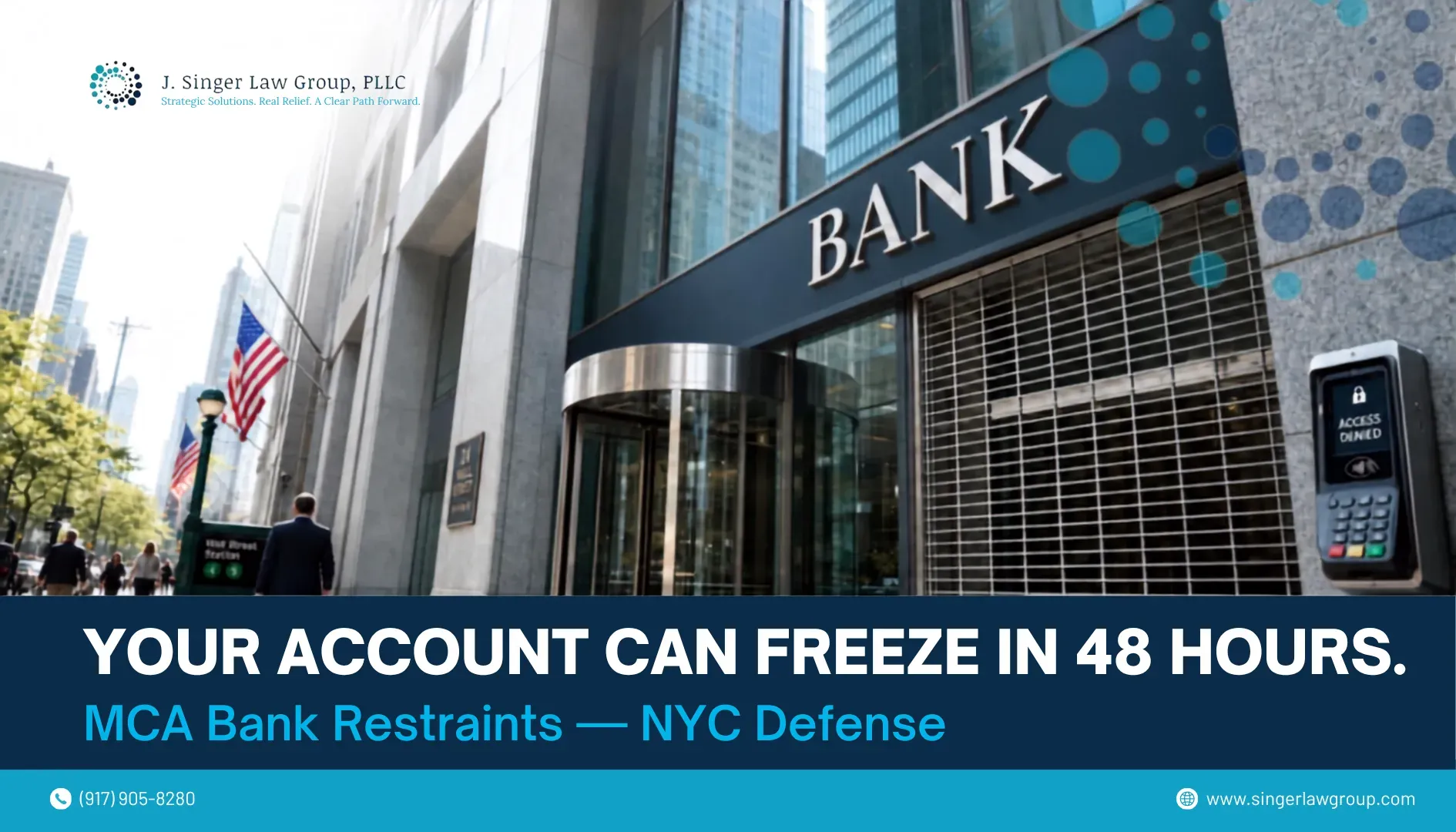
An MCA bank restraint can turn a business cash-flow problem into an immediate operating crisis.
You may discover the problem when payroll will not clear, a supplier payment is rejected, or your bank tells you that funds in the account have been restrained.
By that point, the MCA funder may already have taken enforcement action.
For a New York business owner, the priority is figuring out exactly what happened.
Was a judgment entered?
Was a Confession of Judgment involved?
Which funder obtained the judgment?
Where was it filed?
What amount is being claimed?
Which accounts have been restrained?
Is there a personal guarantee?
Are other MCA funders involved?
Those questions matter because a business shouldn't respond to an account restraint without understanding the full context.
The agreement, judgment, court filings, restraining notice, payment history, reconciliation provisions, guarantees, UCC filings, and the business's overall financial condition can all affect the available strategy.
Jeb Singer is the Managing Partner of Singer Law Group and co-founder of Singer Tariff Recovery. His practice includes business restructuring, bankruptcy, and disputes involving Merchant Cash Advance agreements.
Through Singer Tariff Recovery, Jeb also works with U.S. importers seeking to understand and organize potential tariff recovery opportunities. That work begins with the underlying customs records, including affected entries, Importer of Record information, entry status, and a clear administrative recovery plan.
The subject matter differs, but the approach is consistent: start with the documents, determine what the facts show, and build the strategy from there.
In an MCA bank restraint matter, that means starting with the MCA agreement and enforcement documents.
A bank restraint does not automatically mean the funder wins or that the business has no options.
Depending on the facts, potential strategies may include challenging a judgment or a Confession of Judgment, asserting contractual rights, negotiating with the funder, restructuring MCA obligations, or evaluating bankruptcy protection.
Not every option applies to every business.
The right response depends on the documents, the creditor structure, the strength of the available defenses, and whether the underlying business remains viable.
If your business account has already been restrained, speed matters.
But speed without a strategy can make the situation worse.
The first step is understanding exactly what the funder did and what legal and financial options remain.
What Is an MCA Bank Restraint, and How Does It Happen So Fast?
An MCA bank restraint occurs when a funder or other judgment creditor takes legal steps that restrict funds in a business bank account.
For the business owner, the effect can be immediate.
Money may still appear in the account, but the company may not be able to use it normally.
That can interfere with:
- Payroll
- Rent
- Inventory purchases
- Supplier payments
- Insurance
- Taxes
- Equipment payments
- Debt service
- Other operating expenses
The speed of the situation is one reason MCA enforcement can be so disruptive.
A business may spend weeks or months struggling with daily or weekly MCA payments, then discover the problem has shifted from cash-flow pressure to judgment enforcement.
The business owner may not understand what happened until the bank restraint is already in place.
That is why the first question should not be:
How much does the funder say we owe?
Start with:
What legal action has actually been taken?
Obtain the relevant documents and identify:
- The judgment creditor
- The court
- The index or case number
- The judgment amount
- The date of judgment
- The restraining notice
- The MCA agreement
- Any Confession of Judgment
- Personal guarantees
- UCC filings
- Payment history
- Default notices
- Reconciliation requests and responses
- Communications with the funder
These documents help determine what happened and what you can do next.
The Confession of Judgment: The Legal Weapon Behind Every Bank Freeze
A Confession of Judgment, commonly called a COJ, is a document that can allow a creditor to seek entry of a judgment based on a debtor’s prior written authorization, subject to applicable New York law and procedural requirements.
In the MCA context, the first question is whether the business signed a COJ and, if so, what it says.
Do not assume every MCA agreement is identical.
Review:
- Who signed the COJ?
- Which business entity is identified?
- Whether an individual guarantor is included.
- The amount described.
- The facts stated in support of the judgment.
- Where was the COJ filed?
- When was it executed?
- When was the judgment entered?
- Whether the filing complied with applicable requirements?
Once a judgment exists, the creditor may access enforcement procedures that were not available before judgment.
That is why identifying the judgment itself is critical.
If you learn about the problem from your bank, ask for whatever information the bank can provide about the restraint.
Then have counsel obtain and review the court filings.
The legal analysis should begin with the documents, not with assumptions about how MCA funders usually operate.
Depending on the circumstances, questions may involve the validity of the COJ, the judgment, the underlying MCA agreement, the amount claimed, the enforcement method, or other defenses.
Those issues require case-specific analysis.
For a deeper explanation of what happens when you default on an MCA, Singer Law Group has a separate resource addressing the progression from payment problems and default to potential enforcement.
How a Restraining Notice Works Under New York Law
After obtaining a judgment, a judgment creditor may use New York enforcement procedures to pursue assets that can legally be reached to satisfy that judgment.
A restraining notice served on a bank can prevent the transfer or use of funds that are subject to the restraint.
From the business owner’s perspective, the practical result can be severe.
The company may suddenly lose access to cash it expected to use for ordinary operations.
That is why the bank restraint should be treated as both:
A legal problem
and
An immediate business problem.
Counsel needs to understand the judgment and enforcement procedure.
Management needs to understand what the restraint means for:
- Payroll
- Employees
- Suppliers
- Customers
- Rent
- Taxes
- Insurance
- Inventory
- Other lenders
- Other MCA funders
- Daily operations
Do not make major decisions about moving money, opening accounts, transferring assets, or communicating with creditors without first understanding the legal consequences.
Instead, determine:
What account is restrained?
How much is restrained?
Which judgment is involved?
Who obtained the judgment?
Are additional accounts or assets potentially exposed?
Are there other judgment creditors?
Is there a personal guarantee?
What does the business need to keep operating?
That information helps counsel evaluate the immediate response while management assesses whether the business can continue operating during the dispute.
The Role of UCC Article 9 Liens in Cutting Off Your Cash Flow
A bank restraint and a UCC filing are not the same thing.
That distinction is important.
An MCA transaction may involve a UCC-1 financing statement or other rights relating to the business’s receivables or assets, depending on the agreement and transaction structure.
When a UCC filing exists, it can become another important part of the creditor analysis.
Counsel should determine:
- Which funder filed the UCC-1
- When it was filed
- What collateral is described
- Whether other creditors have UCC filings
- The order in which relevant filings were made
- Whether the company has traditional secured debt
- Whether several MCA funders claim interests in the same assets or receivables
This becomes particularly important when the business has more than one MCA.
What looks like a dispute with one funder may actually be a larger creditor problem.
For example, a company may have:
A bank restraint from Funder A
while
Funder B claims rights involving receivables.
and
A bank already holds a lien on business assets.
Looking at only one creditor can produce the wrong strategy.
The complete creditor picture matters.
That includes:
- MCA balances
- UCC filings
- Judgments
- Personal guarantees
- Bank debt
- Equipment financing
- Tax obligations
- Landlord obligations
- Other secured creditors
- Other significant unsecured debt
Once that picture is clear, the business and its counsel can begin evaluating the available paths.
That may involve litigation.
It may involve negotiation.
It may involve a broader MCA restructuring.
And when creditor pressure is too extensive to solve one funder at a time, you may need to evaluate bankruptcy.
The point is not to assume which solution is right.
The point is to understand the problem before choosing the solution.
An MCA bank restraint is serious.
But the restraint itself doesn't tell the whole story.
The agreement, judgment, enforcement documents, creditor stack, and the business's financial condition determine what comes next.
Why Are NYC Business Owners the Most Targeted Borrowers in the Country?
New York businesses operate in an environment where MCA agreements, Confessions of Judgment, UCC filings, personal guarantees, and aggressive collection efforts can create serious pressure when cash flow deteriorates.
But a business owner shouldn't assume every MCA dispute follows the same path.
The important question is not whether New York businesses are targeted more often than businesses everywhere else.
The important question is:
What enforcement action is being taken against your business right now?
A New York company dealing with an MCA bank restraint needs to identify:
- Which funder is involved?
- Which agreement is being enforced?
- Whether a judgment has been entered?
- Where the judgment was entered?
- Whether a Confession of Judgment was involved?
- Which bank accounts are affected?
- Whether a personal guarantee exists?
- Whether UCC filings are involved?
- Whether other MCA funders have claims against the business?
- Whether other secured or judgment creditors are involved?
That information determines the real scope of the problem.
A business with one MCA and a disputed judgment may require one strategy.
A business with four MCA funders, multiple UCC filings, several personal guarantees, tax obligations, bank debt, and a restrained operating account may require something entirely different.
That is why the analysis should go beyond the creditor that acted first.
Where COJs Are Filed: New York County vs. Kings County Supreme Court
If a Confession of Judgment is involved, one of the first steps is identifying exactly where the judgment was entered.
Do not rely only on what the funder or collection representative tells you.
Obtain the court information and review the actual filing.
Important information can include:
- Court
- County
- Index number
- Date of filing.
- Date judgment was entered.
- Name of the judgment creditor.
- Name of the business debtor.
- Name of any individual judgment debtor.
- Amount of the judgment.
- Confession of Judgment.
- Supporting affidavit.
- Enforcement documents.
- Restraining notice.
The filing location can matter because procedural requirements may depend on the facts surrounding the transaction, the parties, and the judgment.
The goal is not simply to find the case.
The goal is to understand how the creditor obtained the judgment and whether there is a basis to challenge what happened.
Questions may include:
Was the Confession of Judgment enforceable under the circumstances?
Was it filed in the proper place?
Were the required procedural steps followed?
Does the judgment match what the underlying agreement actually permits?
Is the amount accurate?
Were payments properly credited?
Is the individual guarantor actually included in the judgment?
Those are document-specific questions.
If there may be grounds to challenge the judgment, counsel can evaluate whether the business has a basis to fight a Confession of Judgment in New York.
The existence of a judgment should be taken seriously.
But it should also be reviewed.
A business owner should not assume that because a judgment appears on the court docket, there is nothing left to analyze.
The MCA Stacking Trap: When Multiple Funders Race to Freeze the Same Account
One MCA can create significant cash-flow pressure.
Multiple MCAs can create a much more complicated problem.
“Stacking” generally refers to a business taking on additional MCA obligations while one or more existing MCA positions remain outstanding.
The result can be several daily or weekly withdrawals competing for the same operating cash.
When revenue declines, the problem can compound quickly.
The business may begin using incoming revenue to satisfy yesterday’s financing obligations instead of today’s operating expenses.
Then one funder declares a default.
Another increases collection pressure.
A bank account is restrained.
A supplier is not paid.
Payroll becomes difficult.
The company may respond by seeking another advance, which adds another payment obligation to an already strained cash-flow structure.
At that point, treating each MCA as an isolated debt may no longer make sense.
The business needs a complete creditor analysis.
That should include:
- Outstanding balance claimed by each MCA funder
- Daily or weekly payment amount
- Remaining payment schedule
- Reconciliation provisions
- Default provisions
- Confessions of Judgment
- Personal guarantees
- UCC filings
- Judgments
- Pending lawsuits
- Bank restraints
- Traditional secured debt
- Tax obligations
- Landlord obligations
- Equipment financing
- Other significant creditors
Then compare those obligations against the company’s actual ability to operate.
Ask:
What is the company’s current weekly revenue?
How much are MCA funders withdrawing?
What does payroll require?
What does the business need for inventory and suppliers?
Which creditors are secured?
Which creditors have judgments?
Which owners signed personal guarantees?
Can the business remain viable if the current payment structure continues?
These questions help determine whether the problem can realistically be handled through negotiations with individual funders or whether the company needs a broader restructuring strategy.
The funder that restrained the bank account may be the most immediate problem.
It may not be the only problem to solve.
Long Island and Westchester Businesses: You Are Not Outside the Blast Radius
Businesses outside the five boroughs can face the same underlying MCA issues.
A company operating on Long Island or in Westchester may still have MCA agreements with New York provisions, Confessions of Judgment, personal guarantees, UCC filings, ACH authorizations, or other enforcement terms that need careful review.
Do not assume geography alone determines whether a funder can take enforcement action.
The analysis should begin with:
Where is the business located?
Where was the agreement made?
What does the agreement say?
Where is the funder located?
Was a Confession of Judgment signed?
Where was the judgment entered?
Where is the bank account maintained?
Who signed the personal guarantee?
What enforcement action has already occurred?
Those facts help counsel understand the dispute and determine what options may be available.
The same is true when the business has operations in several locations.
A company may be headquartered outside New York City but maintain bank accounts, customers, employees, assets, or business relationships in New York.
Do not assume enforcement risk based solely on the company’s mailing address.
Review the documents and the actual enforcement history.
One Restraint May Be a Warning of a Larger Restructuring Problem
A bank restraint creates an immediate crisis.
But management should also ask what caused the business to reach this point.
Was there a temporary revenue decline?
Did one major customer stop paying?
Did the business lose a contract?
Did seasonal revenue fall below expectations?
Did several MCA payments become unsustainable at the same time?
Did the company borrow again to keep up with existing MCA payments?
Is the core business still profitable before debt service?
Those questions matter because releasing or resolving one bank restraint may not fix the underlying financial problem.
If the business is fundamentally viable but its debt structure has become unmanageable, you may need to consider a broader restructuring.
That can involve:
- Negotiating with MCA funders
- Reviewing reconciliation rights
- Challenging judgments where legitimate grounds exist
- Restructuring payment obligations
- Addressing secured creditors
- Resolving tax or landlord obligations
- Evaluating litigation
- Considering bankruptcy when appropriate
The objective should be larger than getting through the next few days.
It should be determining whether the company can return to a sustainable operating structure.
That requires looking at the entire business.
Revenue.
Expenses.
Cash flow.
Assets.
Secured debt.
MCA obligations.
Judgments.
Guarantees.
Taxes.
And the company’s ability to continue operating.
A restrained account demands immediate attention.
But the strongest response also asks a broader question:
Is this one creditor problem, or is the restraint exposing a larger restructuring problem?
That answer can determine what the business needs to do next.
What Are Your Legal Rights and Defenses After a Bank Account Freeze?
A restrained bank account is serious.
It does not mean the legal analysis is over.
Once the business understands which creditor obtained the restraint and which judgment is being enforced, the next step is to review how the funder got there.
That review should begin with the documents.
Depending on the case, counsel may need to examine:
- MCA agreement
- Confession of Judgment
- Affidavit supporting the Confession of Judgment
- Judgment
- Restraining notice
- Payment history
- Default notices
- Reconciliation provisions
- Reconciliation requests and responses
- ACH authorization
- Personal guarantee
- UCC filings
- Communications with the funder
- Settlement communications
- Bank records
- Court filings
The purpose is not to search for a technicality.
It is to determine whether the funder has the rights it claims, whether the judgment and enforcement process are legally supportable, and what defenses or restructuring options are available.
Singer Law Group approaches Merchant Cash Advance defense by examining the legal dispute and the business's financial condition together.
A business may have a legitimate defense to part of a funder’s claim and still need a broader restructuring strategy.
Another company may have several MCA funders, judgments, tax obligations, and secured debt that one lawsuit cannot realistically resolve.
The right strategy depends on the full picture.
Grounds to Vacate a Confession of Judgment in New York
The existence of a Confession of Judgment does not mean every challenge is foreclosed.
But not every COJ provides automatic grounds to vacate it.
Counsel needs to review the specific judgment and the documents supporting it.
Potential issues may include how the Confession of Judgment was executed, where it was filed, whether it followed applicable procedural requirements, whether the amount entered is supported, and whether the underlying transaction or enforcement presents other defenses.
Start with the basic facts:
Who signed the Confession of Judgment?
Determine whether it was signed on behalf of the business, individually, or both.
What amount does it authorize?
Compare the judgment amount with the agreement and payment history.
Were payments properly credited?
Compare the judgment calculation with what the business actually paid.
Where and when was the judgment entered?
The filing history may matter to the procedural analysis.
What triggered the claimed default?
Determine what the funder says the business did and compare that with the agreement.
Was reconciliation requested?
If the agreement contains a reconciliation provision, review whether the merchant attempted to use it and how the funder responded.
What does the underlying MCA transaction actually require?
The substance of the agreement matters.
MCA transactions are generally structured as purchases of future receivables rather than traditional loans. In a dispute, however, counsel may examine whether the transaction's contractual terms and operation align with that structure.
That analysis can involve questions such as:
- Whether repayment was truly contingent on receivables
- Whether the agreement provided a meaningful reconciliation mechanism
- Whether the term was finite or effectively indefinite
- What happened if the business failed or revenue declined
- Whether the funder assumed a genuine risk that receivables would not be generated
- How the parties actually performed under the agreement
These are legal and fact-specific questions.
A business owner should not assume that calling an MCA a “loan” is enough to invalidate the agreement.
Likewise, the fact that a document is labeled a purchase of receivables does not eliminate the need to examine how the transaction was actually structured and enforced.
When legitimate grounds exist, counsel can determine what procedural steps may be available to challenge the judgment or seek other relief.
The important point is this:
Review the judgment before assuming it cannot be challenged.
Asserting Your Reconciliation Rights to Reduce or Stop ACH Withdrawals
Some MCA agreements contain reconciliation provisions designed to address changes between projected receivables and actual business performance.
The exact language matters.
A reconciliation provision may allow the merchant to request an adjustment when actual receivables differ from the amount used to calculate the regular remittance.
But the process is not necessarily automatic.
The agreement may require the business to:
- Submit a written request.
- Provide bank statements.
- Provide processing statements.
- Produce revenue records.
- Request reconciliation within a particular period.
- Follow a specified procedure.
- Continue complying with other contractual obligations.
If the business previously requested reconciliation, preserve the complete record.
That includes:
- Request sent to the funder.
- Date of request.
- Financial documents provided.
- Funder’s response.
- Any request for additional documents.
- Any adjustment offered.
- Any denial.
- Subsequent ACH withdrawals.
- Default notices sent afterward.
Those communications can become important in a later dispute.
If the company has not requested reconciliation, counsel should first review the agreement and circumstances before deciding what action makes sense.
Do not assume that sending an email containing the word “reconciliation” will automatically stop ACH withdrawals or undo an existing judgment.
Instead, ask:
Does the agreement provide a reconciliation right?
What does the provision actually require?
Did the business satisfy those requirements?
Did the funder honor the provision?
How does the reconciliation history affect the funder’s default claim?
The answers may affect both litigation and negotiation strategy.
A meaningful reconciliation provision can also matter when evaluating the nature of the underlying MCA transaction.
That is another reason to review the provision carefully rather than treat it as boilerplate.
Are Any Funds in Your Account Protected from an MCA Restraint?
Do not assume that an MCA funder can automatically take every dollar in a restrained account.
Do not assume the opposite either.
Whether particular funds can be reached can depend on the type of account, ownership of the money, the judgment, the restraint, applicable exemptions or protections, and other facts.
The first step is identifying what is actually in the account.
For example, determine whether the account contains:
- Ordinary operating revenue
- Payroll funds
- Customer funds
- Trust or escrow funds
- Insurance proceeds
- Loan proceeds
- Tax-related funds
- Funds belonging to another entity
- Other money that may require separate analysis
Keep records showing the source of significant deposits.
If funds belong to another person or entity, documentation may become especially important.
Counsel should also review exactly who is named in the judgment.
If the judgment is against one business entity, but the restraint affects an account belonging to another entity, counsel should investigate that distinction.
The same applies to individual accounts.
A judgment against a corporation or LLC does not automatically mean every account associated with an owner can be treated as property of the business.
Likewise, a judgment that includes an individual guarantor can create a different enforcement analysis.
Do not respond by moving or concealing assets.
That can create additional legal problems and make negotiations more difficult.
Instead, identify the source and ownership of the restrained funds and give counsel the records needed to determine whether there is a legitimate basis to seek relief.
Personal Guarantees: When the Funder Can Come After Your Personal Accounts
Many MCA agreements include some form of personal guarantee.
That can create serious exposure for a business owner.
But a guarantee doesn't answer every enforcement question.
You need to review the actual language.
Start by determining:
- Who signed the guarantee?
- What obligations are guaranteed?
- What events trigger liability?
- Whether the guarantee is limited or broad.
- Whether the guarantor is named in a judgment.
- Whether a Confession of Judgment includes the guarantor.
- What defenses may apply?
- What personal assets may be subject to enforcement?
- What exemptions or protections may apply?
Do not assume that because the business is an LLC or corporation, the owner’s personal assets are automatically protected from an MCA claim.
A valid personal guarantee can change that analysis.
At the same time, do not assume a funder can take any personal asset it chooses.
Judgment enforcement still follows legal procedures and applicable protections.
The distinction between business liability and personal liability becomes especially important when several MCA agreements are involved.
A business owner may have personally guaranteed:
Funder A
but not
Funder B.
Or different owners may have guaranteed different obligations.
Build a guarantee schedule.
This helps separate the company’s exposure from the owners’ individual exposure.
That distinction can become important when evaluating settlement, restructuring, litigation, or bankruptcy.
Your Defense Strategy Should Match the Real Problem
A bank restraint naturally puts the immediate focus on getting access to the account.
That matters.
But the business should also determine whether removing or resolving the restraint would actually solve the financial problem.
Consider a company with:
- Three MCA funders
- A restrained operating account
- Two personal guarantees
- Past-due taxes
- A traditional secured loan
- Current payroll obligations
- Declining revenue
Even if the business obtains relief from one restraint, the company may still have an unsustainable capital structure.
That is why an MCA defense should not automatically mean fighting every creditor separately.
Depending on the circumstances, the strategy may involve:
- Challenging a judgment
- Enforcing contractual rights
- Negotiating a temporary payment adjustment
- Reaching a settlement
- Restructuring multiple MCA obligations
- Addressing other secured or priority debt
- Evaluating bankruptcy protection
The business should ask two questions at the same time:
What can we do about this restraint?
and
What does the company need to become financially stable again?
Sometimes those questions lead to the same strategy.
Sometimes they do not.
A viable business with a temporary MCA dispute may need focused litigation or negotiation.
A viable business overwhelmed by several creditors may need a broader restructuring.
And a business that cannot meet payroll, operating expenses, taxes, and debt obligations under its current structure may need to evaluate whether bankruptcy provides tools that individual negotiations cannot.
The important thing is not to force every MCA case into the same solution.
Start with the documents.
Understand the judgment.
Identify the defenses.
Map the creditor structure.
Review the cash flow.
Then decide what strategy gives the business the best realistic path forward.
New York’s Evolving MCA Regulatory Landscape: What the Law Says Now
New York’s treatment of commercial financing has continued to develop as lawmakers, courts, regulators, funders, and businesses address how Merchant Cash Advance transactions operate in practice.
For a business owner facing an MCA bank restraint, those developments matter.
But they don't answer the immediate question.
The first question is still:
What does your agreement say, what judgment was entered, and what enforcement action has actually been taken?
An MCA dispute can involve several different legal and contractual issues at once.
Those may include:
- The structure of the MCA transaction
- Reconciliation provisions
- Default provisions
- Confessions of Judgment
- Personal guarantees
- UCC filings
- ACH authorizations
- Judgment enforcement
- Bank restraints
- The funder’s conduct
- The merchant’s payment and revenue history
The fact that New York law governing commercial financing has evolved does not mean every MCA agreement is invalid.
It also does not mean every funder has an unlimited right to enforce an agreement exactly as written.
Each transaction needs to be reviewed on its own facts.
Confessions of Judgment Require Careful Review
New York has restricted the use of Confessions of Judgment in commercial transactions.
For a business owner, the practical lesson is simple:
Do not assume a COJ is enforceable merely because the funder produced one.
And do not assume it is invalid simply because it arises from an MCA transaction.
Review the actual document.
Counsel should determine:
- Who signed it?
- When was it signed?
- Which entity is named?
- Whether an individual guarantor is named?
- Where was it filed?
- When was judgment entered?
- What amount was entered?
- Whether payments were properly credited?
- Whether applicable procedural requirements were followed?
- Whether other defenses may exist?
If the business has already been restrained, review the COJ alongside the judgment and restraining notice.
The objective is to determine what legal rights the funder actually has, not what either side assumes those rights to be.
Disclosure Rules Do Not Automatically Resolve an MCA Dispute
New York has also increased disclosure requirements for certain forms of commercial financing.
Those requirements reflect a broader focus on giving businesses more information about financing terms before they enter a transaction.
But disclosure regulation does not automatically answer whether a particular MCA judgment can be challenged or whether a bank restraint can be lifted.
For a business already in default, counsel still needs to review:
The agreement.
The payment history.
The claimed default.
The reconciliation provisions.
The judgment.
The enforcement action.
A regulatory issue may become relevant to the analysis.
It should not replace the analysis.
Do Not Build a Defense Around a Proposed Law
Business owners sometimes find articles or online discussions about proposed changes to MCA regulation and assume those proposals will stop current enforcement.
That can be dangerous.
A bill, proposal, or anticipated change in law should not be treated as though it already controls an existing dispute.
Your strategy needs to be based on the law that applies to the transaction and enforcement action now.
If the legal landscape changes while the dispute is pending, counsel can evaluate what effect, if any, that change has on the case.
Until then, focus on the documents and the facts.
A restrained business usually cannot afford to build its immediate strategy around what the law might become.
What to Do the Moment Your Account Is Frozen
When you discover that an MCA funder has restrained your business account, there is a natural temptation to start making calls immediately.
The bank.
The funder.
Your broker.
Another lender.
Your accountant.
Your employees.
Anyone who might help release the money.
Before making major financial or legal decisions, get organized.
The restraint creates urgency.
Your response still needs a strategy.
Day One: Call an MCA Defense Attorney, Not the Funder
Start by identifying exactly what happened.
Contact counsel experienced in MCA disputes and provide whatever documents you already have.
That may include:
- MCA agreement
- Confession of Judgment
- Personal guarantee
- Bank notice
- Restraining notice
- Judgment information
- Default notices
- Payment history
- Reconciliation requests
- Emails and text messages with the funder
- UCC information
- Recent bank statements
If you don't have all of those documents, don't wait to begin the review.
Start with what you have.
At the same time, ask the bank for information concerning the restraint.
Determine:
- Which creditor served it
- Amount being restrained
- Account affected
- Date received by the bank
- Court or judgment information available
- Whether other restraints have been received
Avoid making admissions, settlement promises, or payment commitments to the funder before you understand the judgment and agreement.
That does not mean every direct conversation with a funder is harmful.
It means the business should understand its position before negotiating from a crisis.
Counsel can then begin evaluating:
Is there a basis to challenge the judgment?
Does the agreement contain reconciliation rights?
Is the amount claimed accurate?
Is the business or an individual guarantor named in the judgment?
Are multiple MCA funders involved?
Is immediate negotiated relief possible?
Does the business need a broader restructuring plan?
At the same time, management needs to determine how long the business can operate under the restraint.
Calculate:
- Available unrestricted cash
- Payroll due
- Rent due
- Critical supplier payments
- Insurance
- Taxes
- Inventory requirements
- Essential operating expenses
- Incoming receivables
- Other automatic withdrawals
This creates the financial picture counsel needs when discussing possible solutions.
Day Two: Document Everything and Stop the Bleeding
Don't wait until the second day if you can complete these steps sooner.
The purpose of this stage is to create one complete file showing what the business owes, what has happened, and what it needs to keep operating.
Build a creditor list.
Then gather the agreements and enforcement documents for each major creditor.
For every MCA, identify:
- Original purchase amount
- Purchased amount or receivables amount
- Amount funded
- Payments made
- Balance claimed
- Daily or weekly remittance
- Reconciliation provision
- Default provision
- Personal guarantee
- Confession of Judgment
- UCC filing
- Lawsuit or judgment
- Bank restraint
- Current settlement discussions
Do not rely only on the funder’s payoff figure.
Compare it against the agreement and payment history.
Also preserve communications.
Emails, text messages, reconciliation requests, notices, and settlement discussions may become important.
One thing the business should be particularly careful about at this stage is taking on another financing product to survive the current MCA payments.
When a company is already under severe MCA pressure, a promise to “consolidate” or eliminate several obligations through a new program may sound attractive.
Review the terms carefully.
Singer Law Group has addressed the risks surrounding MCA debt consolidation fraud and programs that may leave distressed businesses in a worse position.
A new financing obligation does not solve the problem if the company cannot support the new payment structure.
The goal is not simply to replace one withdrawal with another.
The goal is to restore sustainable cash flow.
Day Three: Execute the Strategy
Again, do not wait three days to act if you can act immediately.
By this point, counsel and management should be working toward a clear strategy based on the documents, creditor structure, and the business's financial condition.
The available paths may include:
Challenge the judgment or enforcement action.
If legitimate legal grounds exist, counsel can determine what relief may be available.
Assert contractual rights.
If reconciliation or another contractual provision is relevant, determine how it affects the dispute.
Negotiate with the funder.
A negotiated resolution may involve temporary payment relief, modified payments, settlement, or another restructuring arrangement.
The terms depend on the funder, the business’s finances, the strength of the legal positions, and what the company can realistically perform.
Restructure several MCA obligations together.
If multiple MCA payments have become unsustainable, solving only the funder that restrained the account may leave the company in the same financial position.
A broader restructuring may be needed.
Evaluate bankruptcy.
If the business is viable but cannot manage its creditor structure through individual negotiations, bankruptcy may provide tools that out-of-court negotiations cannot.
Don't decide to file simply because an MCA account has been restrained.
Bankruptcy affects the entire business and creditor structure.
But you shouldn't ignore it when the company faces multiple judgments, unsustainable MCA payments, secured debt, tax obligations, lawsuits, or other collection activity.
Depending on the business and its circumstances, that analysis may include Chapter 11 bankruptcy or a potential Subchapter V case.
The right strategy depends on the numbers.
Build a 13-Week Cash-Flow Picture.
When a business is under immediate creditor pressure, management needs more than a monthly profit-and-loss statement.
Build a short-term cash-flow forecast.
A 13-week model can help show:
- Expected weekly collections
- Payroll
- Rent
- Inventory
- Taxes
- Insurance
- Critical suppliers
- Debt payments
- MCA withdrawals
- Other operating expenses
- Weekly cash balance
Then model more than one scenario.
Scenario 1: The restraint remains in place
How long can the company operate?
Scenario 2: The restraint is resolved, but existing MCA payments continue
Does the business become cash-flow positive?
Scenario 3: MCA payments are reduced or restructured
Can the company meet ordinary operating expenses?
Scenario 4: Several creditors continue enforcement
Does an out-of-court solution remain realistic?
Scenario 5: Bankruptcy protection is considered
Does the underlying business generate enough operating cash to support a restructuring?
This analysis helps separate a temporary liquidity crisis from a deeper balance-sheet problem.
The Goal Is Not Just to Unfreeze the Account
Getting access to the operating account may be the immediate priority.
It should not be the only objective.
If the business account is released tomorrow but the company still has three unsustainable MCA withdrawals, past-due taxes, unpaid suppliers, and no working capital, the crisis has only been delayed.
The broader goal is to determine what the business needs to survive.
That may mean fighting an improper judgment.
It may mean negotiating with one funder.
It may mean restructuring several MCA obligations.
It may mean evaluating Chapter 11 or Subchapter V.
And in some situations, the financial analysis may show that the business cannot realistically support continued operations under any reasonable restructuring.
The strategy should follow the facts.
Start with the judgment and MCA documents.
Map the creditors.
Understand the cash flow.
Protect the company’s ability to operate.
Then choose the legal and financial path that addresses the real problem, not simply the creditor that acted first.
Five Mistakes NYC Business Owners Make After an MCA Bank Restraint
An MCA bank restraint creates pressure to act immediately.
Payroll may be approaching.
Suppliers may be waiting.
Automatic payments may be failing.
Employees may be asking questions.
And the business owner may be trying to figure out how to keep the company operating while dealing with a funder that has already moved into enforcement.
Urgency matters.
But decisions made immediately after a restraint can affect what happens next.
Here are five mistakes business owners should avoid.
Mistake #1: Negotiating Before You Understand What Happened
When an account is restrained, the first instinct may be to call the funder and offer whatever payment is necessary to get the account released.
That may or may not be the right strategy.
Before making a settlement proposal, determine:
- Whether a judgment was entered.
- Whether a Confession of Judgment was involved.
- Amount of the judgment.
- Amount the funder claims remains due.
- Payments already made.
- Whether those payments were properly credited.
- Whether the agreement contains reconciliation rights.
- Whether a personal guarantee is involved.
- Whether the owner is individually named in the judgment.
- Whether there may be defenses to the judgment or enforcement action.
A negotiated resolution can be valuable.
But negotiation should begin with an understanding of the company’s legal and financial position.
Do not make a payment commitment the business cannot perform simply because the account is frozen.
A short-term agreement that creates another unsustainable payment schedule may only postpone the problem.
Mistake #2: Moving Money or Assets Without Legal Advice
A restrained business may immediately start looking for another place to deposit revenue.
Don't make that decision casually.
Moving money, changing accounts, redirecting receivables, transferring assets, or changing payment arrangements after a judgment or restraint can create additional legal and financial complications.
The consequences depend on the judgment, restraining notice, asset ownership, creditor rights, and what the business is trying to do.
Do not conceal assets or attempt to defeat lawful enforcement.
Instead, show counsel:
- The restraining notice
- Judgment
- Bank information
- Current account balances
- Expected receivables
- Accounts owned by related entities
- Payroll obligations
- Critical operating expenses
Then determine what the business can legally do to continue operating.
The objective is to protect the company while respecting the legal process, not to make a rushed transfer that creates a second problem.
Mistake #3: Taking Another MCA to Solve the Current MCA Problem
A business that cannot access its operating account may become desperate for liquidity.
That can make another MCA offer look like a solution.
Be careful.
If the company already cannot support its existing daily or weekly withdrawals, adding another payment obligation may deepen the cash-flow problem.
Before taking new financing, calculate what the business can actually support.
Start with:
Weekly revenue
minus
Payroll
minus
Rent
minus
Inventory and critical suppliers
minus
Taxes and insurance
minus
Essential operating expenses.
What remains is the cash available for debt service.
Compare that number with the company’s existing obligations.
If the math does not work before the new financing, another advance may not fix it.
The same caution applies to consolidation and debt-relief programs.
Understand who is offering the program, what fees are charged, what happens to existing payments, whether creditors have agreed to participate, and what the company will owe afterward.
The objective should be a sustainable capital structure, not another temporary cash source.
Mistake #4: Focusing Only on the Funder That Froze the Account
The funder that obtained the restraint is the immediate problem.
It may not be the only creditor threatening the business.
Build a complete list.
Include:
- Every MCA funder
- Judgments
- UCC filings
- Personal guarantees
- Bank debt
- Equipment financing
- Tax obligations
- Landlord obligations
- Significant supplier debt
- Pending lawsuits
- Other secured creditors
Then determine which creditors are already enforcing and which may be next.
This matters because resolving one restraint may not restore financial stability.
Suppose Funder A releases the account, but Funders B and C are also in default.
The company may still face additional collection activity.
Or the business may resume operations only to discover that the remaining MCA payments consume the cash it needs for payroll and inventory.
The solution needs to match the entire creditor problem.
Mistake #5: Waiting Until the Business Has No Options Left
A bank restraint signals that the dispute has already reached a serious stage.
Do not ignore it.
The longer the company operates without understanding its creditor position, the more difficult the situation can become.
Important records may become harder to locate.
Additional creditors may take action.
Payroll problems may grow.
Suppliers may stop shipping.
Customers may be affected.
Owners may make emergency decisions that would not have been necessary with a coordinated plan.
Act as soon as you learn about the restraint.
That does not mean filing a lawsuit or bankruptcy case immediately.
It means gathering the documents and determining what options actually exist.
Those options may include:
- Challenging a judgment where legitimate grounds exist
- Asserting contractual rights
- Negotiating with the funder
- Restructuring MCA obligations
- Coordinating resolutions with several creditors
- Evaluating bankruptcy protection
The earlier the business understands the problem, the more intelligently it can evaluate those choices.
Frequently Asked Questions: MCA Bank Restraints in New York
Can an MCA funder freeze my business bank account without warning?
A funder or other creditor may be able to restrain funds after obtaining the legal rights necessary to use New York judgment-enforcement procedures.
Whether that has happened in your case depends on the documents and procedural history.
If you discover a restraint, determine:
- Who obtained it?
- Whether a judgment exists?
- Where the judgment was entered?
- Whether a Confession of Judgment was involved?
- Amount being restrained?
- Which accounts are affected?
- Whether the judgment includes an individual guarantor?
Do not assume the bank can explain the entire legal history.
The bank may be able to identify the creditor and provide information concerning the restraint, but counsel should review the court record and underlying MCA documents.
What is a Confession of Judgment in an MCA agreement?
A Confession of Judgment, often called a COJ, is a document through which a party authorizes the entry of judgment under specified circumstances, subject to applicable legal requirements.
If an MCA funder relies on a COJ, review the actual document.
Important questions include:
- Who signed it?
- Which entity is named?
- Is an individual guarantor included?
- When was it executed?
- Where was it filed?
- What amount was entered?
- Were payments properly credited?
- Were applicable procedural requirements followed?
Do not assume that every COJ is enforceable simply because a judgment was entered.
At the same time, do not assume every COJ can be vacated.
The available defenses depend on the documents and facts.
Can an MCA funder freeze my personal bank account?
Personal exposure can depend on whether the owner signed a personal guarantee, whether the individual is included in a judgment, and what enforcement rights the creditor has.
The first step is reviewing the guarantee and judgment.
Ask:
Did I sign personally?
What exactly did I guarantee?
Am I named in the judgment?
What personal assets are potentially exposed?
Are any exemptions or other protections applicable?
An LLC or corporation does not necessarily eliminate personal exposure when an owner has signed a guarantee.
But a funder also does not automatically gain unrestricted access to every personal asset simply because a guarantee exists.
The specific documents and enforcement procedures matter.
Can reconciliation stop or reduce my MCA payments?
Possibly, depending on the agreement.
Some MCA agreements contain reconciliation provisions that address differences between projected receivables and actual business performance.
If your agreement contains one, determine:
- What the provision requires.
- How a request must be submitted.
- What financial records must be provided.
- Whether a request was previously made.
- How the funder responded.
- Whether the funder continued withdrawals.
- Whether the reconciliation history affects the claimed default.
Do not assume that requesting reconciliation automatically stops ACH withdrawals or removes an existing judgment.
Review the contract and the parties’ conduct.
Can I settle an MCA after my bank account has been restrained?
A negotiated resolution may still be possible after enforcement begins.
The terms depend on the circumstances.
Factors can include:
- Balance claimed
- Payments already made
- Available defenses
- Judgment status
- Number of MCA funders
- Business cash flow
- Available liquidity
- Personal guarantees
- Other creditors
- Business viability
- Whether bankruptcy is a realistic alternative
A settlement might involve a lump-sum payment, revised payment schedule, temporary relief, or another negotiated structure.
There is no universal settlement percentage or timeline.
The important question is whether the proposed resolution is one the business can actually perform.
A settlement that immediately puts the company back into a cash-flow crisis is not much of a solution.
When several MCA obligations are involved, consider broader MCA restructuring options instead of negotiating each debt in isolation.
Will bankruptcy stop an MCA bank restraint?
A bankruptcy filing can trigger the automatic stay, which generally stops many forms of collection activity against the debtor and property of the bankruptcy estate.
But whether bankruptcy is appropriate requires a much broader analysis than the existence of one MCA restraint.
Counsel should review:
- Business viability
- Revenue and operating cash flow
- Number of MCA funders
- Judgments
- Secured debt
- Tax obligations
- Leases
- Lawsuits
- Personal guarantees
- Assets
- Ability to fund a reorganization
For some qualifying small businesses, Subchapter V bankruptcy may provide a more streamlined path within Chapter 11.
For others, a traditional Chapter 11 case, an out-of-court restructuring, focused litigation, or negotiated settlement may make more sense.
Bankruptcy should not be treated as a threat to use against an MCA funder.
It is a restructuring process that affects the debtor and its creditor structure as a whole.
The right question is not:
“Can bankruptcy stop this funder?”
It is:
“Does bankruptcy give this viable business a better path to reorganize its entire financial structure?”
That requires looking beyond the restrained account.
A bank restraint is the immediate crisis.
The larger objective is to protect a viable business and create a financial structure it can realistically sustain.
Why J. Singer Law Group for MCA Bank Restraint Defense in NYC
An MCA bank restraint is rarely just a banking problem.
It may involve a Confession of Judgment.
A personal guarantee.
Several MCA funders.
UCC filings.
A judgment.
Tax debt.
Secured creditors.
Past-due suppliers.
Payroll pressure.
Or a business that is fundamentally viable but can no longer operate under its current debt structure.
That is why the strategy should not begin and end with:
“How do we get this account unfrozen?”
The better question is:
What does this business need to survive the restraint and become financially stable again?
J. Singer Law Group approaches MCA bank restraint matters from both sides of that problem.
The first is the immediate legal issue.
What happened?
Which funder acted?
What agreement is being enforced?
Was a Confession of Judgment involved?
What judgment was entered?
Is the amount accurate?
What accounts are restrained?
Does the agreement contain reconciliation rights?
Is there a personal guarantee?
Are there legitimate grounds to challenge the judgment or enforcement action?
The second issue is the business's financial condition.
Can the company continue operating under its existing payment structure?
Are several MCA funders involved?
Is the business current on payroll and taxes?
Are secured creditors involved?
Can the company realistically perform under a negotiated settlement?
Would resolving one MCA actually solve the problem?
Or does the business need a broader restructuring?
You need to answer those questions together.
Litigation When There Is Something to Fight
An MCA funder should not be challenged for the sake of creating litigation.
But when the agreement, judgment, Confession of Judgment, payment history, reconciliation process, or enforcement conduct raises legitimate legal issues, you should evaluate them.
That starts with the documents.
Counsel can review:
- MCA agreement
- Confession of Judgment
- Judgment
- Restraining notice
- Personal guarantee
- Reconciliation provisions
- Payment history
- Default notices
- UCC filings
- Bank records
- Communications with the funder
The objective is to determine what defenses actually exist.
Not every judgment can be vacated.
Not every MCA agreement can be challenged successfully.
Not every bank restraint can be immediately removed.
But a business owner should know whether there is a legitimate legal basis to fight before assuming the funder’s position is final.
Singer Law Group’s Merchant Cash Advance Defense practice helps business owners understand those options and develop a response based on the actual agreement and enforcement history.
Negotiation When a Business Solution Makes More Sense
Litigation is not always the best path.
Sometimes the business needs time.
Sometimes it needs a payment structure it can actually perform.
Sometimes several MCA obligations need to be addressed together.
And sometimes a negotiated resolution makes more economic sense than spending months fighting over a judgment.
The important issue is whether the proposed agreement solves the problem.
Evaluate a settlement against the company’s actual cash flow.
Management should understand:
- Required payment
- Payment frequency
- Settlement amount
- Duration
- Default provisions
- Personal guarantee exposure
- Treatment of existing judgments
- Treatment of bank restraints
- UCC releases, if applicable
- Effect on other creditors
- Whether the business can realistically perform
Do not agree to a payment simply because it gets the account released today.
Ask what happens next week.
And next month.
If the settlement puts the company back into default almost immediately, the business has not solved the underlying problem.
When several funders are involved, consider broader MCA restructuring options rather than negotiating with each creditor in isolation.
Bankruptcy When the Entire Creditor Structure Needs to Be Addressed
Some businesses cannot solve their financial problems one creditor at a time.
The company may have:
- Multiple MCA funders
- Judgments
- Bank restraints
- Secured debt
- Tax obligations
- Equipment financing
- Landlord claims
- Supplier debt
- Lawsuits
- Personal guarantees
If the underlying business is viable but the creditor structure has become unmanageable, you may need to evaluate bankruptcy as part of the strategy.
That does not mean bankruptcy is right for every business with an MCA problem.
It means you should consider it when the financial facts justify it.
A Chapter 11 bankruptcy can provide a structured process for addressing creditors while a business seeks to reorganize.
For qualifying small businesses, Subchapter V bankruptcy may offer another Chapter 11 restructuring path.
The analysis should begin with business viability.
Can the company generate positive operating cash flow if it addresses current debt pressure?
Can it meet ordinary operating expenses?
Can it maintain payroll?
Can it purchase inventory?
Can it satisfy ongoing obligations?
Is there a realistic path to reorganization?
If the answer is yes, bankruptcy may provide tools worth considering.
If the answer is no, filing a case to delay one MCA funder may not solve the company’s larger problem.
One Strategy Should Account for the Whole Business
The strongest MCA defense strategy isn't necessarily the most aggressive.
It is the strategy that fits the facts.
For one business, that may mean challenging a judgment.
For another, it may mean negotiating a settlement.
For another, it may mean restructuring several MCA obligations.
And for a company facing pressure from several different creditor groups, it may mean evaluating Chapter 11 or Subchapter V.
J. Singer Law Group looks at the immediate enforcement problem and the business's financial condition together.
That means asking:
What happened legally?
What does the business owe?
What can the business afford?
Which creditors have enforcement rights?
What defenses exist?
Is the underlying business viable?
What solution gives the company the best realistic path forward?
Jeb Singer is the Managing Partner of Singer Law Group and co-founder of Singer Tariff Recovery. His work includes business restructuring, bankruptcy, and disputes involving Merchant Cash Advance agreements.
Through Singer Tariff Recovery, Jeb also works with U.S. importers seeking to understand and organize potential tariff recovery opportunities. That process begins with the underlying customs records: identifying affected entries, reviewing Importer of Record information, organizing entry status, and developing a clear administrative recovery plan.
The subject matter is different, but the approach is the same.
Start with the records.
Understand the facts.
Identify the pressure points.
Then build the strategy around the client’s actual situation.
A Frozen Account Requires Action, but It Also Requires a Plan
If an MCA funder has restrained your business operating account, the immediate consequences can be serious.
Payroll does not wait.
Suppliers do not wait.
Rent does not wait.
And the business cannot operate indefinitely without access to working capital.
But urgency does not mean every business should take the same action.
Do not assume the funder’s position is unchallengeable.
Do not agree to a settlement the company cannot afford.
Do not take another MCA simply because the business needs cash today.
Do not ignore other creditors while focusing entirely on the funder that acted first.
And do not wait until the company’s operating options have disappeared before understanding the legal and financial picture.
Get the MCA agreement.
Get the judgment.
Get the restraining notice.
Identify the guarantees.
Map the creditors.
Understand the cash flow.
Then determine whether the business needs litigation, negotiation, restructuring, bankruptcy, or some combination of those strategies.
The goal is not simply to get through the bank restraint.
The goal is to give a viable business a realistic path forward.
Conclusion
An MCA bank restraint can put immediate pressure on payroll, suppliers, and day-to-day operations, but the frozen account is often only one part of the problem.
The right response starts with understanding the MCA agreement, judgment, restraint, personal guarantees, creditor structure, and the company’s actual cash flow. From there, the business can determine whether the best path is to challenge the enforcement action, negotiate with the funder, restructure MCA obligations, or consider bankruptcy protection.
J. Singer Law Group helps business owners look beyond the immediate crisis and build a strategy around the bigger goal: protecting a viable business and creating a realistic path forward.
If an MCA funder has restrained your business account, acting quickly matters. Just as important is making sure the next move is the right one.