
Commercial Foreclosure Defense in Brooklyn: Protect Your Property in Kings County Supreme Court
By Jeb Singer, Esq., Managing Partner, J. Singer Law Group, PLLC | Commercial Real Estate, Bankruptcy & MCA Defense
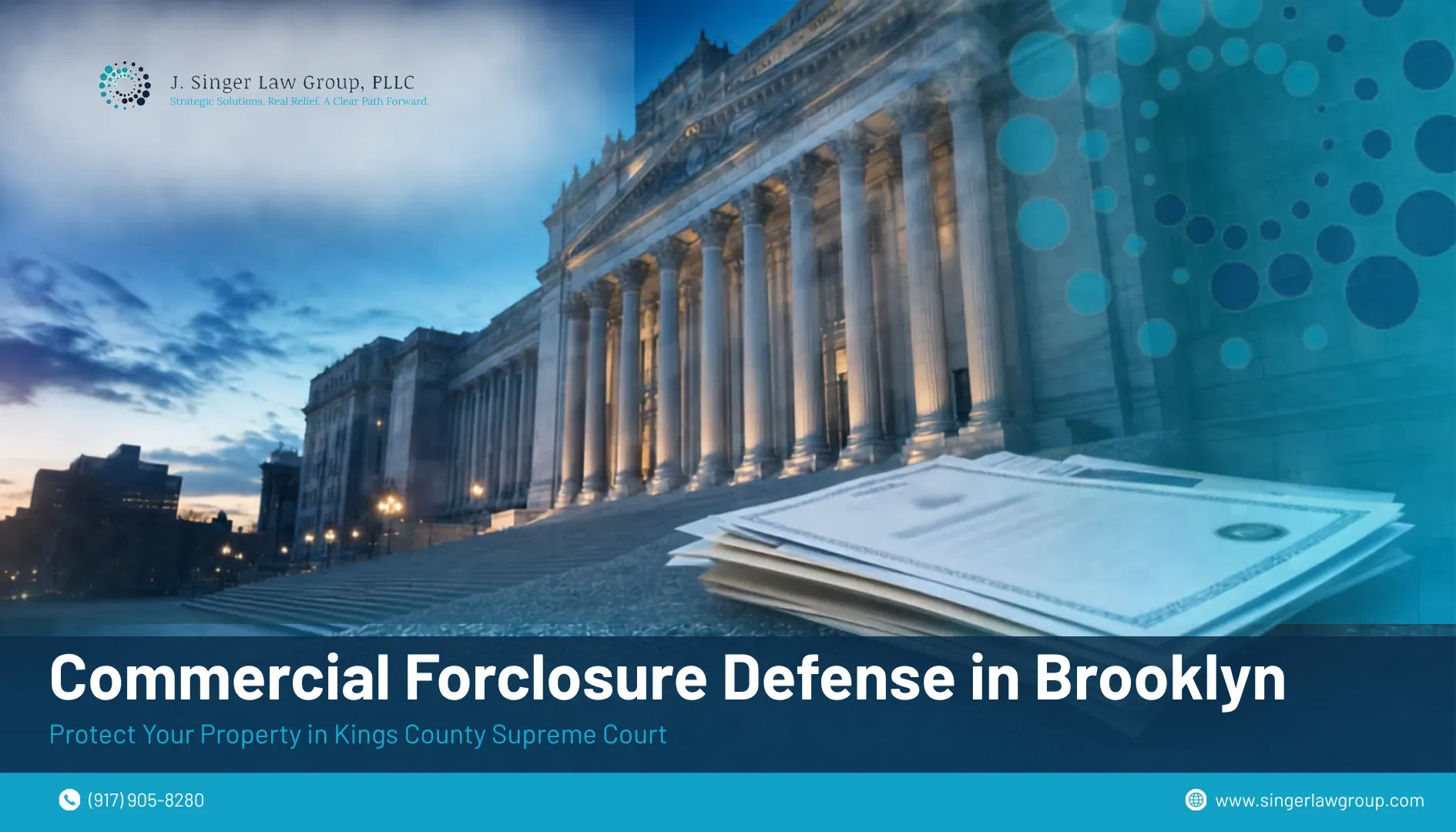
If you have been served with a commercial foreclosure Summons and Complaint involving a Brooklyn property, what you do next matters.
New York commercial foreclosure is a court process. A lender seeking to foreclose on commercial property generally must bring an action, establish its right to foreclose, obtain the required judgment, and proceed through a court-supervised sale.
That allows the property owner to respond.
But those rights need to be preserved.
The deadline to Answer depends on how service was made. In some circumstances, the deadline may be 20 days after service. In others, it may be 30 days. First, determine exactly when and how service occurred so you don't miss the applicable deadline.
From there, the strategy depends on the loan documents, foreclosure complaint, payment and default history, lender’s standing, prior notices and proceedings, property economics, and any personal guaranty.
For some owners, the strongest path may be to defend the foreclosure in state court.
For others, a commercial foreclosure defense in Brooklyn may need to proceed alongside negotiations for a forbearance agreement, loan modification, or another workout.
And when the property remains viable but the debt structure no longer works, Chapter 11 may also be an option.
These are not necessarily separate decisions.
A Brooklyn retail owner, mixed-use landlord, warehouse operator, office property owner, or multifamily investor may need to evaluate litigation, negotiation, and restructuring simultaneously.
The important thing is to understand the procedural posture before making decisions that could affect the property or the owner’s defenses.
Ignoring the case can allow the lender to seek relief without the borrower’s opposition.
Responding allows the property owner to determine what defenses and resolution options are actually available.
What Is Commercial Foreclosure Defense in Brooklyn?
Commercial foreclosure defense in Brooklyn is the process of responding to and defending a lender’s foreclosure action involving commercial property in Kings County, while evaluating available litigation, workout, restructuring, and property-resolution options.
A commercial foreclosure begins with an alleged default under a loan secured by commercial real estate.
The lender may claim that the borrower failed to make required payments, violated another provision of the loan documents, or triggered another event of default.
But the lender does not simply take ownership of the property upon declaring a default.
New York uses a judicial foreclosure process.
That means the lender generally must proceed through the courts and establish its right to foreclose.
For a commercial property located in Brooklyn, the foreclosure action is brought in the Supreme Court of Kings County.
The court process matters because the borrower can respond to the allegations in the complaint, assert appropriate defenses, contest genuinely disputed issues, and pursue a negotiated resolution where it makes financial and legal sense.
Commercial foreclosure defense therefore involves more than trying to delay a sale.
The first questions should be:
What does the loan agreement require?
What default does the lender allege?
Was the action properly commenced?
Can the plaintiff establish its right to enforce the loan?
Are there statute of limitations issues?
Were required procedures followed?
Does the borrower have claims or defenses arising from the transaction?
Is the property financially viable?
Did an owner or principal personally guarantee the debt?
Could the loan be modified or restructured?
Would a sale, refinance, negotiated exit, or bankruptcy provide a better result?
Those questions shape the strategy from the beginning.
Defining Commercial Foreclosure Under New York Law
A commercial foreclosure action involving Brooklyn real estate generally begins when the lender files a Summons and Complaint in Kings County Supreme Court and serves the defendants.
The complaint typically identifies the loan documents, the mortgage, the alleged default, the amounts claimed due, and the plaintiff’s asserted right to foreclose.
The borrower then has an opportunity to respond.
The deadline depends on the method of service, so review the service papers immediately.
An Answer allows the defendant to respond to the lender’s allegations and assert affirmative defenses that are available under the facts and law.
Do not copy those defenses from a generic list.
They should come from the actual loan and foreclosure record.
That review may include:
- The note
- Mortgage
- Loan agreement
- Modifications
- Assignments
- Default notices
- Acceleration notices
- Payment history
- Prior foreclosure proceedings
- Servicing records
- Guarantees
- The Summons and Complaint
- Affidavits of service
- Other documents relied on by the plaintiff
Each foreclosure case has its own history.
A defense that matters in one case may have no application in another.
That is why you should review the documents before deciding whether the strongest strategy is litigation, negotiation, restructuring, or some combination of the three.
How Brooklyn’s Judicial Foreclosure Process Works Under RPAPL Article 13
New York commercial mortgage foreclosures proceed through the state’s judicial foreclosure framework.
RPAPL Article 13 provides important parts of that process.
The lender commences an action and seeks a judgment authorizing the sale of the mortgaged property.
The borrower has an opportunity to appear and defend the case.
If the parties contest issues, they may proceed through motions, discovery where appropriate, and other court proceedings before a judgment is entered.
RPAPL § 1301 also addresses a lender’s pursuit of remedies involving the mortgage debt.
Its application depends on the procedural history and claims involved, so a borrower should review whether the lender has brought other actions involving the same debt and how those proceedings affect the foreclosure.
RPAPL § 1321 addresses the computation of amounts due and the use of a referee in the foreclosure process.
If the case progresses toward a judgment of foreclosure and sale, the amount the lender claims is owed may itself require review.
Principal, interest, default interest, late charges, advances, attorneys’ fees, and other claimed amounts can materially affect the final payoff or deficiency exposure.
The judicial process therefore provides more than one point at which the borrower may need to act.
The objective should not be delay for its own sake.
Use it to identify legitimate defenses, understand the lender’s claim, protect the property’s value, and determine whether the dispute can be resolved on better terms.
Commercial vs. Residential Foreclosure Defense: Key Differences in New York
Commercial and residential foreclosures both involve New York’s judicial foreclosure system, but you should not treat them as the same type of case.
One significant difference involves settlement conferences.
New York provides certain residential borrowers with statutory protections and procedures that do not necessarily extend to commercial borrowers.
Commercial borrowers generally should not assume that the court will create a workout process for them.
If a business wants to pursue a forbearance agreement, modification, discounted payoff, negotiated sale, or other resolution, it may need to develop that strategy directly with the lender while the foreclosure case continues.
Commercial foreclosure also involves financial and contractual issues that differ from those in a typical homeowner foreclosure.
The property may generate rental income.
There may be commercial leases.
Several entities may be involved in ownership or operations.
The loan may include cash-management provisions.
There may be assignments of rents.
Principals may have signed personal guarantees.
Other creditors may hold liens against the property or business.
The property may also be part of a larger operating business.
Those facts can affect both litigation and negotiation.
For example, a lender deciding whether to accept a workout may care about occupancy, rent collections, property value, operating expenses, taxes, insurance, and the borrower’s ability to perform under revised loan terms.
The borrower needs to understand those same numbers.
A defense strategy that ignores the property's economics is incomplete.
So is a workout strategy that ignores the pending foreclosure case.
The two should be evaluated together.
Property Types Covered: Retail, Mixed-Use, Office, Industrial, and Multifamily
Brooklyn commercial real estate takes many forms.
A foreclosure action may involve:
- A Williamsburg mixed-use property
- A Bushwick warehouse
- A Crown Heights retail building
- A Flatbush multifamily property
- A Sunset Park industrial facility
- A Red Hook commercial property
- A DUMBO office building
- A Downtown Brooklyn commercial property
The property type can affect the financial strategy.
A fully leased multifamily or mixed-use building may present a very different workout opportunity from a vacant retail property.
An industrial property with a strong operating tenant may support a different restructuring proposal from an office building facing significant vacancy.
But the core legal questions remain similar.
What does the lender need to establish?
What defenses does the borrower actually have?
What is the property worth?
What income does it generate?
What debt can it realistically support?
Is there personal guaranty exposure?
And which outcome gives the owner the strongest, most realistic path forward?
Commercial foreclosure defense should answer those questions early.
The goal is not simply to remain in litigation.
It is to understand the legal and financial position well enough to decide what should happen next.
What Brooklyn Commercial Foreclosure Defense Strategies Actually Work?
No single defense works in every Brooklyn commercial foreclosure.
The strategy needs to come from the loan documents, foreclosure complaint, payment history, prior proceedings, lender conduct, property economics, and the borrower’s goals.
Some cases have substantial litigation issues.
Others are better positioned for a negotiated workout.
And some require both.
The first objective is to determine what the lender must prove and whether the foreclosure record supports those claims.
From there, the property owner can decide which defenses to raise and whether to proceed with litigation alongside settlement, restructuring, or another resolution.
Challenge the Lender’s Standing to Foreclose
Standing can be an important issue in a New York commercial foreclosure.
If standing is properly disputed, the plaintiff may need to establish that it had the necessary interest in the note when the foreclosure action was commenced.
That requires looking beyond the name appearing on the foreclosure complaint.
Review the loan history.
Who originated the loan?
Was the note transferred?
Were there assignments?
Who possessed or otherwise had the right to enforce the note when the action began?
Do the documents relied on by the plaintiff support its claimed interest?
The review may include:
- The original note
- Allonges
- Mortgage
- Assignments
- Loan-transfer records
- Affidavits submitted by the plaintiff
- Servicing records
- Prior foreclosure filings
- Other documents offered to establish the plaintiff’s rights
An assignment issue does not automatically defeat a foreclosure.
Neither does a technical defect that has no legal effect on the plaintiff’s right to enforce the note.
The question is whether the plaintiff can establish standing under the facts of the case.
Timing matters too.
Courts should evaluate standing early because procedural rules can affect how and when the issue must be raised.
If the loan has changed hands several times or the foreclosure plaintiff differs from the original lender, the transfer history warrants careful review.
The borrower should not assume the plaintiff lacks standing because the loan was assigned.
But the borrower should not assume standing has been established because the plaintiff says it owns the debt.
Review the evidence.
Assert the Six-Year Statute of Limitations Under CPLR 213(4)
New York generally applies a six-year statute of limitations to a mortgage foreclosure action.
In a commercial foreclosure, the loan's history can matter.
The analysis may involve questions such as:
When did the alleged default occur?
Was the debt accelerated?
Was there a prior foreclosure action?
What happened in that action?
Was it dismissed or discontinued?
Were later notices sent?
Did the parties enter a modification or other agreement?
Did the lender take other action affecting the debt?
Do not determine the limitations period from the date on the current complaint alone.
A loan may have years of history.
Prior acceleration and foreclosure activity can affect the analysis, and New York law governing limitations on mortgage foreclosure needs to be applied to the actual procedural history.
That is why prior court records matter.
If there was an earlier foreclosure action involving the same property and debt, obtain:
- The complaint
- Any Answer
- Acceleration notices
- Motions
- Orders
- Judgment information
- Discontinuance papers
- Settlement or modification documents
- Relevant correspondence
Then compare those documents with the current action.
A statute-of-limitations defense can be significant when supported by the record.
But do not assert it based on assumptions about when the lender accelerated the loan or what effect a prior proceeding had.
Build the timeline first.
Then determine what the law does with it.
Raise Procedural Defects and Notice Failures
Commercial lenders still have to follow the procedures applicable to the foreclosure action and the parties’ loan documents.
That creates another area for review.
Start with service.
Was the correct borrower served?
Were guarantors or other necessary parties named where appropriate?
How was service made?
Does the affidavit of service match what actually occurred?
Then review the loan documents.
Commercial loan agreements often contain their own notice provisions.
A lender may be required to provide notice of a particular default, send notice to a specified address, allow a contractual cure period, or satisfy another condition before exercising certain remedies.
Whether a notice problem creates a defense depends on the agreement and the nature of the defect.
Do not assume every mistake defeats the foreclosure.
At the same time, do not treat notice provisions as meaningless simply because the borrower knows payments were missed.
Review:
- Default notices
- Acceleration notices
- Contractual cure provisions
- Addresses specified in the loan documents
- Delivery requirements
- Proof of mailing or delivery
- Summons and Complaint
- Affidavits of service
- Amendments or modifications affecting notice
Also review the foreclosure complaint for what the lender alleges.
Does it accurately identify the loan?
Does the claimed default match the documents?
Does the plaintiff allege compliance with contractual conditions that the borrower disputes?
Are the amounts claimed consistent with the payment history?
Procedural defenses need to be tied to facts.
The purpose is not to search for harmless errors.
It is to determine whether the lender complied with requirements that affect its right to obtain the relief it is requesting.
Challenge Usurious or Predatory Lending Terms Where Applicable
Some commercial financing arrangements may raise questions about interest rates, fees, default charges, or the transaction's true economic substance.
Usury may be one issue to evaluate.
But a commercial loan's high interest rate does not automatically create a defense.
New York’s usury laws contain important limitations and exceptions.
The availability of a usury defense may depend on factors including:
- The identity and legal form of the borrower.
- The principal amount of the loan.
- The interest and charges being evaluated.
- The structure of the transaction.
- Whether an applicable statutory exception exists.
- The particular usury theory being asserted.
That means a commercial property owner should not look only at the stated interest rate.
The entire transaction may need to be reviewed.
That can include:
- Stated interest
- Default interest
- Origination charges
- Exit fees
- Extension fees
- Other amounts charged in connection with the loan
Bridge loans and hard-money financing can be expensive.
Expensive does not automatically mean unlawful.
If the transaction's economics raise a legitimate usury or lending-law issue, however, evaluate it before the borrower assumes every amount claimed in the foreclosure is enforceable.
The same principle applies to other lender conduct.
If the borrower believes the lender violated the loan agreement, misapplied payments, imposed unauthorized charges, or engaged in conduct affecting the foreclosure claim, preserve the records supporting that position.
The defense needs evidence.
Negotiating Forbearance Agreements and Loan Modifications in Parallel
Defending the foreclosure does not necessarily mean the borrower and lender cannot negotiate.
In many commercial cases, they should evaluate both tracks.
The litigation protects the borrower’s legal position.
The workout discussions explore whether the loan can be resolved without completing the foreclosure.
A forbearance agreement may provide the borrower additional time while the lender agrees to refrain from taking specified enforcement steps, subject to negotiated conditions.
A modification may change payment terms, maturity, interest, treatment of arrears, or other provisions of the existing loan.
Other negotiations may involve:
- A reinstatement
- Extended maturity
- Modified amortization
- Interest adjustments
- Arrears repayment
- Discounted payoff
- Property sale
- Refinancing
- Deed-in-lieu discussions
- Deficiency treatment
- Personal guaranty exposure
The right proposal depends on the property.
A lender considering a workout will want to know whether the property can support the restructured debt.
The borrower should know that too.
Before proposing terms, understand:
- Current property value
- Rental income
- Occupancy
- Operating expenses
- Taxes
- Insurance
- Existing liens
- Capital needs
- Current debt service
- Cash available for a reinstatement or settlement
- Realistic future debt-service capacity
A commercial real estate loan workout should address the property's economics, not simply ask the lender for more time.
The pending foreclosure must remain part of the strategy.
Do not assume that settlement discussions stop litigation deadlines.
Unless an agreement or court order provides otherwise, the foreclosure case may continue while the parties negotiate.
That means the borrower should protect its court position while pursuing a business resolution.
The two tracks can support each other.
A properly defended case may give the parties time to evaluate a workout.
A viable workout may eliminate the need to litigate the foreclosure through judgment and sale.
The goal is not to choose litigation simply because a lawsuit exists.
It is to determine which combination of litigation and negotiation best protects the property owner’s position.
Five Mistakes Brooklyn Commercial Property Owners Make After Receiving a Foreclosure Summons
The first days after receiving foreclosure papers can affect what options remain available later.
A commercial property owner does not need to make every strategic decision immediately.
But certain mistakes can make the case harder than it needs to be.
Mistake 1: Ignoring the Summons While Trying to Work Things Out With the Lender
Workout discussions do not replace the obligation to respond to a foreclosure action.
A borrower may already be speaking with the lender, servicer, or workout department when the Summons and Complaint arrive.
Do not assume those discussions mean the lawsuit is on hold.
Unless the lender has agreed otherwise or the court has entered appropriate relief, litigation deadlines continue to run.
Determine the Answer deadline based on how you served the complaint.
Then make sure you address the foreclosure case while negotiations continue.
This is one of the most important distinctions in commercial foreclosure defense:
You can negotiate and defend at the same time.
Do not sacrifice one while pursuing the other.
Mistake 2: Assuming There Are No Defenses Because the Loan Is in Default
A payment default does not answer every legal question in a foreclosure action.
The lender still needs to establish its entitlement to the relief it seeks.
Depending on the case, issues may exist involving:
- Standing
- Statute of limitations
- Notice
- Service
- Loan accounting
- Default interest
- Fees
- Prior foreclosure proceedings
- Loan modifications
- Assignments
- Other contractual requirements
That does not mean every borrower has a winning defense.
It means default and foreclosure are not the same question.
The borrower may acknowledge missed payments while still disputing the lender’s right to recover a particular amount or proceed in a particular way.
Review the case before deciding there is nothing to defend.
Mistake 3: Negotiating Without Knowing the Property’s Numbers
A workout proposal needs to be financially credible.
Telling a lender that the borrower “just needs more time” is not the same as showing how the property can perform under revised terms.
Know the numbers before proposing a modification or forbearance.
Prepare current information concerning:
- Rent roll
- Occupancy
- Operating income
- Operating expenses
- Taxes
- Insurance
- Existing liens
- Property value
- Capital expenditures
- Available liquidity
- Proposed payment capacity
Then determine what the property can realistically support.
A workout that merely postpones another default may not protect the property for long.
The objective should be a structure the borrower can actually perform.
Mistake 4: Focusing Only on the Property and Ignoring the Personal Guaranty
The foreclosure action concerns the mortgaged property.
The owner’s financial exposure may extend beyond it.
If a principal signed a personal guaranty, review that document early.
Do not wait until a foreclosure sale is approaching to determine what the lender may claim against the guarantor.
Ask:
Is the guaranty limited or unlimited?
Does it contain carve-outs?
What events trigger liability?
Does it cover a deficiency?
Does it include attorneys’ fees or other costs?
Are there defenses specific to the guaranty?
The answers may affect the entire foreclosure strategy.
For example, an owner deciding whether to invest additional money into a workout should understand what personal exposure may remain if the workout fails.
Likewise, a negotiated sale or surrender of the property should not be evaluated only by what happens to the mortgage.
What happens to the guaranty matters too.
Mistake 5: Waiting Until a Foreclosure Sale Is Imminent to Consider Bankruptcy or Other Exit Options
A property owner may have several possible paths:
Defend the foreclosure.
Negotiate a modification.
Enter a forbearance agreement.
Refinance.
Sell the property.
Pursue a negotiated surrender.
Consider Chapter 11.
The right choice depends on the property and debt structure.
Waiting until late in the foreclosure process can reduce the practical time available to evaluate those choices.
If the property is viable but the current debt cannot be sustained, evaluate restructuring before the situation becomes an emergency.
If the property is no longer economically viable, the owner should understand the consequences of an exit, including potential deficiency and guaranty exposure.
And if Chapter 11 may be necessary, the decision should be based on a restructuring strategy rather than simply the desire to stop an approaching sale.
Commercial foreclosure defense works best when the property owner knows the available paths early enough to compare them.
The question is not simply:
“How do I stop the foreclosure?”
It is:
“What outcome makes the most legal and financial sense for this property, this debt, and this owner?”
How Does the Brooklyn Commercial Foreclosure Timeline Work: And How Do You Use It Strategically?
A Brooklyn commercial foreclosure does not proceed from missed payment to foreclosure sale in a single step.
It proceeds through a judicial process.
For the property owner, that means several points where decisions must be made about defenses, negotiations, the property’s financial future, and, when appropriate, restructuring.
The process timeline depends on the case.
A contested foreclosure involving motion practice, discovery, disputed loan issues, or negotiations may look very different from an uncontested case.
Court scheduling also matters.
That is why a property owner should not build a strategy around an assumed foreclosure timeline.
Focus instead on the stage the case has reached and what needs to happen before the next one.
The objective is not to make the foreclosure take as long as possible.
The goal is to use the available court process to protect legitimate defenses while determining whether to retain, refinance, restructure, sell, or resolve the matter another way.
Step 1: Responding to the Summons and Complaint
The first major deadline arrives when the borrower is served with the foreclosure Summons and Complaint.
The response deadline depends on how service was made.
That should be determined immediately.
Do not assume you have a particular number of days based on something you read online or because another foreclosure defendant had a different deadline.
Review the service papers.
Identify the date and method of service.
Then calculate the applicable response deadline.
Also review the foreclosure complaint against the underlying loan documents.
Ask:
Who is the plaintiff?
What loan does the plaintiff claim to enforce?
What default is alleged?
What amount does the lender claim is due?
When does the lender claim the default occurred?
Does the complaint reference acceleration?
What mortgage and note are involved?
Does the plaintiff allege that required notices were provided?
Are there prior foreclosure proceedings involving the same debt?
The Answer is the borrower’s formal response to those allegations.
It may admit allegations that are not genuinely disputed, deny allegations the borrower contests, and assert affirmative defenses supported by the facts and applicable law.
Those defenses should come from the case.
Do not copy them from a generic foreclosure-defense list.
Depending on the facts, the review may involve standing, statute of limitations, service, notice, accounting, prior proceedings, contractual requirements, or other issues.
If a borrower does not respond, the lender may seek relief based on the borrower’s default.
Responding to the Summons and Complaint promptly helps preserve the borrower’s ability to participate in the case and determine which defenses to raise.
Step 2: Filing Your Answer and Affirmative Defenses in Kings County Supreme Court
For a commercial property located in Brooklyn, the foreclosure action proceeds in Supreme Court in Kings County.
After preparing the Answer, it must be filed and served in accordance with applicable procedural requirements.
But filing the Answer should not end the initial investigation.
It should begin the next stage.
Counsel may need to review:
- The note
- Mortgage
- Loan agreement
- Assignments
- Allonges
- Modifications
- Forbearance agreements
- Payment records
- Default notices
- Acceleration notices
- Prior foreclosure actions
- Servicing correspondence
- Guarantees
- Rent assignments
- Other relevant loan documents
The foreclosure complaint tells you what the lender is alleging.
The loan file helps determine whether those allegations are supported or can be challenged.
That distinction matters.
For example, the lender may allege a particular balance is due.
The borrower may agree that payments were missed but dispute default interest, late fees, advances, attorneys’ fees, or other amounts included in the claimed balance.
Or the borrower may identify a prior modification or payment history that affects the lender’s allegations.
The same review may uncover issues requiring additional factual development.
An Answer therefore should not be viewed as the entire defense strategy.
It establishes the borrower’s position at the beginning of the case.
What happens next depends on the remaining disputed issues.
Step 3: Discovery, Motions, and Foreclosure Conferences
After the pleadings are in place, the case may move into motion practice and, where appropriate, discovery.
The lender may seek summary judgment.
That generally means the lender is asking the court to decide that it has established its entitlement to foreclosure without a trial on the relevant issues.
The borrower may oppose that motion.
Depending on the case, the borrower may also move for appropriate relief.
The issues can include questions involving:
- Standing
- Statute of limitations
- Service
- Contractual notice
- Loan accounting
- Assignments
- Payment history
- Amounts claimed due
- Other disputed facts or legal issues
Discovery may also become relevant where information necessary to evaluate a claim or defense is not already available.
Not every commercial foreclosure will require extensive discovery.
Not every case will involve the same motions.
The strategy should follow the disputed issues.
This stage can also be an important time to discuss workouts.
Pending litigation does not prevent the borrower and lender from exploring a business resolution.
The parties may discuss:
- Forbearance
- Loan modification
- Reinstatement
- Refinancing
- Discounted payoff
- Property sale
- Deed in lieu
- Deficiency treatment
- Other negotiated resolutions
But negotiations should not cause the borrower to ignore the foreclosure case.
Unless the parties have agreed otherwise or the court has granted appropriate relief, litigation continues.
Court deadlines still matter.
Motions still need to be answered.
Required appearances still need to be handled.
The borrower therefore needs to know what is happening on both tracks.
The litigation strategy should protect the borrower’s legal position.
The workout strategy should determine whether a financially realistic way exists to resolve the loan.
If a negotiated resolution becomes possible, the parties can determine what should happen to the pending foreclosure action as part of that agreement.
Step 4: Referee Appointment and Judgment of Foreclosure Under RPAPL § 1321
If the lender establishes its entitlement to foreclose, the case can proceed to computing the amount due and ultimately to a Judgment of Foreclosure and Sale.
RPAPL § 1321 addresses the use of a referee in the foreclosure process.
The referee may be directed to compute the amount due under the mortgage.
That calculation can be significant.
The claimed amount may include more than unpaid principal.
Depending on the loan documents and case, the lender may seek:
- Accrued interest
- Default interest
- Late charges
- Taxes or insurance advanced by the lender
- Property-related advances
- Attorneys’ fees
- Other recoverable amounts
Those numbers should be reviewed.
Do not assume that because the lender established a payment default, every component of its requested payoff is automatically correct.
The referee’s computation and related submissions may provide an opportunity to identify disputed amounts and raise appropriate objections.
If the court ultimately enters a Judgment of Foreclosure and Sale, the case moves closer to a foreclosure auction.
At that point, the borrower’s options may be narrower than they were when the Summons and Complaint first arrived.
That's why you should evaluate decisions about workouts, refinancing, property sales, and restructuring before the case reaches its final stages.
The judgment stage is not the time to begin determining the property's value or whether the loan can realistically be restructured.
Those questions should already have been addressed.
Step 5: Foreclosure Sale And How to Stop It
A Judgment of Foreclosure and Sale authorizes the foreclosure process to proceed toward sale of the property.
Once a sale is scheduled, timing becomes increasingly important.
The borrower should know:
- The scheduled sale date
- Current amount claimed by the lender
- Property value
- Existing liens
- Available refinancing options
- Status of any pending workout
- Whether a sale of the property is realistic
- Personal guaranty exposure
- Potential deficiency exposure
- Whether bankruptcy has been evaluated
Circumstances may still arise that postpone or stay a scheduled sale.
For example, the lender may agree to adjourn a sale while a workout or closing is being completed.
A party may seek court relief where a legally supported basis exists.
A bankruptcy filing may also affect a scheduled foreclosure sale through the automatic stay, subject to bankruptcy law and the specific circumstances of the case.
But none of those possibilities should be treated as a guaranteed last-minute solution.
Waiting until just before the sale can reduce your practical options.
A refinancing takes time.
A property sale takes time.
A workout takes time.
A Chapter 11 case requires financial information and a restructuring strategy.
And a request for court relief requires a legal basis.
The stronger approach is to evaluate those options before the foreclosure reaches the auction stage.
If the property remains financially viable, ask what structure would allow the borrower to retain it.
If the existing mortgage cannot be serviced, ask whether refinancing or restructuring can address the problem.
If the property needs to be sold, determine whether a negotiated sale can produce a better outcome than a foreclosure auction.
If the owner signed a personal guaranty, determine what happens to that exposure under each option.
And if Chapter 11 may be necessary, evaluate whether the property and broader debt structure can support a reorganization.
Use the foreclosure timeline to answer those questions while meaningful choices remain.
That is the strategic value of the judicial process.
Not delay for the sake of delay.
Time to make the right decision about the property.
Can Chapter 11 Bankruptcy Stop a Commercial Foreclosure in Brooklyn?
Chapter 11 bankruptcy can become an important option when a Brooklyn commercial property is facing foreclosure, but the property, business, or broader investment remains financially viable.
A bankruptcy filing generally triggers the automatic stay.
That stay can stop covered collection and foreclosure activity against the debtor and the bankruptcy estate's property while the case proceeds.
For a commercial property owner facing an approaching foreclosure sale, that protection can be significant.
But Chapter 11 should not be viewed simply as a way to stop an auction.
Stopping the foreclosure creates time.
The more important question is what the borrower can realistically accomplish with that time.
Can the mortgage be restructured?
Does the property generate enough income to support a reorganization?
Can arrears be addressed through a plan?
Are there other creditors creating financial pressure?
Does the owner have enough liquidity to operate during the bankruptcy?
Is there equity in the property?
Is refinancing realistic?
Would a sale through the bankruptcy process produce a better result than foreclosure?
Those questions determine whether Chapter 11 bankruptcy is a restructuring strategy rather than simply a temporary response to foreclosure.
How the Automatic Stay Under 11 U.S.C. § 362 Stops Foreclosure
One of the most important protections a bankruptcy filing provides is the automatic stay under 11 U.S.C. § 362.
The stay generally takes effect when you file the bankruptcy petition.
In a commercial foreclosure situation, it can prevent covered foreclosure activity from continuing against the debtor or the bankruptcy estate's property.
That may affect:
- A pending foreclosure action
- A scheduled foreclosure sale
- Certain judgment-enforcement activity
- Other covered efforts to collect prepetition debt from the debtor or estate property
For a Brooklyn property owner, that can change the immediate situation.
Instead of responding only to the next foreclosure deadline, the debtor can address the mortgage within a federal bankruptcy proceeding.
But the automatic stay has limits.
A secured lender may seek relief from the stay from the bankruptcy court.
Whether the court grants relief depends on the circumstances and applicable bankruptcy law.
That means filing Chapter 11 does not guarantee the lender will be prevented from foreclosing throughout the bankruptcy case.
The debtor needs a strategy for the property.
The property’s value matters.
Its income matters.
The mortgage balance matters.
The debtor’s ability to protect the lender’s interest may matter.
The feasibility of the proposed restructuring matters.
That is why Chapter 11 preparation should involve more than determining when the foreclosure sale is scheduled.
The debtor should know what it intends to do with the property after filing.
Restructuring Commercial Mortgage Debt Through a Chapter 11 Plan
Chapter 11 is designed around reorganization.
For a commercial property owner, that may create an opportunity to address mortgage debt as part of a broader restructuring plan.
The exact treatment of a secured lender depends on the loan, collateral, property value, bankruptcy rules, and proposed plan.
A Chapter 11 strategy may involve issues such as:
- Treatment of mortgage arrears
- Interest
- Maturity
- Payment structure
- Property valuation
- Secured and unsecured claims
- Other liens against the property
- Tax obligations
- Trade debt
- Lease obligations
- Personal guaranty exposure outside the debtor’s case
- Sale or refinancing alternatives
The goal is not simply to move the foreclosure from state court into bankruptcy court.
The goal is to determine whether the debtor can propose a restructuring that gives the property or business a workable financial future.
Consider a Brooklyn mixed-use building that still generates substantial rental income but cannot meet the current mortgage payment due to arrears, default interest, and other accumulated obligations.
If the underlying property remains viable, Chapter 11 may provide a framework for addressing the debt while the debtor continues operating.
The analysis starts with the numbers.
What is the property worth?
What income does it generate?
What are the operating expenses?
What taxes and insurance need to be paid?
What other liens exist?
How much debt can the property realistically support?
What cash will be available during the bankruptcy?
Those questions matter because a reorganization plan needs to be grounded in financial reality.
A plan that postpones another default does not solve the underlying problem.
Chapter 11 works best when the debtor can identify the cause of the distress and demonstrate how the reorganized structure addresses it.
Subchapter V: A Streamlined Option for Smaller Brooklyn Businesses
Some qualifying small-business debtors may be eligible to reorganize under Subchapter V of Chapter 11.
Subchapter V bankruptcy was designed to provide a more streamlined Chapter 11 process for eligible small-business debtors.
Eligibility depends on the statutory requirements in effect when the bankruptcy case is filed.
Because those requirements can change, a business owner considering Subchapter V should confirm current eligibility rather than relying on a debt limit quoted in an older article.
For a qualifying Brooklyn business or commercial property owner, Subchapter V may offer a different path through Chapter 11 than a traditional reorganization case.
But streamlined does not mean simple.
The debtor still needs accurate financial records.
The property or business still needs a viable plan.
Secured debt still needs to be addressed.
Cash flow still matters.
And the debtor still needs to comply with bankruptcy process requirements.
Subchapter V can be particularly relevant when the commercial property is connected to an operating business.
For example, a business may own the building where it operates while also carrying trade debt, tax obligations, equipment financing, or other liabilities.
In that situation, the foreclosure may be one part of a larger financial problem.
Addressing the mortgage without addressing the other obligations may not be enough.
A broader reorganization can allow the debtor to evaluate those debts together.
The central question remains the same:
Can the underlying business or property support a realistic reorganization?
If the answer is yes, Subchapter V may be worth evaluating.
Timing Your Chapter 11 Filing for Maximum Strategic Effect
The timing of a Chapter 11 filing matters.
But the objective should not be to wait until the last possible moment.
A commercial property owner facing foreclosure may be tempted to postpone the bankruptcy decision until the sale date approaches.
That can turn a restructuring decision into an emergency.
Chapter 11 requires information.
Before filing, the debtor may need to understand:
- Property value
- Mortgage balance
- Current arrears
- Other secured debt
- Tax obligations
- Rental income
- Operating expenses
- Existing leases
- Cash on hand
- Bank accounts
- Other creditors
- Pending litigation
- Personal guarantees
- Potential sources of financing
- Proposed restructuring terms
That information is easier to evaluate before a foreclosure sale is imminent.
Earlier analysis also allows the owner to compare bankruptcy with other options.
A loan workout may be possible.
The property may be refinanced.
A negotiated sale may produce enough value to resolve the mortgage.
The lender may agree to forbearance.
Or Chapter 11 may provide the strongest framework for addressing the entire debt structure.
The decision should come from that comparison.
Not every commercial foreclosure belongs in bankruptcy.
If the borrower has a strong state-court defense and a realistic workout opportunity, Chapter 11 may not be necessary.
If the property cannot generate enough income to support any realistic restructuring, bankruptcy may not solve the underlying economic problem.
But when the property remains viable, and foreclosure is driven by a debt structure that can be reorganized, Chapter 11 can provide a framework to address the problem before the property is lost.
The automatic stay is an important part of that framework.
It is not the entire strategy.
The real work is determining what happens after the stay takes effect.
What Happens With Deficiency Judgments After a Brooklyn Commercial Foreclosure?
Losing the property may not end the financial issues created by a commercial foreclosure.
If the foreclosure sale does not produce sufficient value to satisfy the mortgage debt and other amounts recoverable by the lender, the lender may seek a deficiency judgment where permitted by New York law.
Consider that possibility before the foreclosure sale, especially when a business owner or principal signed a personal guaranty.
A property owner evaluating a workout, sale, bankruptcy, or negotiated surrender should therefore ask two separate questions:
What happens to the property?
And what debt or personal exposure remains afterward?
Those answers may lead to very different strategies.
Understanding Deficiency Judgments Under RPAPL § 1371
A foreclosure sale may produce less than the amount the lender claims is owed.
That does not necessarily mean the difference automatically becomes a judgment against the borrower or guarantor.
RPAPL § 1371 provides the framework for seeking a deficiency judgment following a mortgage foreclosure.
The deficiency analysis can involve the mortgage debt, foreclosure sale price, property value, and the procedural requirements applicable to the lender’s request.
Property value can become particularly important.
The amount obtained at a foreclosure auction does not necessarily answer every valuation question involved in determining a deficiency.
That is why a commercial property owner should understand the property’s value before the sale.
Consider a simplified example.
A lender claims $4 million is due under the mortgage.
The property is sold at foreclosure for substantially less than that amount.
The remaining exposure should not simply be assumed to equal the difference between those two numbers.
Under New York law, the applicable deficiency analysis and property valuation need to be considered.
The borrower should also determine whether the lender seeks deficiency relief and whether it has satisfied the applicable procedural requirements.
This becomes especially important when the borrower has limited assets but one or more principals signed personal guarantees.
The foreclosure strategy should account for that exposure before the property is sold.
Waiting until after the auction to consider the deficiency can leave the owner reacting to a problem that could have influenced earlier negotiations.
Protecting Personal Assets When You Personally Guaranteed the Mortgage
Personal guarantees are common in commercial real estate financing.
But not all guarantees are the same.
Some may provide broad payment obligations.
Others may be limited.
Some contain carve-outs that can trigger additional liability after specified conduct.
The language matters.
If you signed a guaranty, review it early in the foreclosure case.
Ask:
- Is the guaranty limited or unlimited?
- What obligations does it cover?
- Does it cover a foreclosure deficiency?
- Are there specific carve-outs?
- What events trigger those provisions?
- Does it include attorneys’ fees and enforcement costs?
- Have modifications been affecting the guaranty?
- Did the guarantor consent to later changes in the loan?
- Are there defenses specifically related to enforcing the guaranty?
The answers can affect how the property owner approaches the entire foreclosure.
For example, surrendering the property may resolve the lender’s collateral problem while leaving a substantial guaranty claim behind.
A property sale may pay down most of the mortgage balance but still leave personal exposure unresolved.
A forbearance agreement may also contain acknowledgments, releases, or guaranty provisions that deserve careful review before signing.
The property and guaranty should therefore be analyzed together.
If the property cannot realistically be retained, the objective may shift from saving the real estate at any cost to controlling what happens after the owner exits.
That can include negotiating the treatment of the remaining debt and guaranty.
Negotiating a Deficiency Waiver as Part of a Workout
A deficiency waiver can be an important part of a negotiated commercial foreclosure resolution.
The concept is straightforward.
In exchange for an agreed resolution involving the property, the lender may agree not to pursue some or all remaining deficiency exposure.
Whether the lender will agree depends on the circumstances.
Factors may include:
- Property value
- Loan balance
- Other liens
- Foreclosure costs
- Borrower’s financial condition
- Guarantor assets
- Strength of the lender’s claims
- Strength of the borrower’s defenses
- Proposed sale or surrender terms
- Timing
- Whether the negotiated resolution gives the lender a better result than continued litigation
A waiver should not be assumed.
It needs to be negotiated and documented.
If the borrower is considering a deed in lieu, discounted payoff, consensual sale, or another negotiated exit, address deficiency treatment directly.
Do not assume that transferring or selling the property automatically releases the borrower or guarantor from everything else.
The written agreement should make clear what happens to:
- Remaining mortgage debt
- Deficiency claims
- Personal guarantees
- Attorneys’ fees and costs
- Other lender claims
- Existing foreclosure litigation
- Releases between the parties
This is one reason a foreclosure workout should be evaluated as more than a discussion about monthly payments.
The final resolution must address which obligations survive.
Commercial Short Sales as an Alternative to Foreclosure
A commercial short sale may be another option when the property needs to be sold, but its market value is not enough to satisfy the mortgage in full.
The lender’s cooperation is critical.
Because the lender holds a mortgage on the property, a sale for less than the debt usually requires an agreement that addresses the lender’s lien and how the sale proceeds will be handled.
Other liens may also need to be resolved.
A commercial short sale therefore involves more than finding a buyer.
The owner needs to understand:
- Current property value
- Expected sale price
- Mortgage payoff
- Other liens
- Closing costs
- Taxes
- Lender requirements
- Personal guaranty exposure
- Deficiency treatment
- Timing of the pending foreclosure
The proposed transaction must also make sense for the lender.
A lender may compare the expected short-sale recovery with the time, cost, and uncertainty of continuing through foreclosure.
That can create room for negotiation.
Singer Law Group’s Commercial Short Sale Brokerage Services may be relevant when a negotiated property sale becomes part of the broader foreclosure strategy.
But a short sale should not be viewed only as a way to transfer the property.
The agreement with the lender needs to address what happens after closing.
If a principal signed a personal guaranty, does it survive?
Will the lender waive a deficiency?
Are claims being released?
What happens to the pending foreclosure action?
Those terms can matter as much as the sale price.
A successful negotiated exit should resolve as much uncertainty as possible, not just change ownership of the real estate.
Why Brooklyn Commercial Property Owners Choose J. Singer Law Group
Commercial foreclosure problems rarely fit into a single legal category.
The owner may initiate a lawsuit in the Kings County Supreme Court.
But the case may quickly involve a loan workout, a personal guaranty, a property sale, a bankruptcy analysis, or broader business restructuring.
That is why the legal strategy should not be limited to one procedural track.
J. Singer Law Group approaches commercial foreclosure by examining the litigation and the underlying financial problem.
The first question is what to do in the foreclosure case.
Next is which outcome makes sense for the property and owner.
Those answers may point in the same direction.
Sometimes they do not.
A borrower may have defenses worth preserving while still needing a negotiated modification.
A viable property may need Chapter 11 rather than another temporary forbearance.
An owner who cannot realistically retain the property may need to focus on a controlled sale and guaranty resolution rather than spending additional capital trying to stop foreclosure indefinitely.
The strategy should follow the facts.
Our Commercial Real Estate and Bankruptcy Practice in Brooklyn
J. Singer Law Group represents business owners and commercial property owners facing financial disputes that can involve both litigation and restructuring.
That combination matters in a foreclosure case.
A foreclosure attorney looking only at the state-court lawsuit may focus on pleadings, motions, and defenses.
A restructuring attorney looking only at the debt may focus on a workout or bankruptcy.
The property owner often needs both perspectives.
The foreclosure case affects the time available and the lender’s enforcement rights.
The property’s economics affect whether a workout is realistic.
The owner’s other debts may affect whether saving the property solves the larger problem.
Personal guarantees may change the consequences of surrendering the property.
Bankruptcy may provide an alternative restructuring path when state-court litigation alone cannot address the debt structure.
Those issues should be evaluated together.
The goal is to understand:
- What the lender can establish
- What defenses are available
- What the property is worth
- What debt the property can support
- What personal exposure exists
- Whether a workout is realistic
- Whether a sale produces a better outcome
- Whether Chapter 11 should be considered
- What needs to happen before the next foreclosure stage
That analysis gives the owner a basis for making decisions instead of simply reacting to the lender’s next move.
Former Federal Bankruptcy Clerks With Restructuring Experience
J. Singer Law Group’s restructuring practice draws on experience in federal bankruptcy court and complex restructuring matters.
That background matters when a commercial foreclosure may ultimately require more than a state-court defense.
A property owner may need to understand how the foreclosure fits into a broader capital structure.
There may be multiple secured creditors.
The operating business may have additional debt.
There may be tax obligations.
The property may be essential to the business.
A bankruptcy filing may affect leases, contracts, creditor claims, and the mortgage at the same time.
Those are restructuring questions as much as foreclosure questions.
Experience with bankruptcy and restructuring can also help identify when Chapter 11 is not the right answer.
Don't recommend bankruptcy simply because it can affect a foreclosure sale.
The property or business needs a viable reason to reorganize.
The numbers need to support the strategy.
The objective is to determine which legal process gives the owner the strongest realistic path forward.
Integrated Strategy: Litigation, Workout, and Bankruptcy Under One Roof
A Brooklyn commercial foreclosure can move in several directions.
Singer Law Group evaluates those paths together.
Litigation may involve defending the Kings County foreclosure action, reviewing standing, analyzing the limitations period, challenging amounts claimed due, addressing notice issues, and preserving other supported defenses.
Workout negotiations may involve forbearance, modification, reinstatement, refinancing, discounted payoff, deficiency treatment, or another consensual resolution.
Bankruptcy may become relevant when the property or operating business remains viable, but the current debt structure cannot continue.
A negotiated exit may involve a sale, a short sale, a deed in lieu, or another agreement designed to address both the property and the remaining financial exposure.
The right strategy may change as the case develops.
For example, a borrower may begin by defending the foreclosure while negotiating a modification.
If the lender will not offer workable terms but the property remains viable, you may need to evaluate Chapter 11.
If the economics no longer support retaining the property, the strategy may shift toward a negotiated sale and deficiency resolution.
That is why commercial foreclosure defense should not be reduced to one objective:
“Stop the sale.”
Stopping a sale can be important.
But the larger objective is to protect the owner’s financial position and to reach the best realistic resolution available under the circumstances.
Schedule a Commercial Foreclosure Strategy Consultation
If your Brooklyn commercial property is already in foreclosure, start with the documents.
Gather:
- Summons and Complaint
- Affidavits of service
- Note
- Mortgage
- Loan agreement
- Assignments
- Modifications
- Forbearance agreements
- Default notices
- Acceleration notices
- Payment history
- Current lender payoff
- Personal guarantees
- Prior foreclosure papers
- Current rent roll
- Property income and expenses
- Existing lien information
- Recent valuation or appraisal information, if available
Those documents help answer the questions that determine strategy.
What is the response deadline?
What does the lender need to prove?
What defenses are supported?
What does the lender claim is owed?
What is the property worth?
Can the property support a workout?
What personal exposure exists?
Would Chapter 11 solve the financial problem?
Would a negotiated sale or other exit produce a better result?
The earlier those questions are answered, the more time the owner generally has to evaluate the available paths.
J. Singer Law Group approaches the consultation as a review of the legal and financial situation surrounding the foreclosure.
The objective is to identify where the case stands, what options deserve serious consideration, and what should happen next.
Call J. Singer Law Group at (917) 905-8280 to discuss a commercial foreclosure involving Brooklyn property.
Common Questions About Commercial Foreclosure Defense in Brooklyn
How long do I have to respond to a commercial foreclosure Summons and Complaint in Brooklyn?
The deadline depends on how you were served.
In some circumstances, a defendant may have 20 days to respond. In others, the applicable period may be 30 days.
Do not assume you know the deadline based on the date printed on the Summons or information from another foreclosure case.
Review when and how the service occurred, and calculate the applicable deadline from there.
This should be one of the first things you do after receiving foreclosure papers.
Missing the deadline can allow the lender to seek a default and make the case more difficult to defend.
Even if you are already negotiating with the lender, servicer, or workout department, do not assume those conversations suspend the foreclosure case.
Unless an agreement or court order provides otherwise, court deadlines continue while negotiations are taking place.
Can a commercial lender foreclose on my Brooklyn property without going to court?
New York is a judicial foreclosure state.
A lender seeking to foreclose a commercial mortgage generally must proceed through a court action and obtain the necessary judicial relief before the property can be sold through foreclosure.
For commercial real estate located in Brooklyn, that action generally proceeds in the Supreme Court in Kings County.
The lender must still establish its right to foreclose.
The borrower has an opportunity to appear in the case, respond to the complaint, and raise defenses supported by the facts and law.
If the lender establishes its case, the foreclosure can ultimately proceed toward a Judgment of Foreclosure and Sale and a foreclosure auction.
That is why you should treat receiving a Summons and Complaint as the start of a legal process, not as notice that the lender already owns the property.
Can I negotiate a loan modification while defending the foreclosure?
Yes. Litigation and workout negotiations can proceed at the same time.
A borrower may defend the Kings County foreclosure action while discussing a potential:
- Forbearance agreement
- Loan modification
- Reinstatement
- Extended maturity
- Refinancing
- Discounted payoff
- Property sale
- Deed in lieu
- Deficiency resolution
- Other negotiated workout
The important point is that negotiations generally do not replace the need to respond to the foreclosure case.
If the lender is discussing a modification, do not assume that means you can ignore an answer, motion, or other court deadline.
The strongest strategy may involve protecting the borrower’s legal position while determining whether the property can support a negotiated resolution.
A workout also needs to make financial sense.
Before proposing new terms, understand the property’s value, rental income, occupancy, operating expenses, existing liens, and realistic debt-service capacity.
The objective should be a resolution the property can support, not another agreement that postpones the same financial problem.
Can Chapter 11 bankruptcy stop a scheduled commercial foreclosure sale?
A Chapter 11 bankruptcy filing generally triggers the automatic stay under 11 U.S.C. § 362.
The automatic stay can stop covered foreclosure activity against the debtor or property of the bankruptcy estate, including a scheduled foreclosure sale in appropriate circumstances.
That protection can allow a commercial property owner to address the mortgage and other obligations through bankruptcy.
But Chapter 11 should not be viewed simply as an emergency tool for stopping an auction.
A secured lender may seek relief from the automatic stay.
The debtor also needs a viable reason to reorganize.
Before filing, the property owner should understand:
- Property value
- Mortgage balance
- Arrears
- Rental or business income
- Operating expenses
- Other liens
- Tax obligations
- Available cash
- Other creditors
- Potential refinancing
- Proposed treatment of the secured debt
The important question is not simply whether Chapter 11 can affect the foreclosure sale.
It is whether Chapter 11 provides a realistic path for restructuring the property or business after the case is filed.
For some qualifying small-business debtors, Subchapter V may also be worth evaluating.
What happens if the foreclosure sale does not pay the entire commercial mortgage?
A foreclosure sale may produce less than the amount the lender claims is owed.
In that situation, the lender may seek a deficiency judgment where permitted under New York law.
RPAPL § 1371 provides the framework for deficiency judgments following mortgage foreclosure.
The analysis can involve the mortgage debt, the foreclosure sale, the property value, and the applicable procedural requirements.
The difference between the lender’s claimed balance and the auction price should not automatically be assumed to equal the final deficiency.
The lender must also pursue deficiency relief through the applicable process.
For a commercial property owner, evaluate this issue before the foreclosure sale whenever possible.
If the owner or a principal personally guaranteed the loan, potential deficiency exposure may affect decisions about:
- Workout negotiations
- Property sale
- Short sale
- Deed in lieu
- Bankruptcy
- Deficiency waiver
- Other negotiated resolutions
The foreclosure sale may resolve what happens to the property.
It does not necessarily resolve all obligations associated with the loan.
Can a commercial mortgage lender pursue me personally after foreclosure?
If you signed an enforceable personal guaranty or another basis for personal liability exists.
The answer depends on the documents.
Commercial mortgage guarantees vary.
Some are broad.
Some are limited.
Others contain carve-outs that create or expand liability when specified events occur.
If you signed a guaranty, review:
- What obligations are guaranteed
- Whether liability is limited
- Whether the guaranty covers a deficiency
- What carve-outs apply
- What events trigger those provisions
- Whether attorneys’ fees or costs are included
- Whether later loan modifications affect the guaranty
- Whether defenses to enforcement may exist
Do not assume that losing the property automatically eliminates personal exposure.
Likewise, do not assume that signing a guaranty automatically entitles the lender to every amount it demands.
Review the guaranty alongside the mortgage, note, foreclosure history, and any proposed settlement.
Personal exposure can materially change what constitutes a good foreclosure resolution.
Protect the Property. Protect Your Position. Know Your Next Move.
A commercial foreclosure in Brooklyn is not just a dispute over real estate.
It can affect the business operating from the property, rental income, existing financing, personal guarantees, other creditors, and the owner’s financial position long after the foreclosure case ends.
That is why the strategy should begin with more than one question.
Yes, you need to know whether the lender can establish its foreclosure case.
But you also need to know whether the property is worth saving, whether the debt can realistically be restructured, what personal exposure exists, and what happens if keeping the property is no longer the best financial decision.
The right path may be defending the foreclosure in Kings County Supreme Court.
It may be negotiating a forbearance agreement or loan modification.
It may involve refinancing or a negotiated property sale.
For a viable property or operating business with an unsustainable debt structure, Chapter 11 may be necessary.
And when retaining the property no longer makes economic sense, the focus may shift to controlling the exit and addressing deficiency and guaranty exposure.
What matters is making that decision while meaningful options remain.
If you have received a commercial foreclosure Summons and Complaint involving a Brooklyn property, start with the documents and the deadline.
Then look at the entire financial picture.
J. Singer Law Group evaluates commercial foreclosure matters from both sides of the equation: the litigation in court and the financial problem to be solved outside it.
The goal is not simply to delay foreclosure.
It is to identify the strongest realistic path forward for the property, the business, and the owner.
If your Brooklyn commercial property is facing foreclosure, contact J. Singer Law Group to discuss where the case stands and what options may be available.
Call (917) 905-8280 to schedule a commercial foreclosure strategy consultation.